Content
Your Brain Isn't Built for Modern Work - Here's the Fix
You’re not lazy. You’re not “bad at focus.” You’re trying to do modern work with hardware that was never designed for it.
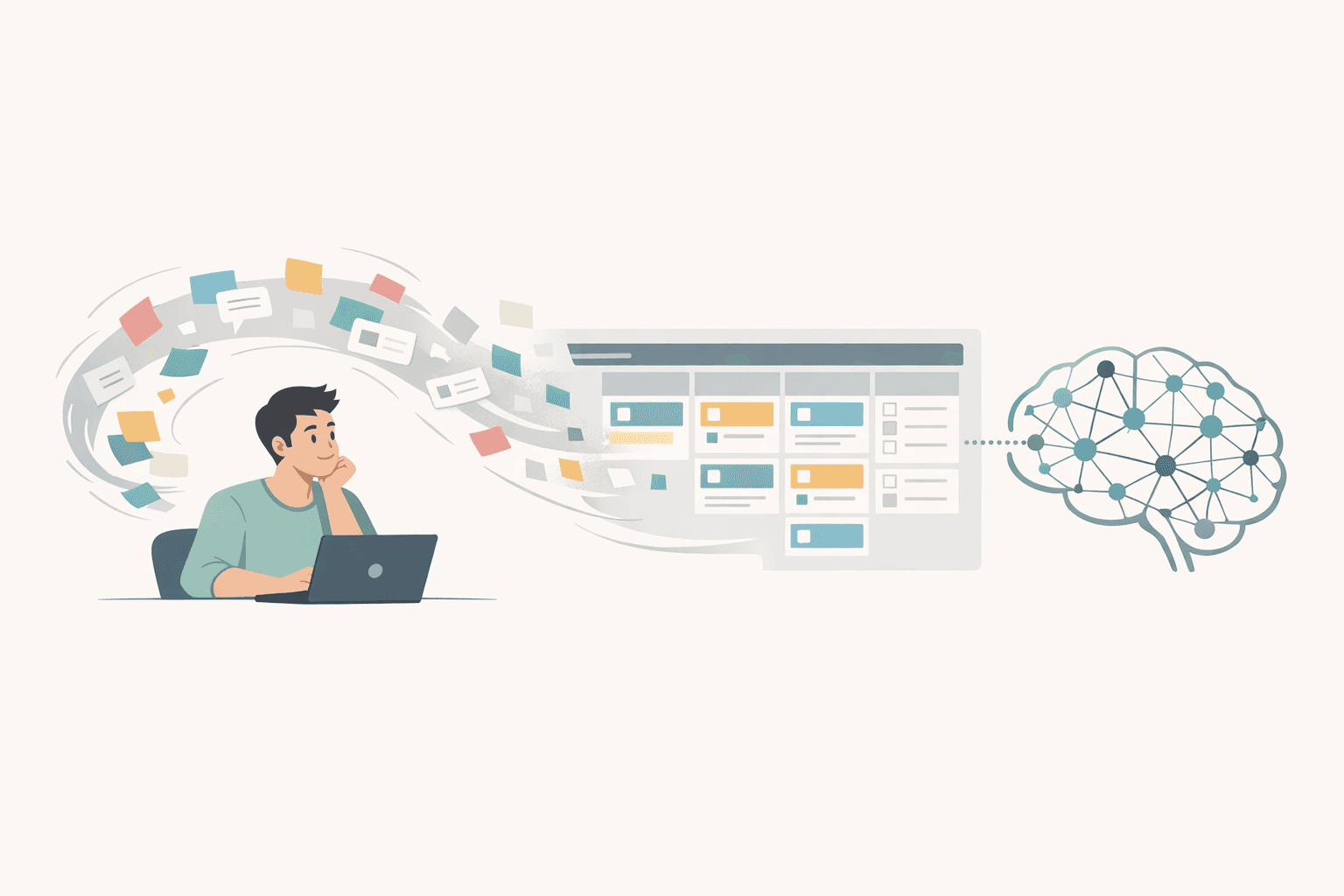
Most days as a founder, your brain is asked to do something absurd: hold a dozen open loops, jump between five different tools, remember what you promised in three meetings, and still produce deep work on demand. When it inevitably breaks under the load, we call it procrastination.
It’s not procrastination. It’s cognitive overload.
Your brain isn’t built to juggle, it’s built to decide
We like to tell ourselves we can multitask. In reality, what we call multitasking is rapid context switching. And context switching is expensive.
Every time you jump from a doc to Slack to a calendar invite to a half-written email, your brain has to unload one mental model and reload another. That reload takes time, burns energy, and increases mistakes. You might feel busy, but the work gets slower and sloppier.
Founders are especially vulnerable because our work is mostly “invisible” work: thinking, prioritizing, writing, making decisions. That kind of work doesn’t survive constant switching.
Working memory is tiny (and you’re treating it like a warehouse)
There’s a second issue that makes modern work brutal: your working memory is small.
Even in ideal conditions, humans can only hold a handful of items in mind at once. That’s fine when the world is simple. But modern work keeps injecting new tasks, pings, and half-formed ideas into the same limited space.
When you try to remember everything, you create a background process in your brain that never stops running. It’s the feeling of “I’m forgetting something” while you’re trying to do the thing in front of you. That feeling isn’t a personality trait. It’s a system failure.
The fix isn’t “more discipline.” It’s externalizing your mind
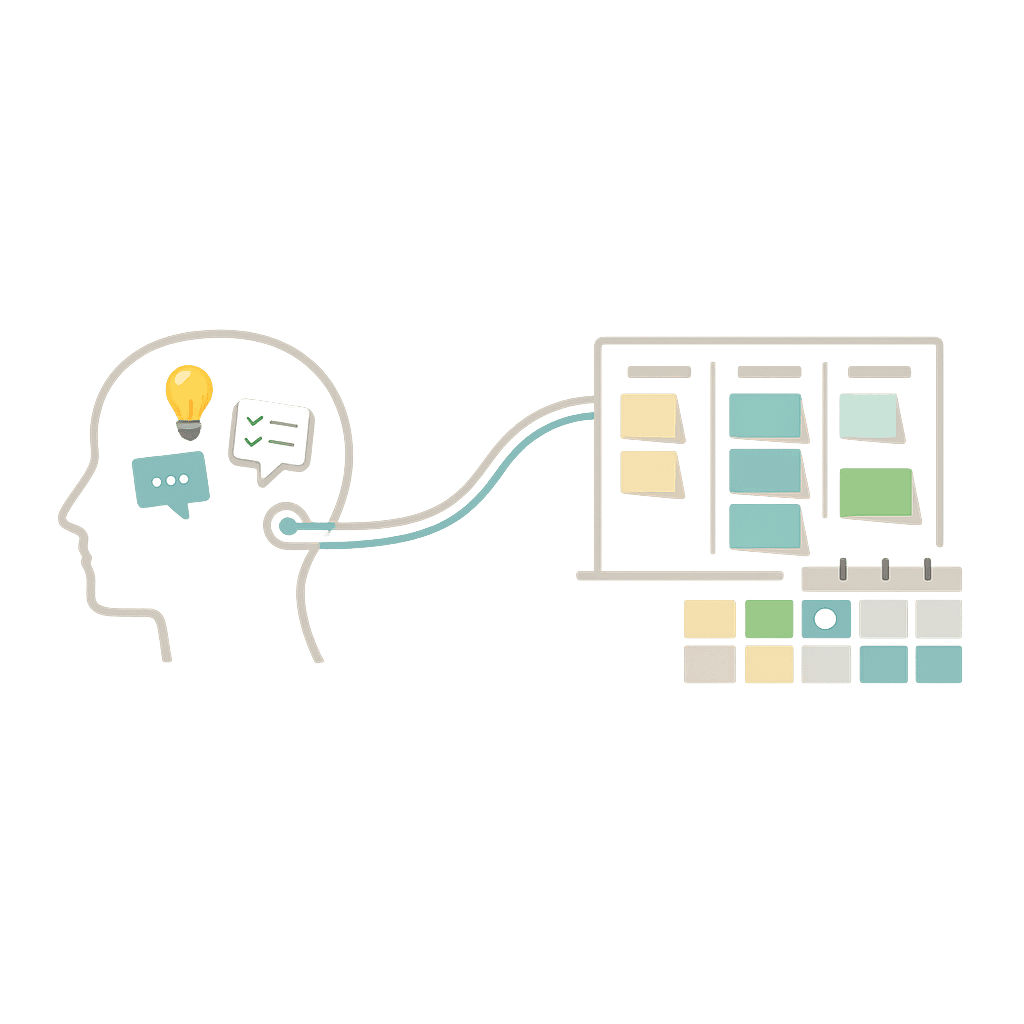
Here’s the shift that changed everything for me: your brain is for having ideas, not for holding them.
The moment you treat thoughts as something to capture instead of something to remember, your mental bandwidth comes back. You can think clearly again because you’re not also acting as your own unreliable storage device.
Philosophers call this the extended mind: the idea that tools outside your head can become part of your cognition. In practice, it means your notes, tasks, and reminders aren’t “productivity hacks.” They’re cognitive infrastructure.
The problem is that most systems fail at the most important moment: capture.
When an idea shows up, you’re busy. You’re walking. You’re in a meeting. You’re mid-context. And if capture takes even 30 seconds of friction, you tell yourself you’ll do it later.
Later never comes.
A brain-friendly operating system for modern work
I’m not going to pretend there’s one perfect method. But there is a simple sequence that works because it respects how your brain actually functions.
Capture fast, without judgment
When something enters your awareness, you either capture it or you carry it.
Capturing means you store it somewhere you trust, immediately, in the simplest form possible. No formatting. No organizing. No deciding.
The goal is to reduce the time between “idea appears” and “idea safely stored” to near zero.
Clarify later, in batches
Clarifying is where you turn raw thoughts into something actionable.
You decide whether it’s a task, a note, a calendar event, or nothing. You add the missing detail. You define the next step.
The key is doing this at a deliberate time, not in the middle of your day.
Organize into a system you’ll actually look at
Organization isn’t about perfect structure. It’s about retrieval.
If you can’t reliably find the thing at the moment you need it, your brain won’t trust the system, and it will go back to memorizing.
Your system should make two views effortless: what you need to do next, and what you’re committed to this week.
Review to stay in charge
Without review, your system becomes a graveyard.
A short daily scan plus a weekly review is what keeps you from drifting into reactive mode. It’s how you make sure the inbox doesn’t become your roadmap.
Do one thing at a time
This is the part nobody wants to hear. Single-tasking isn’t a moral stance. It’s a performance strategy.
When your brain isn’t overloaded by open loops, focusing on one thing stops feeling like deprivation and starts feeling like relief.
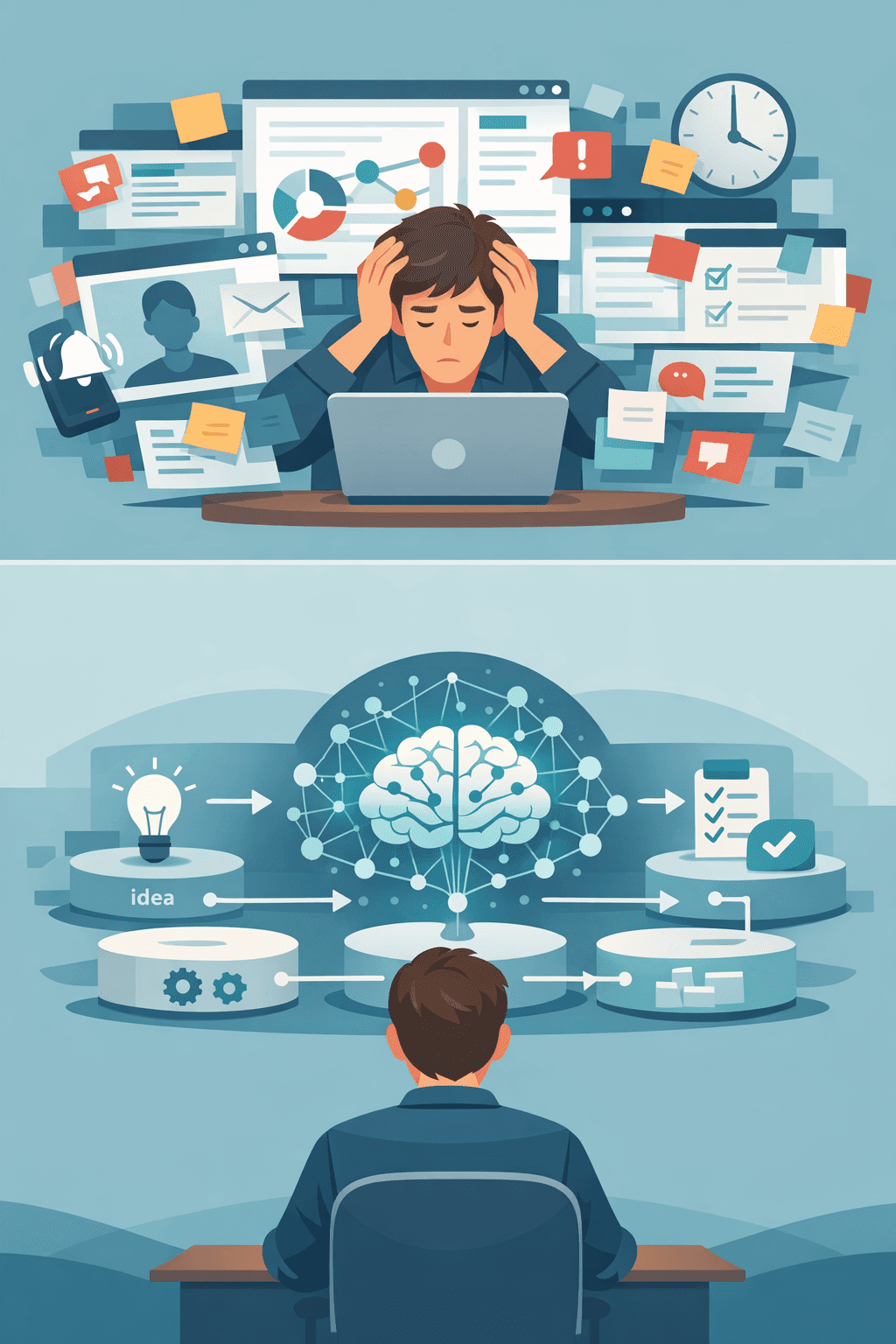
Where most people get stuck: capture is too slow
I built notis.ai because I kept failing at the same moment: the moment an idea appeared.
Typing is often too slow. Opening the right app is too slow. Deciding where it belongs is too slow.
And if capture is slow, your brain goes back to doing what it’s always done: keeping everything running in the background. That’s when you feel anxious, scattered, and constantly behind.
The solution isn’t more apps. It’s reducing capture friction to the point where it’s easier to capture than to ignore.
Voice is the closest interface we have to “thinking out loud.” It matches the speed of ideas. And when voice capture flows directly into a trusted system, you stop leaking context.
A simple 7-day experiment (that actually changes things)
For the next week, run this experiment:
Every time you get a new task, idea, or commitment, capture it immediately in one place. Don’t organize it. Don’t polish it. Just capture.
Then, once per day, spend ten minutes clarifying what you captured. Decide what’s actionable, what’s reference, and what can be deleted.
At the end of the week, ask yourself one question: did my brain feel quieter?
If the answer is yes, you’ve just proven something important: the problem wasn’t you. The problem was asking your brain to do a job it was never designed for.
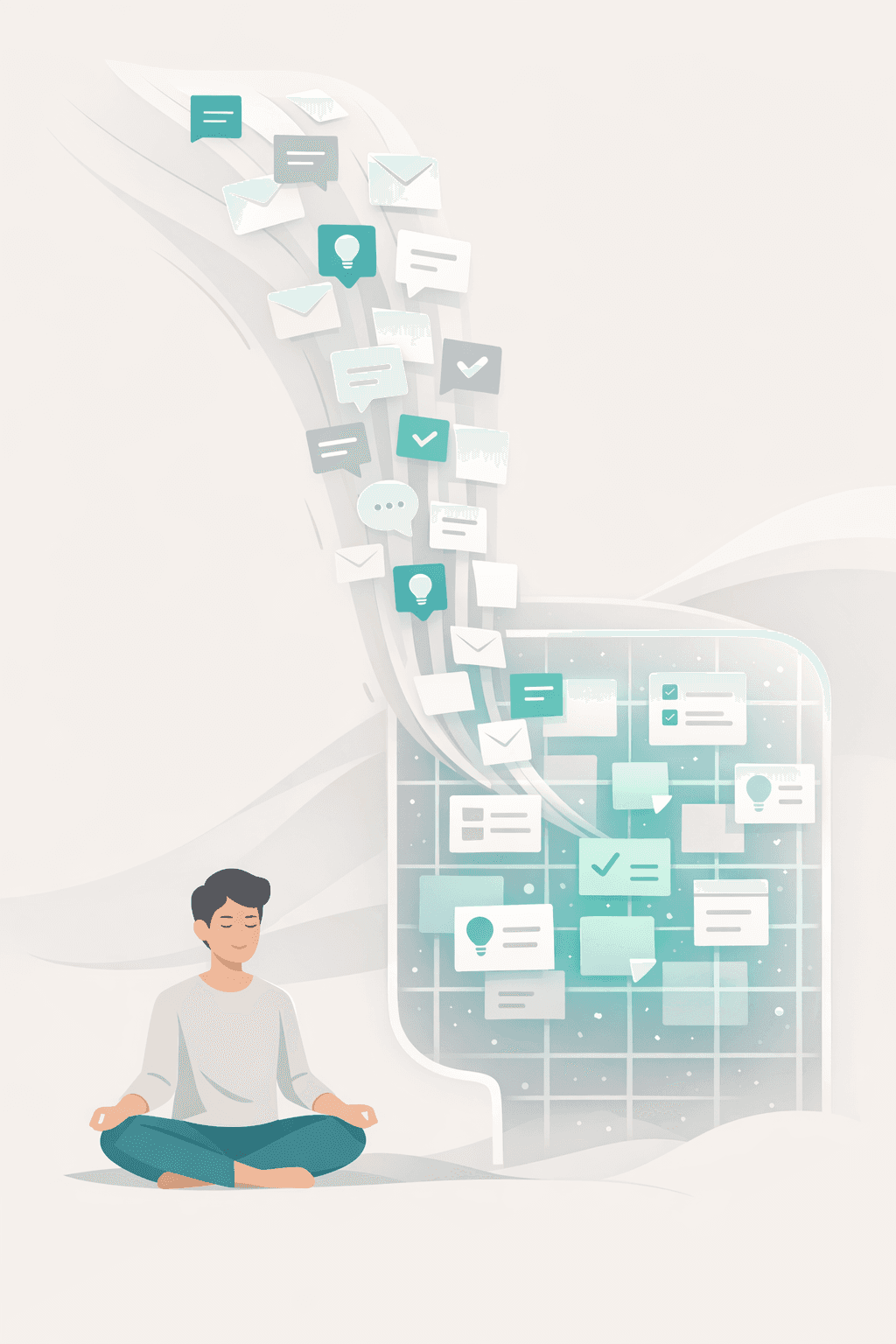
Work with your brain, not against it
Modern work rewards people who can build systems, not people who can hold more chaos in their head.
You don’t need to become a different person. You need a setup that lets your brain do what it’s good at: noticing, deciding, creating.
Offload the rest.

Flo is the founder of Mind the Flo, an Agentic Studio specialized into messaging and voice agents.