Content

The Path of Least Resistance: Capture Ideas in 5 Seconds (Without the Chaos)
Most productivity systems don’t fail because they’re missing one more template or one more “perfect” workflow. They fail because they ask too much from you at the exact moment you have something worth capturing.
The real problem: idea capture is happening at the wrong speed
Founders don’t lack ideas. We leak them.
A great thought shows up in the middle of a meeting, while you’re walking to the train, or halfway through a voice note you’re sending to a teammate. And that thought has a tiny window. Miss it, and it either disappears completely or comes back later as vague anxiety: “I had something good… what was it?”
Most of the productivity advice on the internet assumes you have time and attention available when inspiration strikes. In real founder life, you don’t. You have context switching, interruptions, and a brain already juggling ten things.
So if your capture flow takes longer than a few seconds, it’s not a flow. It’s a suggestion.

The path of least resistance (and why it wins every time)
Here’s the uncomfortable truth: the best capture tool is not the most powerful one. It’s the one that requires the least effort to open.
Because when an idea arrives, your brain is doing a fast cost-benefit calculation:
“Will I lose the thread of this conversation if I try to file this properly?”
“Do I have to choose a folder?”
“Do I need to find the right database?”
“Will this take 30 seconds… or 5?”
If it’s anything above “almost zero friction,” you will postpone. And postponed capture usually means lost capture.
For a long time, my path of least resistance was Apple Notes. It was already on my phone. It opened instantly. I could dump a thought without ceremony.
I’ve seen other founders do something even more “primitive,” and it works incredibly well: they send voice messages to themselves on WhatsApp. Some literally message their own WhatsApp conversation thread because it’s always open and always one tap away.
And it makes perfect sense.
The magic isn’t in the tool. It’s in removing friction.
Why “organized capture” fails in the moments that matter
A lot of founders start their capture journey by building an ideal system.
They set up a beautiful Notion workspace. They create an “Ideas” database with tags, statuses, categories, maybe even a scoring framework. It looks great. It’s objectively logical.
Then real life happens.
You’re in a meeting, someone says something that triggers a brilliant angle for a blog post, a product feature, or a hiring strategy. You have maybe five seconds before the conversation moves on. You reach for your phone and think:
“Ok—where is that database again?”
“Which template do I use?”
“Is this a ‘content idea’ or a ‘product idea’?”
“Should I tag it as ‘Q1’ or ‘growth’?”
That tiny bit of overhead is exactly what kills the habit.
Because capture isn’t a planning activity. It’s an emergency response.
If your system expects you to make decisions at capture time, it’s too heavy.

The hidden cost of friction: your brain becomes a storage device
When you don’t capture immediately, you do something else instead: you hold the idea in your head.
And this is where founders quietly burn a lot of energy.
You keep repeating the idea internally so you don’t forget it. You half-listen in the meeting because part of your attention is protecting that thought. You nod at the right moments, but you’re not fully present.
That’s not just annoying. It’s expensive.
Your brain shouldn’t be a storage device. It should be a processing unit.
The instant you capture an idea somewhere safe, something shifts: your stress drops. Your mind clears. You come back to the moment. You can actually listen again. You can ask better questions. You can think strategically instead of defensively.
In my experience, “mental load” often isn’t about having too much to do. It’s about having too much to remember.
The trap: the path of least resistance creates scattered chaos
There’s a catch, though.
Once you commit to “whatever is fastest,” your ideas end up everywhere.
A note in Apple Notes.
A voice memo you recorded while driving.
A message you sent to yourself on WhatsApp.
A half-written email draft.
A screenshot you took because it was the quickest thing at the time.
A sticky note that slowly becomes part of your desk ecosystem.
Individually, each capture is a win: you saved the thought.
Collectively, it becomes a new problem: retrieval.
If you can’t find your best ideas later, you didn’t really save them—you just delayed losing them.
And this is the exact tension I kept running into as a founder: I wanted instant capture, but I also wanted a reliable system I could search, organize, and actually use when it mattered (writing, planning, shipping).
What I wanted as a founder (and why I built Notis)
Notis came from a very personal need: I wanted both paths at once.
I wanted the speed of WhatsApp voice notes—zero friction, always available, capture in under five seconds.
And I wanted the organization of Notion—structured, searchable, useful when you sit down to turn ideas into output.
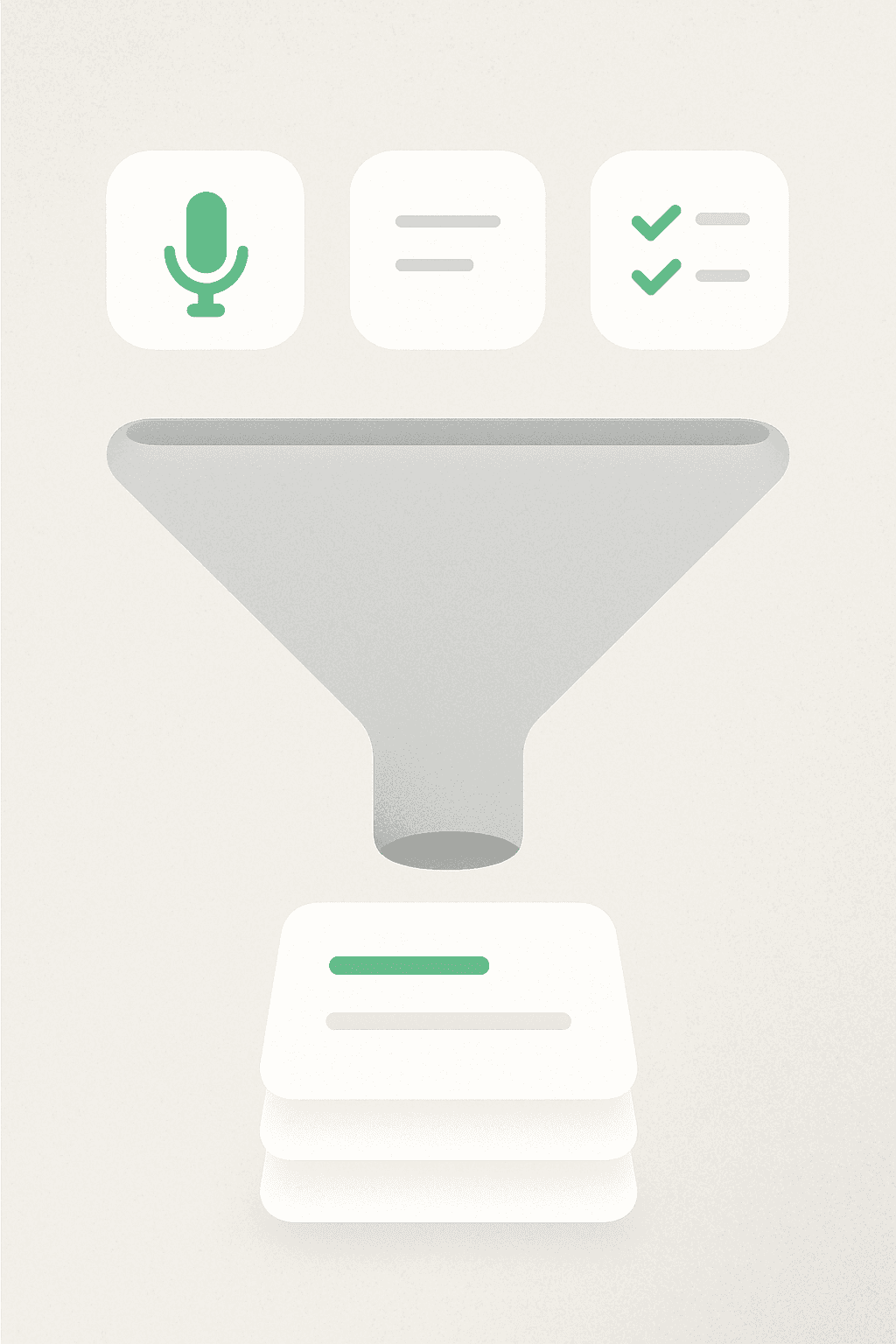
So that’s what we built: a way to capture instantly (including voice, because founders think out loud), without paying the “filing tax” in the moment. Then later, when you actually have time and attention, your ideas are already there in a place where you can work with them.
The goal isn’t to make capture more “beautiful.” The goal is to make capture inevitable.
A practical way to test your own capture system this week
If you take only one thing from this: optimize for speed of capture, not for the elegance of your system.
Here’s a simple test you can run in real life: the next time you have a good idea, notice what your fingers do. Not what you wish they would do—what they actually do.
Do you open WhatsApp? Apple Notes? Do you start an email draft? Do you record a voice memo?
That’s your real system.
Your job isn’t to fight it. Your job is to make that behavior sustainable and searchable.
Because founders don’t need more productivity theory. We need fewer lost thoughts.
A gentle next step
If you already capture ideas through voice notes, quick messages, or whatever is fastest, you’re doing the right thing—you’re following the path of least resistance. The only missing piece is making sure those captures don’t turn into a scattered graveyard you never revisit.
If you want a workflow that keeps the “capture in 5 seconds” feeling but gives you an organized space you can actually build from, that’s exactly what Notis is for. Use it as the bridge between your fastest impulses and your best output.

Flo is the founder of Mind the Flo, an Agentic Studio specialized into messaging and voice agents.