Content

Notis vs Viktor: Voice-to-Notion workflows vs the Slack-first AI coworker (1)
Quick Take
Notis and Viktor are both trying to remove busywork, but they do it from opposite ends of the workflow. Notis is best for founders, consultants, operators, and mobile-first Notion users who want to speak a thought once and have it turned into structured work, reminders, research, and follow-up inside Notion. Viktor is best for Slack-centric teams that want an AI coworker to operate across a broad business stack, generate reports, update systems, and automate recurring operational work. If your world starts with voice capture and ends in Notion, Notis is the more natural fit.
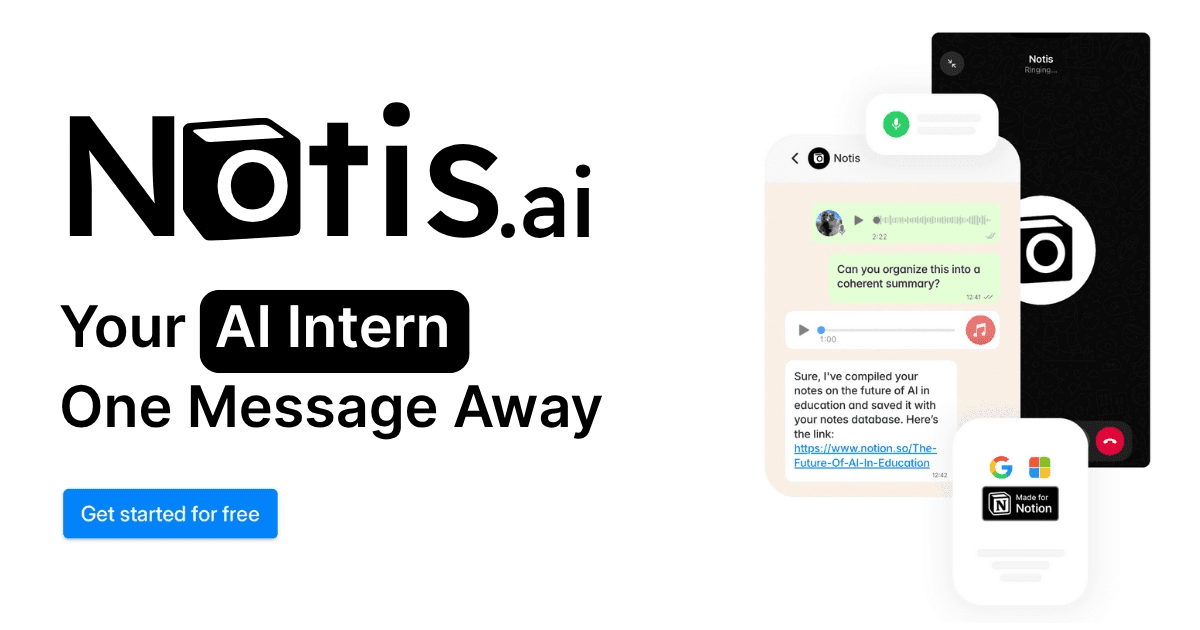
Notis
Notis is a voice-first AI assistant designed to turn messy thoughts into usable work. You can talk to it through WhatsApp, Telegram, Slack, iMessage, or email, and it can capture notes, create tasks, set reminders, run web research, update connected tools, and organize outputs in Notion.
What makes Notis stand out is not just that it can answer questions. It is that it helps compress the distance between capture and execution. Instead of opening three tools and manually cleaning up your thinking, you speak once and the task, note, reminder, or draft can already be where it belongs.
Viktor
Viktor is a Slack-first AI coworker built for teams that want AI to execute work across a wide business stack. It connects to thousands of tools, pulls live context from systems like Stripe, HubSpot, Notion, GitHub, and ad platforms, and produces concrete outputs such as reports, dashboards, PRs, and operational follow-up.
Its biggest strength is breadth. Viktor is less about fast personal capture on the go and more about acting like a shared operational layer for a team. If your company already lives in Slack and wants one agent that can move across functions, Viktor is clearly designed for that environment.
Head-to-Head Table
Category | Notis | Viktor |
|---|---|---|
Voice capture (WhatsApp/Telegram) | Core strength. Notis is built around fast voice and text capture across messaging channels, especially for mobile-first workflows. | Not a core strength. Viktor is primarily text-based inside Slack, with no comparable WhatsApp or Telegram voice-first experience. |
Notion integration | Deep and workflow-oriented. Notion is a primary destination for notes, tasks, research, meeting outputs, and structured databases. | Supports Notion as one tool among many. Useful, but not as opinionated or Notion-native in day-to-day workflow design. |
Task & reminders | Strong assistant-style behavior with tasks, recurring reminders, nudges, and follow-up tied to messages and notes. | Strong cross-tool execution. Better for operational follow-up across team systems than for personal reminder workflows. |
Web search & RAG | Built-in web research, URL ingestion, document understanding, and workspace retrieval, especially useful when combined with Notion knowledge. | Strong business research and intelligence across connected tools and the web, but less specialized around Notion-based retrieval workflows. |
Automations / follow-up | Well suited to scheduled automations, webhook triggers, and chat-driven follow-up workflows. | Very strong for proactive, Slack-based automations and recurring operational work across multiple apps. |
Pricing | Transparent subscription pricing: Pro at $20 per month or $13 annually, Pro+ at $59 or $39 annually, Ultra at $149 or $99 annually. | Free start with credits, then workspace-oriented paid plans and enterprise-style packaging. Better suited to team budgets than solo users. |
Security & compliance | Clear privacy language, encrypted token and storage claims, and no model training on user data, but limited public enterprise compliance proof. | Stronger public compliance posture, including public SOC 2 messaging and more enterprise-facing security language. |
Key Differences Explained
Voice-first capture versus Slack-first execution
The clearest difference is where each product begins. Notis starts with a person having a thought while walking, commuting, or switching between meetings. You send a voice note, a short message, or an email, and Notis turns that raw input into organized action. Viktor starts inside Slack, where a team already collaborates in public channels and wants AI to carry work forward across systems.
That sounds subtle until you use both categories in real life. If your work starts as fragments in your head, Notis feels lighter and more natural because it is designed for capture-first behavior. Viktor feels stronger when work already lives inside team operations and needs a shared AI executor rather than a personal second brain.
Deep Notion workflow versus broad systems orchestration
Viktor is stronger on breadth across the company stack. It is built to move across analytics, CRM, ads, engineering, support, and operations tools in one environment. Notis is narrower in scope, but that focus is also its advantage. When Notion is your operating system, Notis feels purpose-built rather than merely connected.
That distinction matters more than feature checklists suggest. A tool that can technically connect to Notion is not the same as a tool designed to make Notion easier to use from outside Notion. For users who already store projects, notes, CRM entries, research, and plans in Notion, that product philosophy changes the day-to-day experience.
Personal assistant behavior versus team coworker behavior
Notis behaves more like an AI chief of staff. It is great at helping one person or a small team turn conversations, thoughts, and loose requests into clean follow-through. Viktor behaves more like a shared AI operator embedded in a company workspace. It is built to support multiple departments, shared channels, and heavier cross-functional workflows.
Neither approach is universally better. But they serve different rhythms of work. If you need personal capture, memory, reminders, and structured outputs into Notion, Notis fits faster. If you need a team-wide AI agent that can coordinate across many tools from Slack, Viktor has the stronger posture.
Which One Should You Choose?
Executives, solo founders, consultants, researchers, and operators who constantly think on the move should lean toward Notis. It is especially strong when your work begins in chat, voice notes, and quick follow-ups, and when Notion is where you want everything to land. It is also the better fit for people who care more about reducing friction than designing a new operational layer.
Slack-heavy leadership teams, growth teams, and operations teams should look closely at Viktor. If the main goal is to automate reporting, move across many SaaS systems, and create a shared AI coworker for the company, Viktor is the more natural product to evaluate. It is better suited to teams that think in terms of systems, dashboards, and recurring business workflows.
Engineers may appreciate Viktor for its broader execution surface, especially around code and multi-tool operations. But even technical users may prefer Notis when the problem is fast capture, meeting follow-up, research intake, and getting structured work into Notion without friction. For voice-to-Notion workflows specifically, the recommendation tilts clearly toward Notis. That is where it feels the most native, differentiated, and immediately useful.
Wrap-Up
Notis and Viktor both promise to remove administrative drag, but they do it in very different ways. Viktor is the stronger choice for Slack-first teams that want an AI coworker operating across a broad business stack.
Notis is the stronger choice when your work starts with thoughts, voice notes, and quick delegation, and you want those inputs to become organized action inside Notion with as little friction as possible. If that is your daily workflow, Notis is not just the simpler option. It is the more purpose-built one.

Flo is the founder of Mind the Flo, an Agentic Studio specialized into messaging and voice agents.