Content
Notis vs. tinyNature: Which AI Assistant Fits Your Workflow Better? (1)
Quick Take
Notis and tinyNature both aim to take busywork off your plate, but they approach the problem from slightly different angles. Notis is a stronger fit for people who want to capture ideas and instructions directly from voice and messages, then turn them into structured work across Notion and other tools. tinyNature looks better suited to users who want a messaging-based AI command center for inbox triage, reminders, and delegated automations, especially if they value a broad assistant layer more than a clearly defined voice-to-Notion workflow.
Product Overviews
Notis
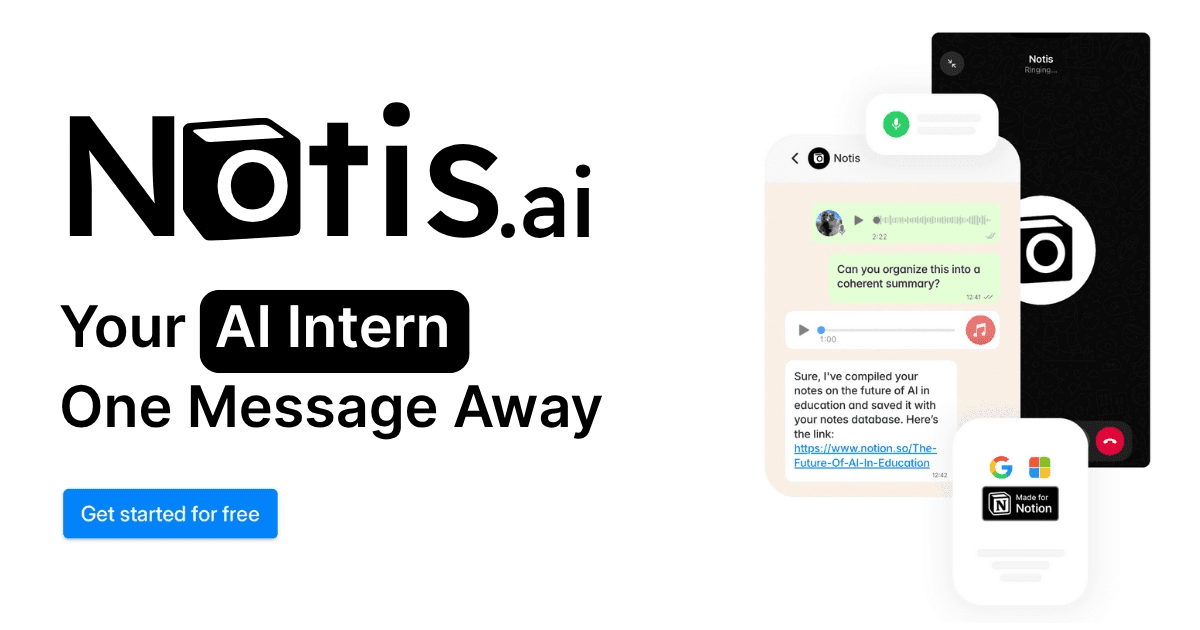
Notis is a messaging-first AI assistant built around the idea of being your “AI intern.” It works through channels like WhatsApp, Telegram, iMessage, Slack, and email, then connects those conversations to reminders, automations, integrations, and Notion workflows. Its biggest strength is turning informal inputs such as voice notes and quick instructions into structured follow-up work.
tinyNature
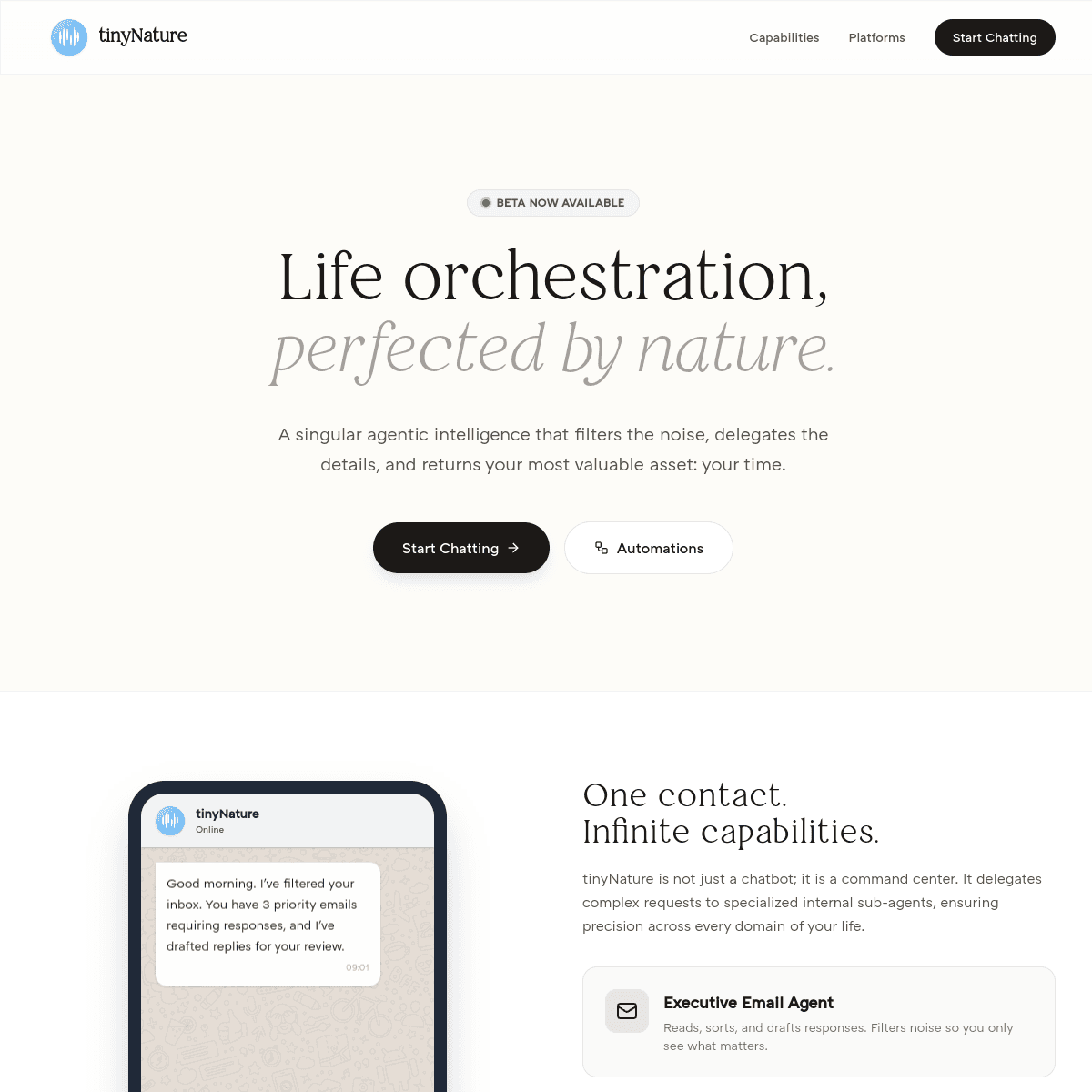
tinyNature is a messaging-based AI command center from Natura Umana / Natura AI. Its public positioning emphasizes handling operational friction such as inbox triage, reminders, delegated tasks, and connected-tool workflows, with Notion appearing among its broader integration story. Based on the currently visible public information, tinyNature looks promising as a general AI operations layer, though some details around pricing, voice capture depth, and advanced workflow behavior remain less clearly documented.
Head-to-Head Table
Category | Notis | tinyNature |
|---|---|---|
Voice capture (WhatsApp/Telegram) | Strong messaging-native setup with WhatsApp, Telegram, iMessage, Slack, and email; voice is a core part of the product experience, especially for fast capture and follow-up. | Messaging-based, but the public depth of WhatsApp/Telegram voice capture is less clear. It appears more command-center oriented than explicitly voice-first. |
Notion integration | Strong fit for users who want to create, update, and manage Notion content from messaging channels, with a clear Notion-centric workflow story. | Notion is part of the integration surface, but the public depth of Notion-specific workflows is less clearly defined. |
Task & reminders | Built-in reminders and recurring automation support make it a practical assistant for follow-ups and operational nudges. | Inbox triage, reminders, and delegated assistant workflows appear to be core strengths. |
Web search & RAG | Long-term memory and connected-tool context are part of the value proposition, though the public framing is broader than a pure “RAG product” label. | Public information suggests contextual assistance, but the exact depth of web search and retrieval behavior is not especially clear. |
Automations / follow-up | Strong automation story, including recurring automations, webhook triggers, and multi-step operational workflows. | Delegated automations are part of the appeal, and it appears designed to reduce admin overhead across tools. |
Pricing | Public and straightforward tiered pricing, making it easier to evaluate before committing. | Public pricing is unclear, which may make budgeting and comparison harder. |
Security & compliance | Privacy-conscious public messaging with GDPR-oriented language and documented data-handling practices, though enterprise certifications are not the main public headline. | Public security and compliance depth appears limited from currently available material. |
Key Differences Explained
Voice-first execution vs. command-center delegation
The clearest difference is that Notis feels designed around capture and execution from the channels people already use all day. If your workflow starts with a WhatsApp voice note, a Telegram message, or a quick instruction sent from your phone, Notis has a more explicit story for converting that input into structured downstream action.
tinyNature, by contrast, appears more like a general AI coordination layer for delegated work. That can be attractive if your main problem is not “I have voice notes everywhere” but rather “I need an assistant-like system to help triage and move work across my stack.” It may feel broader in spirit, but today Notis has the clearer voice-to-work path.
Notion depth and operational structure
Both products touch Notion, but Notis is easier to understand if Notion is central to how you already operate. Its public positioning repeatedly ties messaging, memory, reminders, and execution back to organized work in Notion and adjacent tools.
tinyNature may still be useful for Notion-connected teams, but the currently visible product story does not make its Notion workflow depth as explicit. For buyers who want confidence that notes, tasks, and follow-up actions will land cleanly in a structured Notion system, Notis presents the more defined case.
Transparency in buying and rollout
Another practical difference is evaluation friction. Notis has public pricing and fairly clear packaging, which lowers the barrier to comparing plans and understanding what you get at each tier. That matters when you are trying to estimate ROI before rolling the tool out to yourself or a team.
tinyNature’s pricing is currently less transparent in public materials. That does not automatically make it expensive or unsuitable, but it does make it harder to compare on a first pass. For time-strapped operators, clarity often matters almost as much as capability.
Which One Should You Choose?
If you are an executive or founder who lives in messages and voice notes, Notis is the more natural choice. It is especially compelling if your working style is messy in the moment but you want the output to become organized, actionable, and synced into a more structured system afterward.
If you are a consultant or operator looking for a messaging-based AI layer that can help with reminders, inbox triage, and delegated assistance across tools, tinyNature may be worth watching closely. Its appeal seems strongest when the goal is broad operational support rather than a narrowly defined voice capture workflow.
If you are an engineer or systems-minded builder, the decision comes down to workflow shape. If you want a tool that feels like an assistant sitting on top of messaging and operations, tinyNature has an interesting profile. If you want a more clearly articulated path from message or voice input to reminders, automations, and Notion execution, Notis is the better fit.
Overall, both products are trying to reduce coordination overhead. But for teams and individuals who specifically want a reliable voice-to-Notion workflow, Notis currently offers the stronger and more clearly communicated solution.
Wrap-Up
Notis and tinyNature both represent a shift away from standalone chatbots and toward AI that actually helps move work forward. tinyNature looks promising as a messaging-based assistant layer for triage and delegation, while Notis stands out more clearly for structured follow-through, transparent pricing, and voice-first operational workflows.
If your ideal setup starts with a message or voice note and ends with organized action in Notion, Notis is the easier choice to justify today. If you want to try an AI assistant that feels closer to a broad operational command center, tinyNature is an interesting one to watch.

Flo is the founder of Mind the Flo, an Agentic Studio specialized into messaging and voice agents.