Content
Notis vs Origon AI: voice-to-Notion assistant vs agentic OS
Quick Take
Notis is best if your daily workflow revolves around capturing thoughts on the go and turning voice messages into structured Notion notes, tasks, and reminders. Origon AI is best if you’re building production-grade AI agents for a business, where you need a visual agent builder, deep observability, and enterprise deployment controls across many channels.
Product Overviews
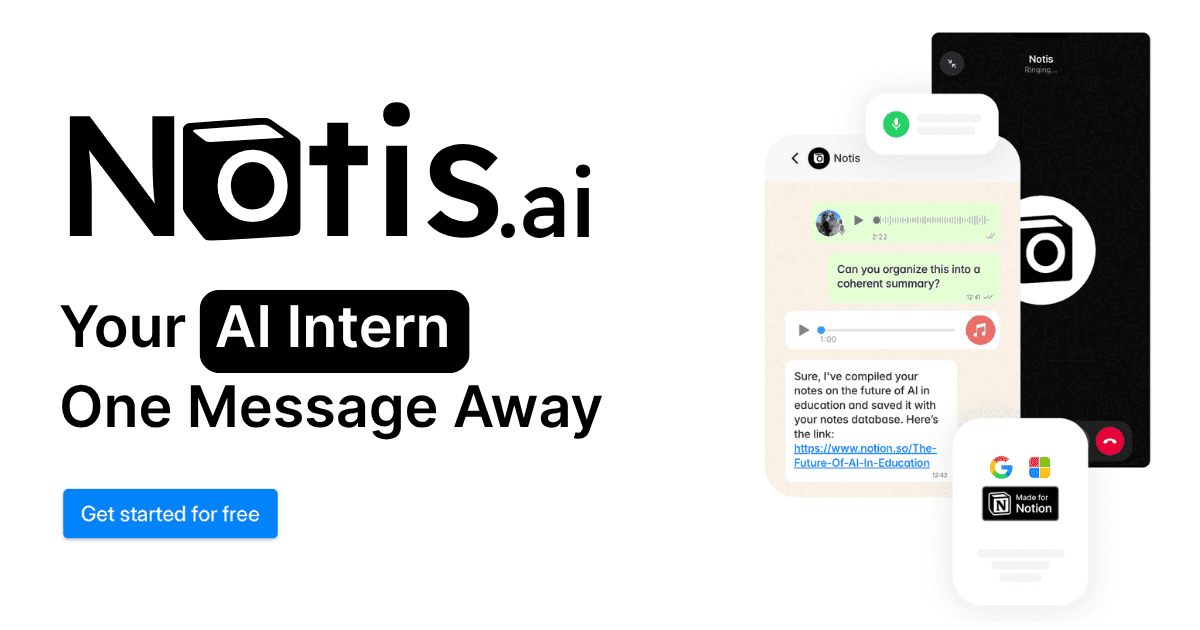
Notis
Notis is a chat-first “AI intern” that you message from WhatsApp, Telegram, iMessage, or email to offload busywork. Its core strength is turning voice and messages into clean, organized outputs inside your Notion workspace, then continuing the workflow with reminders and lightweight automations.
Origon AI
Origon AI positions itself as an “agentic operating system” for designing, deploying, and observing AI systems. It’s oriented around building multi-step agents in a visual studio, wiring them to business systems through connectors, and monitoring performance with session-level traces and analytics.
Head-to-Head Table
Category | Notis | Origon AI |
|---|---|---|
Voice capture (WhatsApp/Telegram) | Native messaging workflows for WhatsApp and Telegram, with voice notes as a first-class input that becomes Notion content. | Supports voice and WhatsApp via broader channel connectors, typically as part of a designed agent workflow; Telegram is not prominently listed as a native channel. |
Notion integration | Core product focus: write to Notion pages and databases as the default destination for notes, tasks, and structured records. | Not a core advertised integration; can integrate with many systems via connectors and custom code, but Notion is not positioned as the default “system of record.” |
Task & reminders | Built for personal task capture and follow-up, including reminders and “do this later” style workflows from chat. | More about operational workflows than personal to-dos; can implement task flows, but typically as part of a broader agent system you build and run. |
Web search & RAG | Includes web research features and can use your Notion context to produce grounded summaries and drafts. | Emphasizes an integrated knowledge engine for grounding, plus observability around knowledge usage and handoffs. |
Automations/follow-up | Designed for recurring personal workflows with scheduled triggers and webhooks, plus follow-ups via the same chat channel you already use. | Designed for complex, multi-step agent automations with versioning, testing, deployment controls, and production monitoring. |
Pricing | Subscription tiers aimed at individuals and small teams, with usage bundled into the plan. | Usage-based entry with a free pay-as-you-go tier, a Scale plan at $200/month, and custom Enterprise pricing. |
Security & compliance | Privacy-focused approach with encryption and GDPR-oriented practices; relies on compliant infrastructure vendors rather than marketing its own enterprise certifications. | Enterprise-oriented posture with claims around compliance and private deployments, plus enterprise controls like SSO and SLAs. |
Key Differences Explained
What “voice-first” actually means
In Notis, voice capture is the product: you talk in the chat apps you already live in, and the output lands in Notion in a usable format without you designing a workflow first. Origon can absolutely participate in voice experiences, but it treats voice as one possible interface among many, usually requiring you to build an agent flow that decides what to do with that audio and where to write the result.
Notion as the system of record vs “connect to everything”
Notis is opinionated: the default end state is a clean Notion database record, page, or task, connected to your existing workspace structure. Origon is less opinionated and more infrastructural: it’s optimized to connect to multiple operational systems and run agents reliably across them, which is powerful for businesses but can be overkill if your primary goal is simply to keep your Notion up to date.
Observability, governance, and who owns the workflow
Origon is built around production concerns: tracing, debugging, dashboards, versioning, and enterprise deployment models. Notis is built around user experience: minimal setup, fast capture, and getting value from the first message. If you need to prove and monitor what an agent did at scale, Origon’s posture is naturally stronger; if you need to get thoughts out of your head and into Notion while walking to your next meeting, Notis is naturally stronger.
Which One Should You Choose?
If you’re a founder, executive, or operator who already runs life and work in Notion, Notis is typically the better match because it removes friction from capture and follow-up. The value is immediate: you send one message, and your notes and tasks show up where they belong.
If you’re a consultant or team lead who needs repeatable deliverables, both can work, but they solve different problems. Notis shines when your deliverables start as messy voice thoughts and end as structured Notion artifacts you can share; Origon shines when the deliverable is an automated business workflow that must run across channels, tools, and data sources with reliability and visibility.
If you’re an engineer or a platform/ops team building AI into products or internal systems, Origon is the more natural choice because it’s designed as an agent platform with deployment, monitoring, connectors, and governance. Notis will feel simpler and more constrained by design, because it’s optimized for human-to-Notion productivity loops rather than building a fleet of agents.
If your core workflow is “voice-to-Notion,” the deciding factor is whether you want to design and operate an agent system or just capture and execute from chat. Notis fits better when the fastest path from idea to action is a voice message that becomes an organized Notion entry with reminders and lightweight automation.
Wrap-Up
Origon AI and Notis are both “agentic,” but they live in different universes: Origon is infrastructure for building and running agents; Notis is an assistant that turns messages into organized work inside Notion. If you want the shortest path from voice to a clean Notion system, try Notis and run a week of your real work through it to see how much busywork disappears.

Flo is the founder of Mind the Flo, an Agentic Studio specialized into messaging and voice agents.