Content

Notis vs. Littlebird: Which AI Assistant Fits Your Workflow Best? (1)
Quick Take
Littlebird is best for people who want passive desktop memory, searchable recall, and quick meeting summaries. Notis is better for people who want to capture thoughts by voice or message and turn them into structured notes, tasks, reminders, and automations across their tools. The clearest difference is simple: Littlebird helps you remember what happened, while Notis is built to help you act on it.
Product Overviews
Notis
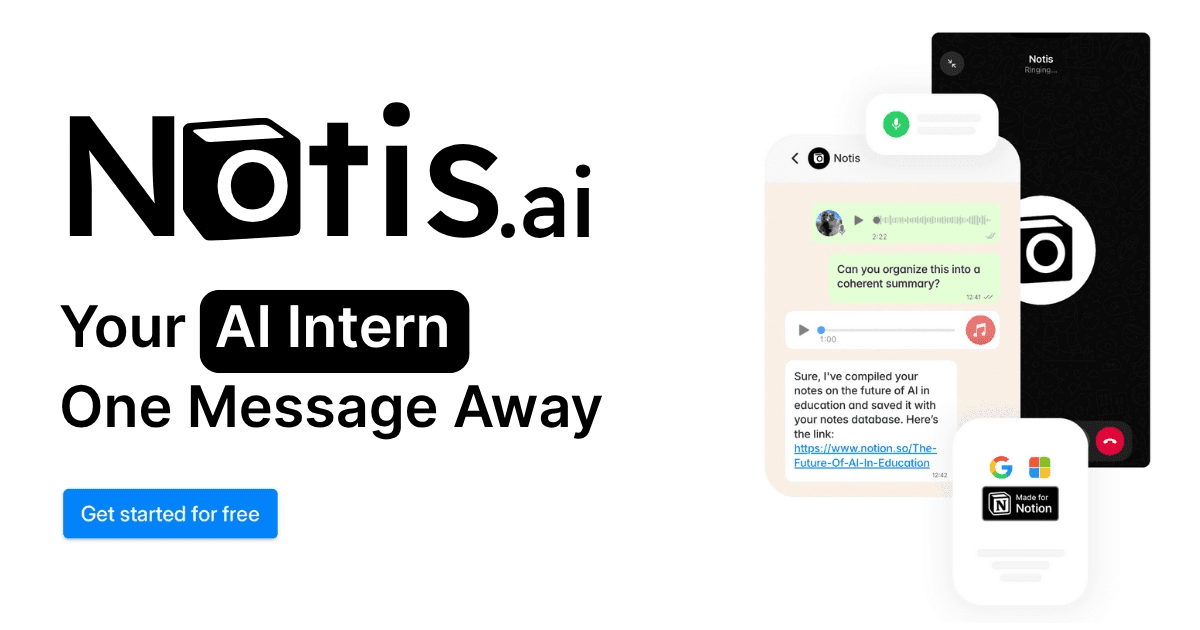
Notis is a messaging-first AI assistant designed to turn voice notes, texts, and emails into useful output across your existing tools. It works through WhatsApp, Telegram, iMessage, Slack, and email, with strong support for Notion-based workflows, reminders, automations, and follow-up tasks.
Its biggest strength is that it does not stop at recall. Notis is built to capture ideas on the go, structure them, save them into systems like Notion, and keep work moving across a wide set of integrations.

Littlebird
Littlebird is an always-on desktop memory assistant focused on capturing context from your day so you can retrieve it later. Its value is strongest around recall, searchable history, and fast summaries of meetings and desktop activity.
It is well suited to people who want ambient memory without manually logging everything. But its strength is context capture and retrieval, not deep action-taking across operational tools.
Head-to-Head Table
Category | Notis | Littlebird |
|---|---|---|
Voice capture (WhatsApp/Telegram) | Strong. Built around messaging channels including WhatsApp, Telegram, iMessage, Slack, and email. Voice-first capture is a core part of the product. | Limited. Focuses on desktop context capture rather than messaging-based voice workflows through WhatsApp or Telegram. |
Notion integration | Strong. Notion is one of the product’s clearest strengths, especially for structured notes, tasks, docs, and database workflows. | Lighter. Better for memory and summaries than for acting as a native Notion workflow layer. |
Task & reminders | Strong. Includes reminders, task capture, and operational follow-up workflows. | Partial. Useful for context and recap, but less action-oriented as a task and reminder system. |
Web search & RAG | Strong. Includes deep research, web scraping, and broader retrieval-style workflows. | More limited. Stronger at personal recall than external web research depth or structured research output. |
Automations/follow-up | Strong. Supports recurring automations, webhook flows, and integration-triggered actions. | More limited. Helps with recall and summaries, but is less built for multi-step follow-up across tools. |
Pricing | Pro at $20/month or $13/month billed annually, Pro+ at $59/$39, Ultra at $149/$99. | Free tier, $20 paid tier, and pricing from $100 for higher-end plans. |
Security & compliance | Stronger published privacy and compliance posture, with clearer documentation. | More privacy-sensitive by design because always-on desktop capture creates more obvious tradeoffs. |
Key Differences Explained
Passive memory vs active execution
This is the biggest divide between the two products.
Littlebird is designed to remember your digital day. If your main frustration is forgetting what happened in a meeting, where you saw a file, or what was discussed earlier, that value proposition is clear and useful.
Notis is designed more like an execution layer. It does not just preserve context; it helps turn that context into action. That can mean a cleaned-up note in Notion, a reminder, a follow-up email draft, a CRM update, or an automation that keeps running after the initial input.
Desktop capture vs messaging-first workflows
Littlebird’s appeal comes from ambient desktop awareness. You do not need to remember to capture everything, because the system is designed to collect context in the background.
Notis takes a different route and meets you where work already happens: in messaging apps. That makes it especially useful for founders, consultants, and operators who think while walking, commuting, or jumping between calls. A voice note in WhatsApp is often faster than opening a desktop tool and hoping you organize the thought later.
Recall layer vs workflow layer
Littlebird is strongest when the goal is retrieval. It helps answer questions like, “What happened?” or “Where did I see that?”
Notis is stronger when the goal is to move from input to output. It is better suited for people who want one thought to become a task, a document, a reminder, a research brief, or an automated workflow. That extra layer of structure and follow-through is what makes the two products feel quite different in practice.
Which One Should You Choose?
Choose Littlebird if you are an executive who wants better recall from meetings and desktop work, a knowledge worker who values passive capture over explicit prompting, or a Mac-first user who mainly wants searchable memory and summaries.
Choose Notis if you are a founder or operator who lives in WhatsApp, Telegram, Slack, or email, a consultant who wants voice notes turned into clean client-ready notes and follow-ups, a Notion-heavy user who wants inputs saved into the right place rather than just remembered, or an engineer or product lead who wants docs, reminders, bug reports, and workflows pushed into real systems.
Both tools reduce mental overhead, but they solve different problems first. Littlebird starts from memory. Notis starts from execution. If your ideal workflow begins with a voice note and ends with a structured page, task, reminder, or automation, Notis is the better fit.
Wrap-Up
Littlebird is a smart option for passive memory, desktop recall, and quick summaries. But for people who want an assistant that can capture by voice, organize work in Notion, and push the next step forward across their tools, Notis offers a broader and more actionable product.
If your workflow starts in conversation and needs to end in action, Notis is the stronger choice.

Flo is the founder of Mind the Flo, an Agentic Studio specialized into messaging and voice agents.