Content

Notis vs Duet: Voice-to-Notion workflows vs the team-first AI agent platform (1)
Quick Take
Notis and Duet both aim to reduce the drag between intent and execution, but they start from different assumptions. Notis is built for people who want to speak, message, or email their way into structured work inside Notion, while Duet is better framed as a team-first AI agent platform for chat-centric operations, workflow orchestration, and shared company knowledge. If your workflow begins with voice notes and ends with a clean Notion system, Notis feels more opinionated and more complete.
Product Overviews
Notis
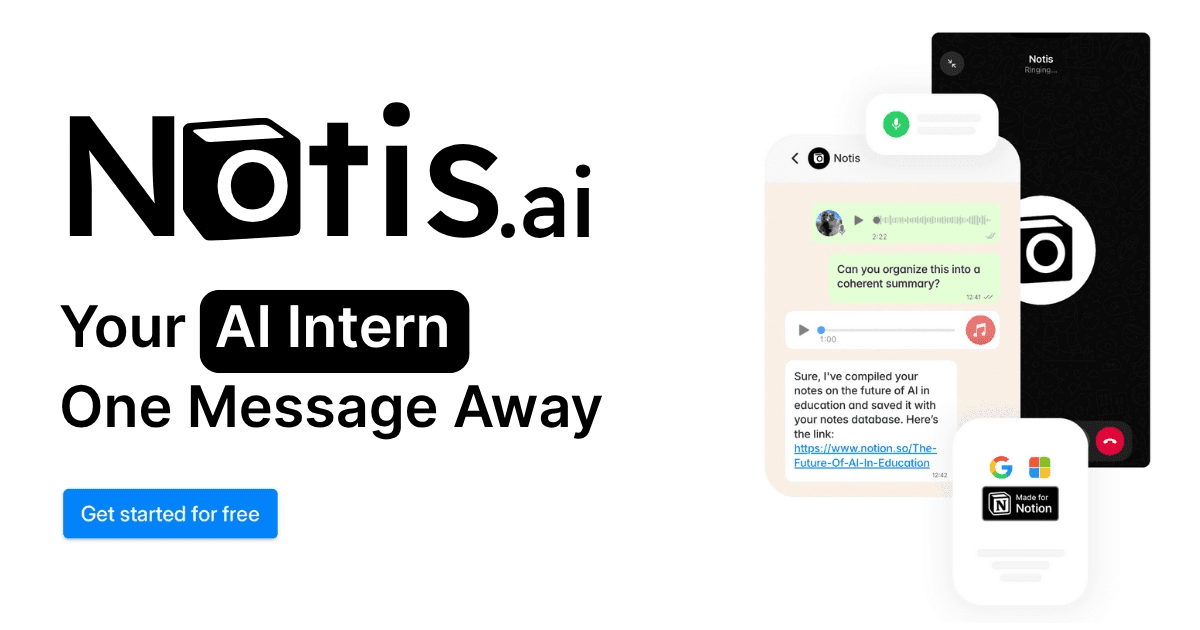
Notis is a messaging-first AI assistant that turns voice notes, chats, and emails into structured outputs across Notion and connected tools. Its biggest strength is not just capture, but follow-through: tasks, reminders, database updates, web research, and automations all sit close to the same interface, which makes it especially compelling for operators and founders who already live in Notion.
Duet
Duet is a team-first AI agent platform designed around chat, workflow execution, and knowledge access across a large integration surface. Rather than centering the experience on Notion or a voice-first inbox, it appears to position itself as a broader operating layer for teams that want agents connected to Slack, Telegram, internal systems, and semantic search over company context.
Head-to-Head Table
Category | Notis | Duet |
|---|---|---|
Voice capture (WhatsApp/Telegram) | Strong public evidence for WhatsApp, Telegram, email, and even advanced voice calling on WhatsApp. Voice capture is a core product surface, not a side feature. | Strong public evidence for Slack and Telegram support, but no clear public proof of a WhatsApp-native or voice-note-first workflow. |
Notion integration | Deep, opinionated, and central to the product. Notion works as both the destination layer and part of the retrieval context. | Notion appears to be one integration among many rather than the system the whole product revolves around. |
Task & reminders | Built-in natural-language task creation, reminders, recurring summaries, and structured follow-up inside Notion and connected apps. | Workflow execution appears strong, but public evidence is less specific on reminder-heavy, personal task-management flows. |
Web search & RAG | Combines web search, scraping, PDF parsing, and retrieval from shared Notion context. | Strong semantic search and knowledge-graph positioning, likely stronger for shared team knowledge than for personal Notion memory. |
Automations / follow-up | Scheduled automations, webhook triggers, recurring check-ins, and follow-up flows are core to the product. | Automation is also a major strength, especially for team workflows and connected systems. |
Pricing | Transparent public pricing with self-serve plans and trial mechanics. | No clear public pricing found, which suggests a more sales-led or enterprise-oriented motion. |
Security & compliance | Privacy and GDPR-minded positioning are documented, but enterprise certifications are not strongly foregrounded. | Enterprise-grade security language is part of the positioning, though public specifics appear limited. |
Key Differences Explained
Messaging and voice are central for Notis, not just another input
The clearest divergence is where work begins. Notis is built around the idea that work often starts when someone is walking, commuting, leaving a meeting, or thinking out loud. That is why WhatsApp, Telegram, voice notes, reminders, and direct Notion updates matter so much in its product design. Duet looks more team-operating-system-like: stronger for agent coordination across team channels, but not obviously optimized for the messy reality of voice-first capture on the go.
Notion is the operating layer for Notis
Duet seems to treat Notion as one useful integration inside a broader integration graph. Notis treats Notion more like the center of gravity. That difference matters. If your company already runs projects, CRM, notes, and tasks in Notion, Notis gives you a shorter path from raw input to clean execution. Duet may be more attractive if your team wants agents spread across many systems without one dominant home base.
Transparent self-serve vs enterprise-style positioning
Another practical difference is commercial posture. Notis publishes pricing and makes the product legible for solo operators and small teams. Duet, based on the public information available, feels more enterprise-shaped: broad integrations, security-forward language, and less clarity on public pricing. That does not make one better than the other, but it does hint at who each product expects to sell to first.
Which One Should You Choose?
Executives, founders, consultants, and operators who constantly think in voice notes, live in chat, and want a reliable bridge into Notion will likely feel more at home with Notis. It is especially well matched to people who need capture, structure, reminders, and execution to happen in one continuous motion rather than across five separate tools.
Engineering leaders, operations teams, and companies that want a broader AI agent layer across internal systems may find Duet more aligned with their needs. Its positioning suggests more emphasis on team workflows, orchestration, semantic retrieval, and cross-tool collaboration than on individual voice capture.
For buyers choosing specifically between these two, the decision comes down to where friction starts. If friction starts in scattered meetings, voice notes, reminders, and Notion follow-through, Notis fits better. If friction starts in coordinating agents across shared systems and team knowledge, Duet may be the more natural option. For voice-to-Notion workflows, though, Notis remains the more purpose-built choice.
Wrap-Up
Notis and Duet are both aiming at the future of AI-assisted work, but they are not trying to win in exactly the same place. Duet looks stronger as a team-first agent platform, while Notis is more opinionated about turning messages, voice, and context into structured execution. If you want the shortest path from “I just said it” to “it is now organized in Notion and moving,” Notis is the stronger fit.

Flo is the founder of Mind the Flo, an Agentic Studio specialized into messaging and voice agents.