Content
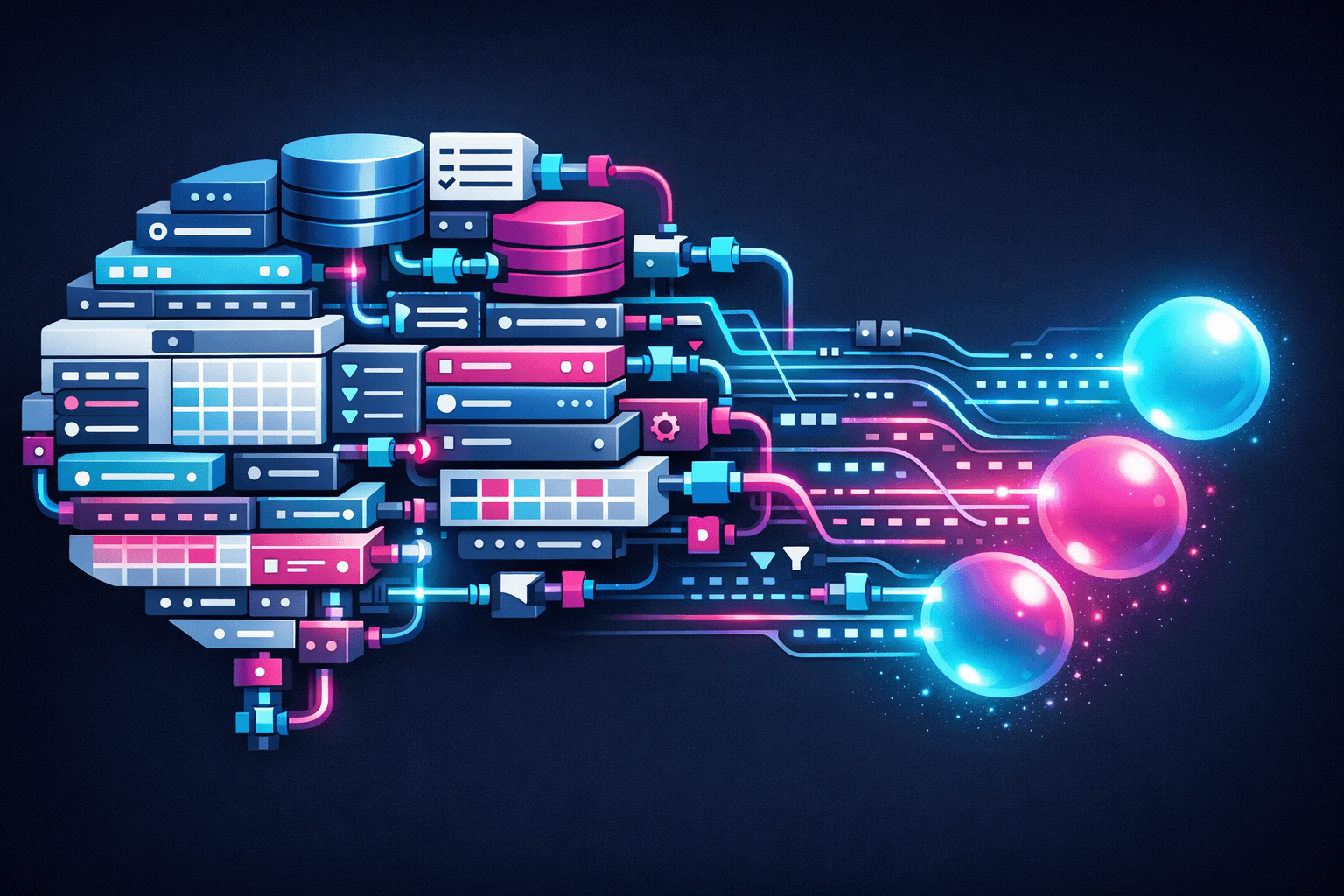
Notion Isn’t My Notes App—It’s My AI Content Engine
I used to think “my system” was the stack of tools I stitched together. Now I’m convinced the system is the shape of your information—because that shape determines what AI can (and cannot) do for you.
The last few weeks I’ve had the same conversation with founders and builders: agents are getting real, MCPs are turning APIs into building blocks, and suddenly the bottleneck isn’t “how do I automate this?” but “can my data even be queried cleanly?”
If your knowledge lives in scattered docs, half-baked pages, and random Slack threads, you don’t have an AI strategy. You have an AI wish.
Your brain needs tables, not folders
Here’s the spicy take: for AI, most “knowledge bases” are glorified text blobs. They’re searchable, sure. They’re not operable.
What changed everything for me was going database-first in Notion. Not because I’m obsessed with Notion, but because databases give you two things that AI actually needs:
First, semantic recall. You can still do vector search across messy text.
Second, structured retrieval. You can ask questions that aren’t vibes-based. The kind of questions businesses run on. “What were my top performing LinkedIn posts?” “Which features shipped in this release?” “What meetings did I have with this person and why do I know them?”
When you can answer those questions deterministically, you can build workflows that don’t collapse the second the model improvises.

I run Notis on top of that idea: make your workspace queryable, then let chat trigger the right automations. The goal isn’t “become a Notion power user.” The goal is to stop losing context and start compounding it.
MCP composability is APIs turning into Lego
In a quick chat with Teo (who’s building an MCP platform), I tested their MCP builder by importing an API with a handful of endpoints. It felt… weirdly easy. Which is a compliment and a warning.
The point isn’t that you can wrap an API. The point is what happens when you can compose multiple APIs into one clean package.
That’s the real unlock: take a Google tool, add your internal CRM endpoint, sprinkle in a Slack action, then ship it as one “thing” your agent can use reliably.
When APIs become composable blocks, two things happen:
One, “integration work” stops being a project and becomes a configuration.
Two, the line between product and workflow blurs. Your customers won’t buy features. They’ll buy outcomes that stitch together three services they already pay for.
I’m bullish on MCP adoption, but I’m not naive about timing. Right now, most companies still don’t get why this matters. That gap is the opportunity.

AI is eating no-code (and it’s not going to negotiate)
I said it out loud in that conversation: no-code tools that don’t pivot hard to AI are going to feel pricing pressure they can’t “marketing” their way out of.
If a founder can open Cursor, describe what they want, and ship a decent landing page or internal tool in an afternoon, the subscription math changes.
It’s already happening. Teo literally decided to quit Webflow the morning we spoke and rebuild their site with Cursor. I still use Framer for the main Notis site, but for new landing pages I increasingly prefer the speed of building directly with AI. Less ceremony. More iteration.
The uncomfortable truth is that a lot of SaaS is just a nicer UI on top of a set of predictable operations. Once AI makes “UI creation” cheap, value shifts to distribution, data, and workflows that are actually hard to replicate.
The real workflow shift: from creation → review
Most people use AI like an intern: “write this post,” “draft this email,” “summarize this meeting.” It works, but it doesn’t compound.
My rule is simple: synthetic content must be anchored in organic content.
That’s why everything goes into Notion databases first: meeting minutes, weekly updates, changelog items, social posts, competitor notes, even ad creatives. Then Notis generates drafts from that substrate.
At that point, my job changes. I’m not the creator in the loop—I’m the editor.
I spend about an hour a week reviewing a batch of generated social posts, picking the best ones, tweaking the voice, and shipping. That’s the shift founders should aim for: stop spending your scarce hours on first drafts.

What I’d do if I were you (founder edition)
If you want to ride this wave instead of being flattened by it, you don’t need a bigger prompt library. You need a tighter system.
Start by centralizing your raw inputs. Meetings, decisions, customer calls, product changes, content experiments. Stop letting the best context die in chat.
Then, model it. Not in a “data warehouse” way. In a “what are the nouns of my business?” way. Customers, features, posts, meetings, competitors, bugs, releases. Give each a home where it can be queried.
Then, automate the boring joins. Meeting prep that pulls relationship context. Monthly changelog drafts that compile shipped work. Competitor monitoring that turns new intel into a comparison post.
Finally, enforce the creation → review loop. If you’re still manually producing everything, you’re capped. If you’re reviewing high-leverage drafts, you scale.
The punchline
The founders who win won’t be the ones who “use AI.” Everyone will use AI.
The winners will be the ones who build an information system AI can actually operate.
Databases beat docs. Composability beats integrations. And review beats creation.
That’s the stack now.

Flo is the founder of Mind the Flo, an Agentic Studio specialized into messaging and voice agents.