Content

Choosing the Wrong AI Model Is a Productivity Killer
Most people are using AI the way you’d run a company if you hated yourself: one person doing accounting in the morning, sales at lunch, and shipping production code at night.
It works, technically. But it’s also the fastest way to turn “AI is magic” into “AI is kind of annoying.”
Different models, different personalities
We talk about LLMs like they’re interchangeable. Pick one. Stick with it. Default to it for everything.
In reality, models have personalities. Some are blunt and decisive. Some are careful and verbose. Some are unbelievably good at technical reasoning, and some are great at flowing copy that sounds human. And just like with people, putting the right brain in the wrong job is a productivity tax you pay every single day.
Here’s the simplest analogy I’ve found: hiring.
If you hired one employee and asked them to do accounting, sales, customer support, and software engineering, you wouldn’t call it “versatile.” You’d call it “bad management.”
The “best” model depends on the job
I use Claude Opus for most of my coding. It’s fast, sharp, and it tends to stay on the rails when the task is technical. One of my colleagues swears by Codex for the same kind of work.
Who’s right?
Both of us.
Fit matters. A model that feels mediocre in your workflow can feel unbeatable in someone else’s, simply because the tasks, constraints, prompts, and expectations are different. The same way someone can struggle under one manager and become employee of the year under another.
Speed beats “slightly smarter” more often than you think
For a long time, I kept using GPT-4.1 for most of my day-to-day work even after GPT-5.1 was out.
Not because GPT-5.1 was bad. Because it was slower, and it wasn’t dramatically better for the tasks I was actually doing.
That’s a detail people underestimate: latency is a feature.
When you’re in the middle of execution, waiting ten extra seconds for an answer you could’ve gotten in two is not a neutral cost. It breaks momentum. It introduces friction. It makes you procrastinate. It makes you reach for the old, dumb-but-fast way of doing things.
So the real question isn’t “What’s the smartest model?” It’s “What’s the model that keeps me moving for this specific task?”
Why ChatGPT can’t pick the right model for you
Chat tools are optimized for one thing: you are sitting there waiting.
That single constraint forces trade-offs. It pushes the product toward fast responses, even when the best response would come from a slower, more thorough pass. It also means you, the user, end up doing the model selection in your head: which model, which mode, which settings, which prompts.
That’s not a user experience. That’s a part-time job.

The Notis approach: multi-agent routing, like a real team
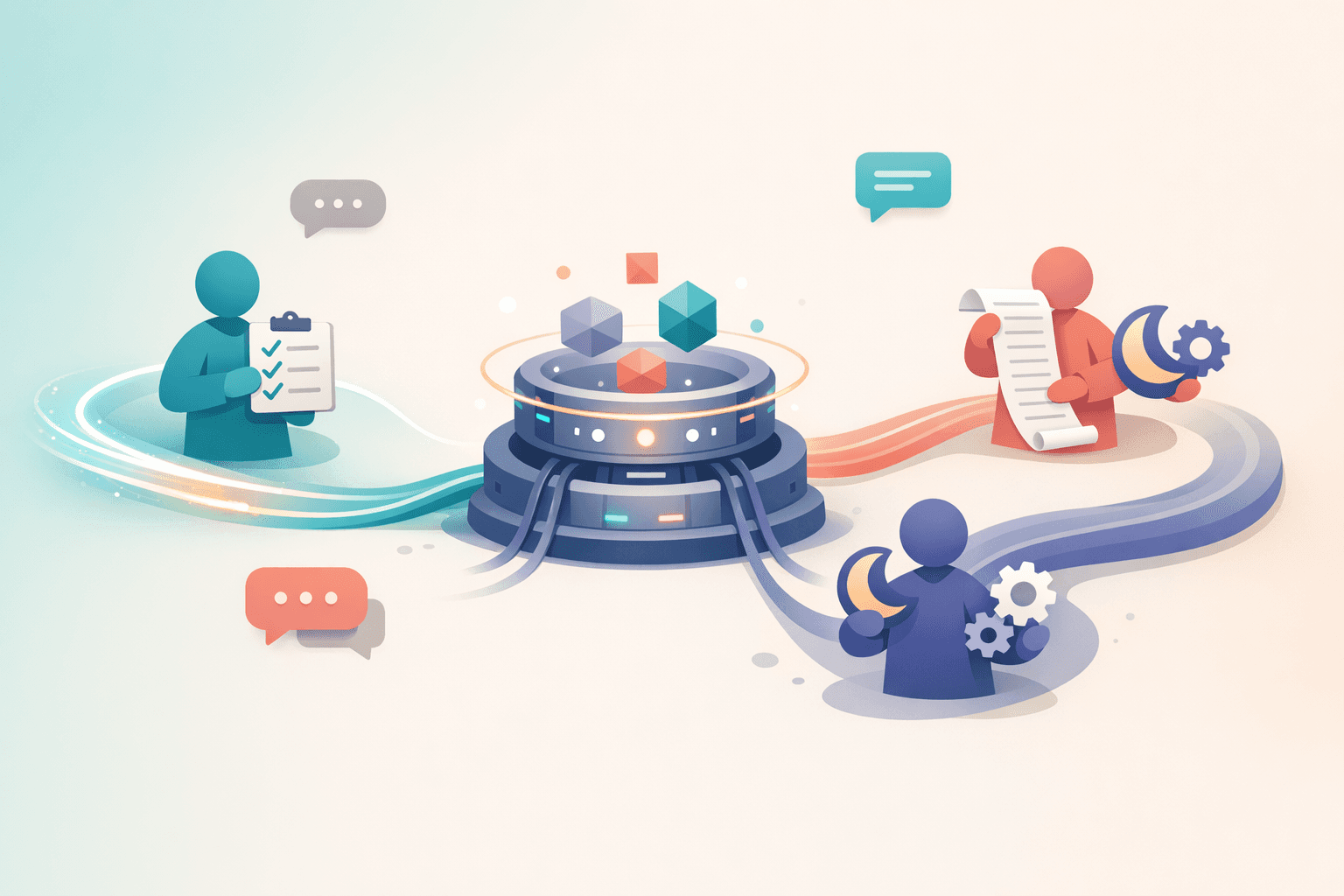
This is exactly why we built Notis with a multi-agent architecture.
The core idea is boring in the best way: match the complexity of the work to the right level of intelligence.
A tiny request like creating a simple task in Notion doesn’t need a genius. It needs speed, reliability, and zero drama.
A longer request like writing a blog post, turning a voice note into a structured plan, or synthesizing a week of meeting notes does need more reasoning, more context handling, and more careful writing.
And the really heavy stuff, like an automation that runs overnight, can use the slowest, smartest model available because nobody is watching the spinner.
In Notis, you send the message once. The system chooses the brain.
That’s it.
“Asynchronous AI” is the unlock
When you text a colleague, you don’t expect a reply in two seconds. You expect a good reply.
That’s the expectation I want for AI productivity.
Not everything needs to be instant. Some things need to be right.
When you remove the pressure for immediate responses, you remove the pressure to optimize for speed over quality. You can let the system take an extra minute to think, browse your workspace, cross-check details, and produce something you can actually ship.

The future isn’t one perfect model
The future of AI productivity isn’t about finding your forever-model.
It’s about having systems that automatically choose the right tool for each job, the same way you run a team. You don’t give every task to your most senior person. You also don’t ask your intern to write your pricing page.
Most people will build this intuition over time. You’ll learn which models feel best for which tasks, and you’ll switch instinctively.
But the real gains come when you don’t have to think about it at all.
Because the bottleneck isn’t what the models can do anymore.
The bottleneck is knowing which one to use, when.

Flo is the founder of Mind the Flo, an Agentic Studio specialized into messaging and voice agents.