Content
Your Standup Meetings Are The Problem — Here’s The Fix
Standups feel like a productivity ritual because everyone shows up, everyone speaks, and everyone leaves with the illusion that work happened.
But if you think your company’s standup meetings are productive, you’re the problem.
That’s not me trying to be edgy. It’s just the most accurate diagnosis I’ve found after watching dozens of teams burn hours every week on the same pattern: people perform “being busy” in a time slot, then go back to doing the actual work, slightly more exhausted and slightly more interrupted than before.
The real job of a standup (and why meetings are a bad interface)
A standup has one job: reduce uncertainty.
Managers want visibility without micromanaging. Teammates want context without endless Slack scrolling. Everyone wants to know what’s blocked, what changed, and what matters today.
The problem is that a synchronous meeting is a terrible interface for that job. It forces everyone into the same time window. It rewards fast talkers. It punishes deep work. And in remote teams across time zones, it becomes a calendar tax that compounds every single week.
If you’re running a 10-person remote team, a “quick” 15-minute standup is rarely 15 minutes. It’s the context switching before it, the late starts, the post-meeting clarifications, and the fact that you just stole the best focus window of the day.
The client problem that triggered this workflow
Last week a client came to me with a situation I see all the time.
Team of ten. Fully remote. The owner had no real visibility into what people were doing. Not because the team wasn’t working, but because the updates lived in a messy combination of Slack threads, half-updated Notion pages, and people’s heads.
Their instinct was the classic fix: “Let’s do weekly standups.”
And I said: perfect. Let’s do standups. Just not as a meeting.
The fix: async voice standups with two automations
Here’s the entire system we deployed.
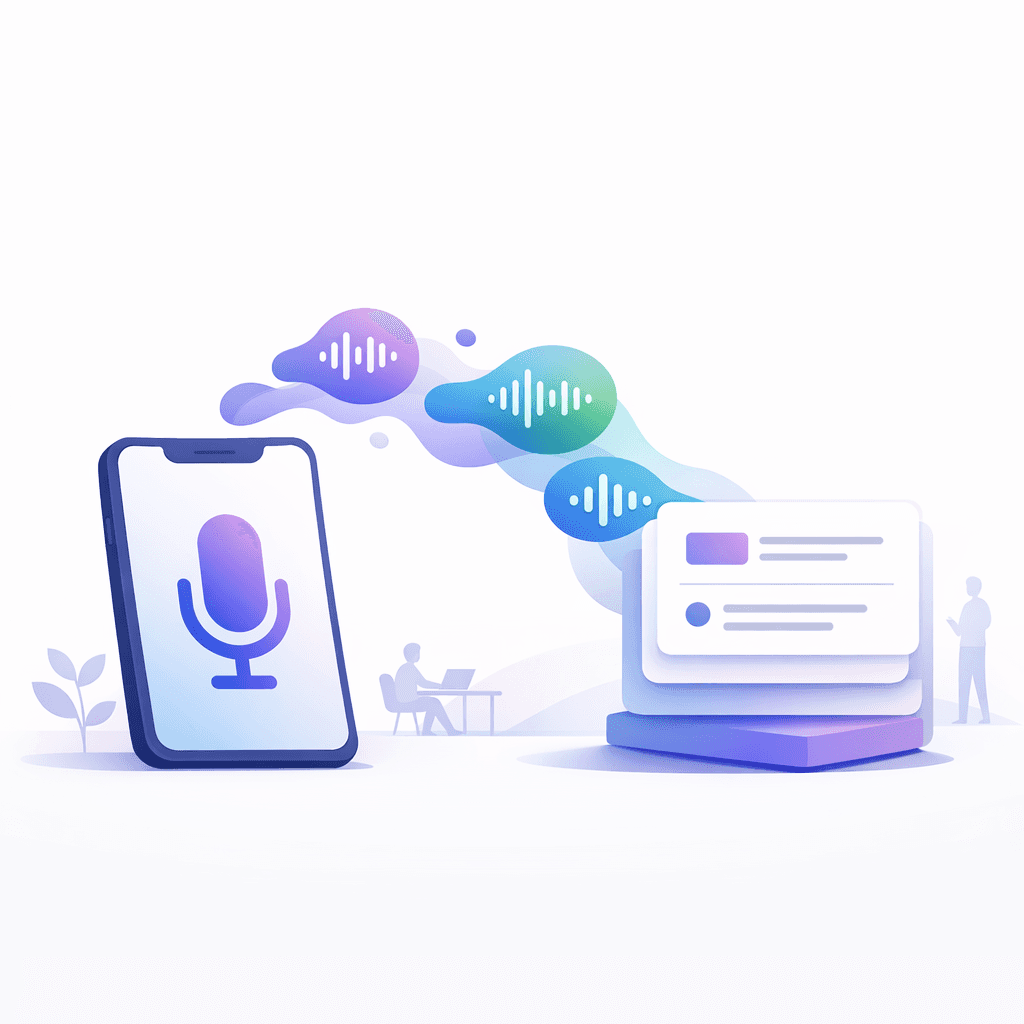
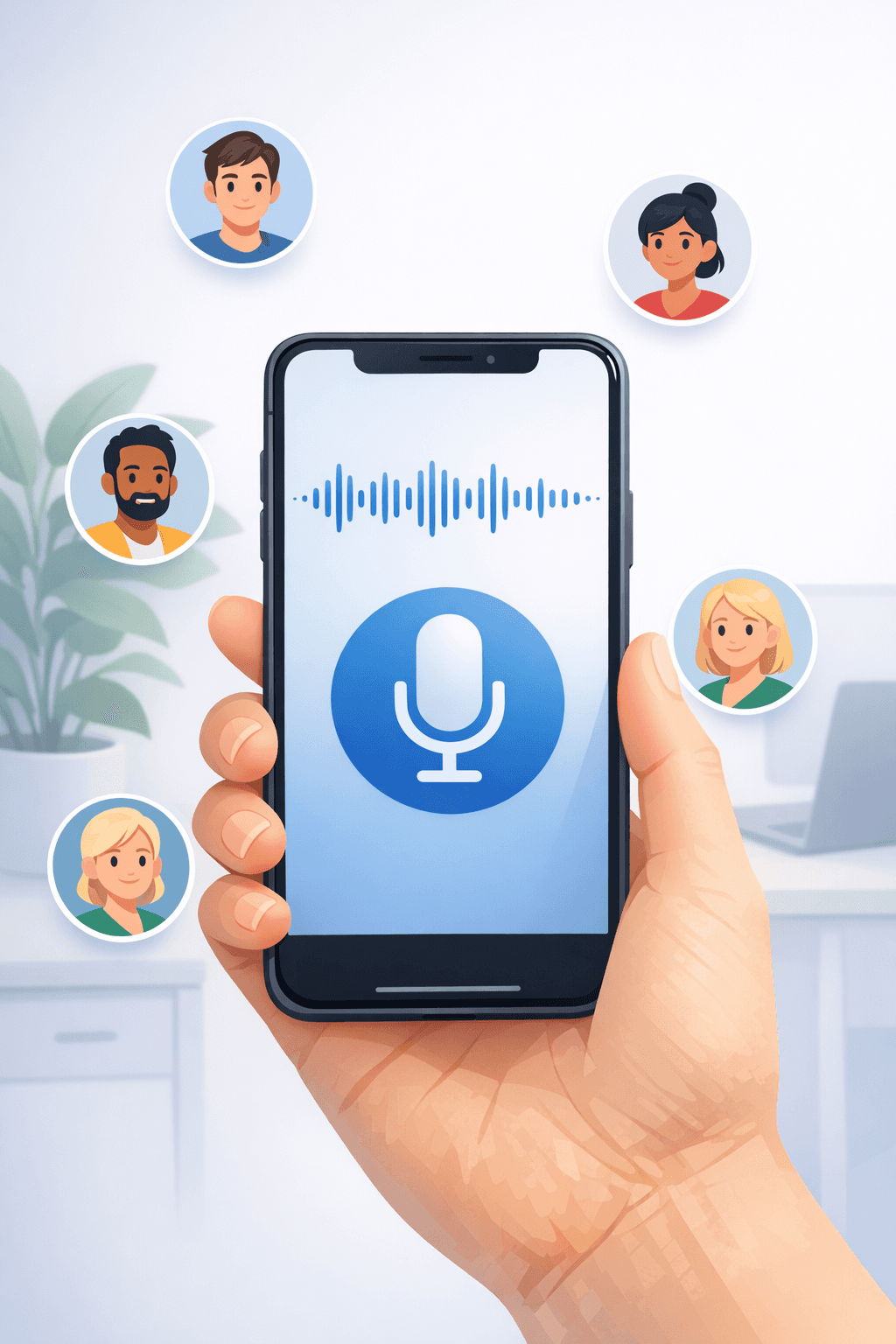
Every Monday at 9:00 AM, everyone on the team gets a reminder from Notis to record a short voice message.
No fancy template. No “three bullet points.” No form to fill. Just a voice note.
People naturally say what matters: what they shipped, what they’re pushing this week, and what’s blocking them. Voice is high-bandwidth and low-friction. You get nuance, confidence, uncertainty, and urgency in a way that text almost never captures.
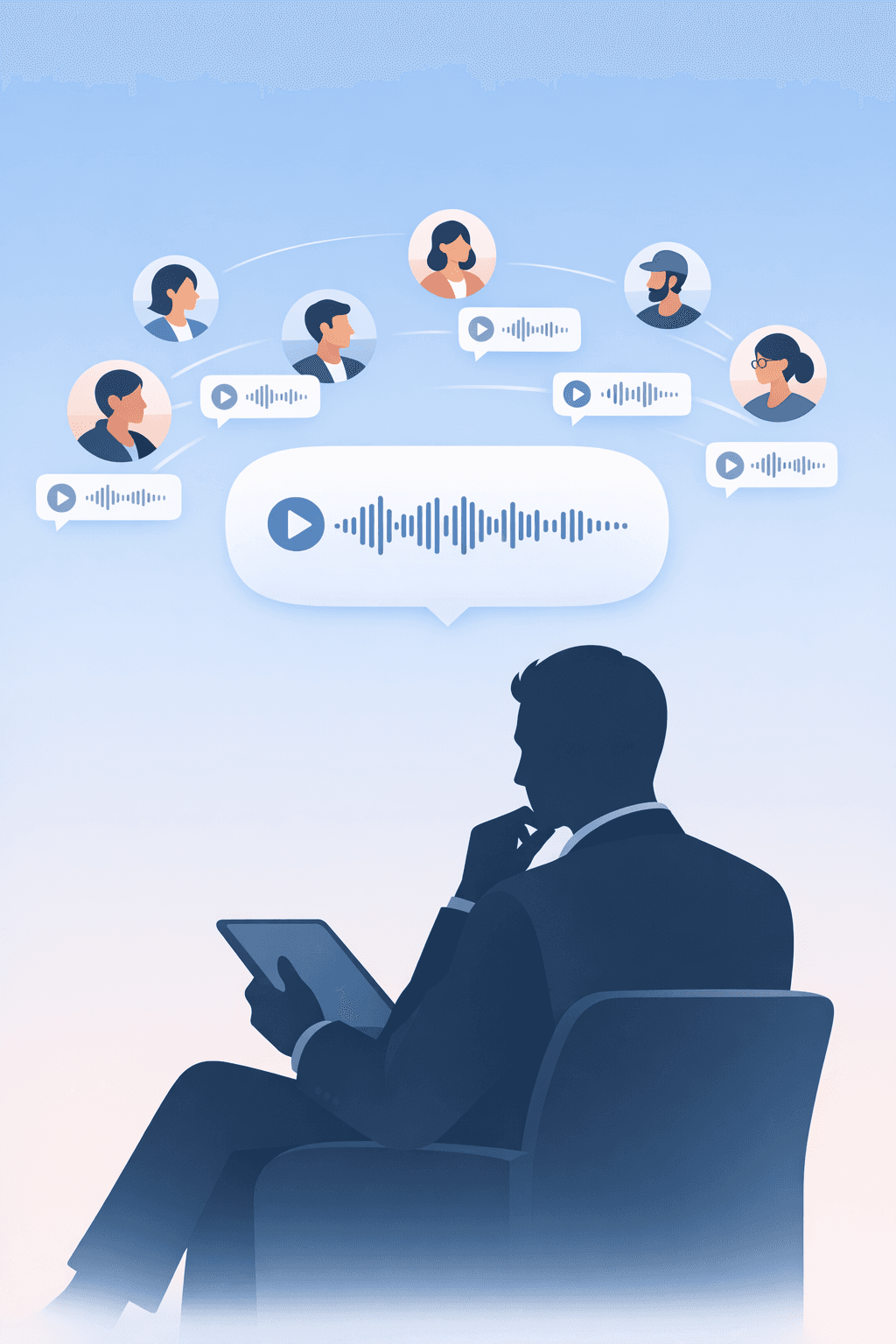
Then, at the end of the day, the owner gets a single voice message generated by Notis that summarizes the entire team’s updates.
One message. One artifact. No meeting.
This is what most leaders actually want from standups: a compressed, readable (or listenable) view of reality.
Why voice works better than typed updates
Typed standup updates look clean, but they’re often dishonest. Not maliciously—just structurally.
Text pushes people into status theatre. You end up with vague lines like “Continuing work on X” because writing is slow, and nobody wants to craft prose for internal updates.
Voice removes that. You can speak for 30 to 60 seconds and you’ll usually cover more truth than five minutes of typing. It also removes the “I need to be at my desk” constraint. People can record from a walk, between calls, or right after finishing a chunk of work while the context is still fresh.
And because Notis can turn those voice notes into structured outputs, you get the best of both worlds: effortless input, organized visibility.
The hidden benefit: leaders stop interrupting
When a founder lacks visibility, they compensate with interruptions.
They ping people. They ask for updates in DMs. They request extra meetings. They “just want to check something real quick.”
It’s not because they’re evil. It’s because uncertainty creates anxiety, and anxiety creates control behaviour.
This workflow removes the uncertainty. The owner receives a consolidated summary on a predictable cadence, and the impulse to interrupt drops dramatically.
What makes this work (and what will break it)
This system works when you treat it like infrastructure, not a one-off hack.
It has to be simple enough that people don’t negotiate with it every week. It has to be consistent enough that leaders trust it. And it has to produce a useful output, otherwise it becomes just another task.
The quickest way to break it is to turn it back into a bureaucratic ritual. If you force a strict script, people will start gaming it. If you demand perfection, they’ll procrastinate. If you make it long, they’ll stop doing it.
Keep it short. Keep it human. Let the automation do the cleanup.
The leadership lesson nobody likes hearing
I’m going to repeat the line from the original rant because it’s important.
If you are not automating and helping your team automate their work, you are a bad leader.
Not because automation is trendy. Because leadership is about designing systems that make good work easier and bad work harder.
Meetings are the default because they’re the easiest thing to schedule. But “easy to schedule” is not the same as “good for output.”
If your standup exists because you don’t trust your team to communicate asynchronously, then your problem is trust.
If your standup exists because you don’t have a system for visibility, then your problem is design.
If your standup exists because that’s how you’ve always done it, then your problem is laziness.
What I’d change if you want to run this daily
Weekly works for many teams because it creates a clean Monday reset. Daily can work too, but only if you keep the friction near zero.
The moment daily updates become another thing people “should do,” they’ll fail. The only reason daily standups survive as meetings is because social pressure forces compliance. Async needs the opposite: it needs to feel easier than skipping.
If you’re considering daily, start with three days a week. Let the habit form. Then increase the cadence if the summaries stay valuable.
The outcome you should expect
For that 10-person remote team, the immediate win wasn’t “saved time,” even though they did save time.
The real win was clarity.
People stopped dreading a meeting that interrupted their morning. The owner stopped feeling blind. The team stopped being peppered with ad-hoc update requests. And the weekly rhythm became a single predictable loop: prompt, record, summarize, move on.
If you want to keep your standup meeting, you can. But don’t confuse tradition with productivity.
Replace the meeting with an artifact, automate the collection, automate the summary, and let your team do what you hired them for: build.

Flo is the founder of Mind the Flo, an Agentic Studio specialized into messaging and voice agents.