Content

Your AI Intern Should Protect Your Social Battery
There is a very specific kind of exhaustion that does not show up in your task manager. You can have time on the calendar, a clear to-do list, even a decent night of sleep, and still look at one Slack thread, one awkward follow-up, or one “quick sync?” and feel your entire operating system shut down.
That is the part of founder productivity we keep pretending is not real. For many neurodivergent founders, the expensive part of delegation is not the work. It is managing another person around the work. The briefing. The tone. The checking-in. The emotional weather. The tiny social taxes attached to every handoff.
This is why the idea of an AI intern matters. Not because AI is magically smarter than humans. It is not. But because you can delegate without spending the same social battery you are trying to protect.
The hidden cost of delegation is social energy
Most business advice treats delegation like a maturity milestone. If you are still doing everything yourself, the story goes, you are the bottleneck. Hire. Delegate. Build systems. Become a real CEO. Lovely. Also incomplete.
Delegation to humans comes with a management surface area. You have to explain the task, interpret misunderstandings, monitor progress, give feedback, repair small frictions, and decide when to intervene. For some founders, that is energizing. For others, especially ADHD, autistic, or otherwise neurodivergent operators, that layer can be more draining than doing the original task.
The internet phrase is “social battery.” Research uses more precise language around camouflaging, masking, and the exhaustion of navigating workplace interaction. A qualitative study on autistic workplace masking describes the effort and fatigue involved in trying to appear “normal” at work (source). Another paper on the reasons, contexts, and costs of camouflaging links that constant social adaptation to real psychological cost (source).
You do not need to diagnose your inbox to understand the point. Some work is hard because it is cognitively hard. Some work is hard because it is socially sticky. Founders usually optimize for the first category and quietly drown in the second.
Why AI delegation feels different
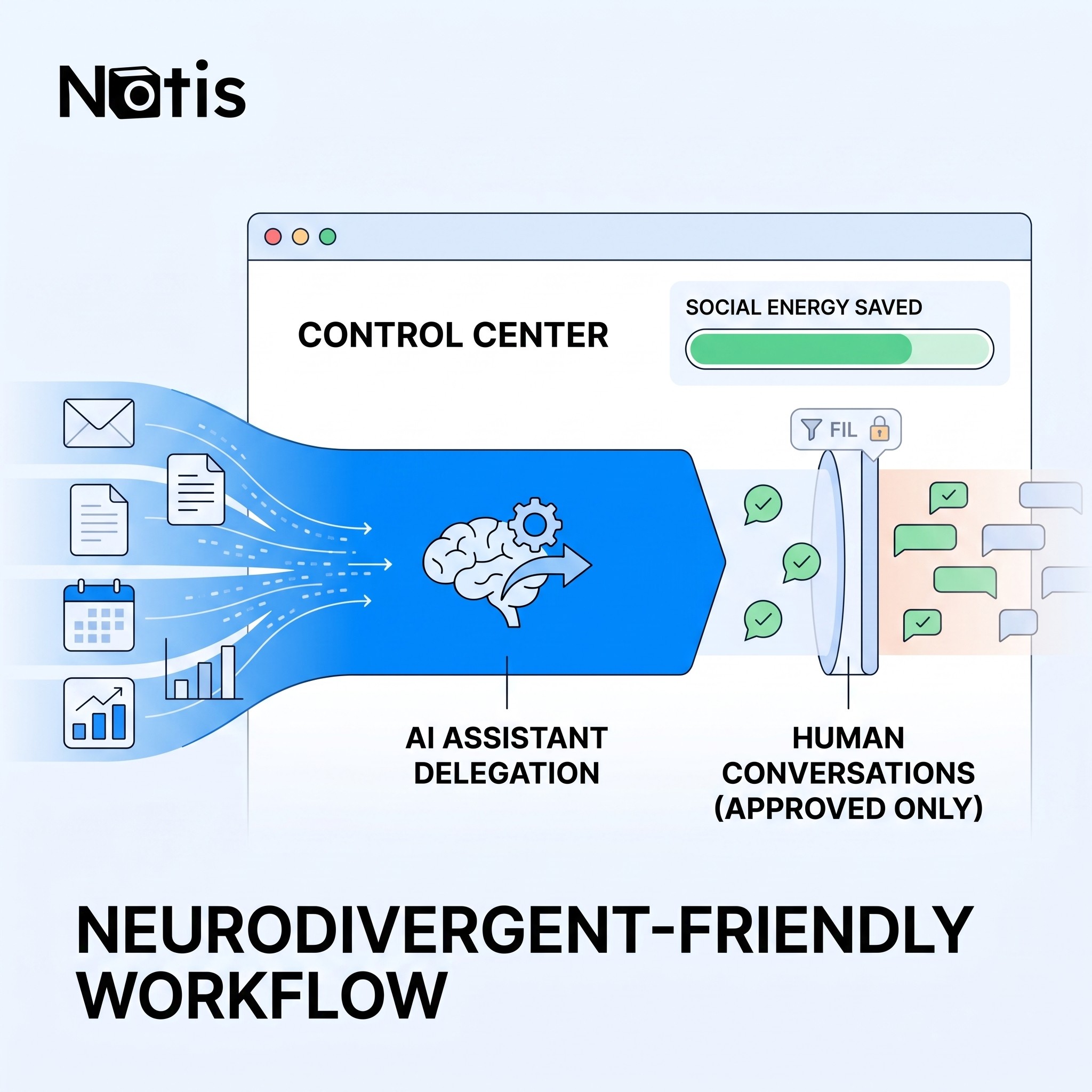
An AI intern does not need reassurance. It does not read your short message as rude. It does not get disappointed if you rewrite the brief three times. It does not mind receiving messy context at midnight. It does not require you to perform friendliness before you can ask for help.
That changes the emotional economics of delegation. You can write, “Find the latest customer emails about this bug, summarize the pattern, draft a response, and tell me what you are unsure about,” without the extra overhead of wondering whether you sounded demanding. You can ask the same question again. You can be terse. You can be chaotic. The AI does not take it personally.
This is not a replacement for humans. Humans are still better for judgment, trust, taste, relationships, conflict, hiring, sales nuance, and any situation where lived context matters. But an absurd percentage of founder work is not that. It is translation work. Turn this voice note into a plan. Turn this thread into a decision. Turn this meeting into next actions. Turn this anxiety blob into three emails I can approve.
That is the sweet spot. The AI intern absorbs the translation layer before it becomes a social interaction.
The three-lane model for social-battery-friendly delegation
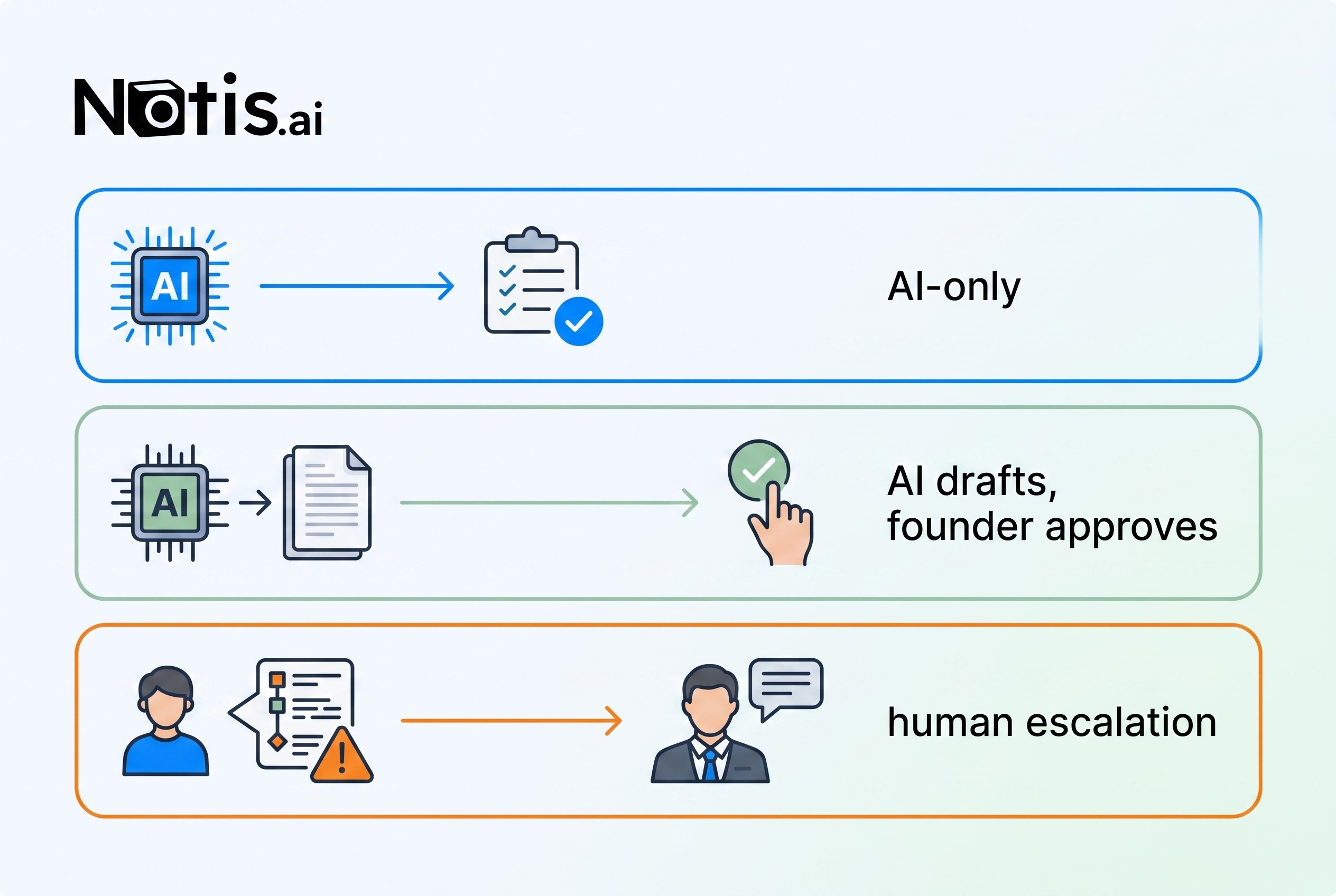
The cleanest way to use AI for this is to stop treating every task the same. I like a three-lane model.
The first lane is AI-only work. These are tasks where the cost of being slightly imperfect is low and the benefit of removing the task from your brain is high. Summaries, drafts, research notes, CRM cleanup, meeting recaps, document formatting, and “make this less embarrassing before I send it” all belong here.
The second lane is AI drafts, founder approves. This is where most relationship-adjacent work should live. Let the AI draft the reply, prepare the follow-up, compare options, or propose the decision. You stay in control of the final click. Your social energy goes into judgment, not into staring at a blank message box while your nervous system negotiates with a greeting line.
The third lane is human escalation. If there is legal risk, emotional complexity, negotiation, a major customer relationship, team conflict, or anything that could damage trust, the AI should prepare you, not pretend to be you. That preparation still matters. Walking into a difficult conversation with context, options, and a first draft is very different from walking in raw.
Why messaging-native matters
A lot of AI tools fail neurodivergent founders because they add another place to check. Another dashboard. Another inbox. Another beautiful product you forget exists until guilt makes you open it.
The social-battery version of AI delegation has to live where the friction is lowest. For me, that is messaging. Send the thought before it evaporates. Record the voice note before the task mutates into dread. Let the assistant do the structuring afterwards.
That is the Notis angle. Notis is built as a messaging-native AI assistant that can work from channels like WhatsApp, Telegram, iMessage, Slack, and email, while connecting into tools such as Notion and other integrations (overview). With voice mode, you can speak naturally, hand off a task, and let Notis continue the work afterwards across connected tools (voice mode).
That last part is important. Capture alone is not enough. I do not need a prettier graveyard of notes. I need the messy sentence to become the follow-up, the task, the meeting brief, the Notion page, the email draft, or the decision memo.

The practical rule: delegate before you socialize
Here is the rule I would give any founder who recognizes this pattern. Before you spend social energy on a task, ask whether an AI intern can reduce the surface area of the interaction.
Before replying to a complicated customer, ask for a summary, risks, and a draft. Before meeting someone, ask for the context and likely agenda. Notis supports meeting workflows like pre-call briefs and post-meeting follow-ups, which is exactly the kind of invisible preparation that makes human interaction less costly (meeting workflows). Before delegating to a contractor, ask the AI to turn your chaotic intent into a clean brief. Before opening a thread, ask what actually needs your judgment.
This does not make you antisocial. It makes you precise. You are not avoiding people; you are protecting the energy needed to be good with people when it actually matters.
The honest caveat
AI can also become avoidance with a nicer UI. If you use it to dodge every hard conversation, the bill comes later. Customers still need trust. Teammates still need clarity. Partners still need you to show up. The goal is not to remove humans from your company. The goal is to remove unnecessary social load from work that never needed to be social in the first place.
That is the game changer. A human assistant can be amazing, but managing a human assistant is still a relationship. An AI intern is not. It is a low-friction delegation layer that lets you spend your human energy where it compounds instead of where it leaks.
If you are a neurodivergent founder, that may be the difference between “I should delegate more” as another shame loop and delegation that actually sticks.

Flo is the founder of Mind the Flo, an Agentic Studio specialized into messaging and voice agents.