Content
Your AI Assistant Does Not Need the Biggest Brain for Every Task
There is a very founder-ish mistake in AI right now: assuming the best assistant is the one that uses the biggest model all the time. It sounds logical. Bigger brain, better work. Except most work is not frontier reasoning. Most work is “turn this voice note into a task,” “summarize this thread,” “draft the polite follow-up,” “check my calendar,” and “remind me if this person does not reply.”
You do not need a rocket engine to open a jar. You need the right amount of intelligence at the right moment.
The future of AI assistants is routing, not bragging rights
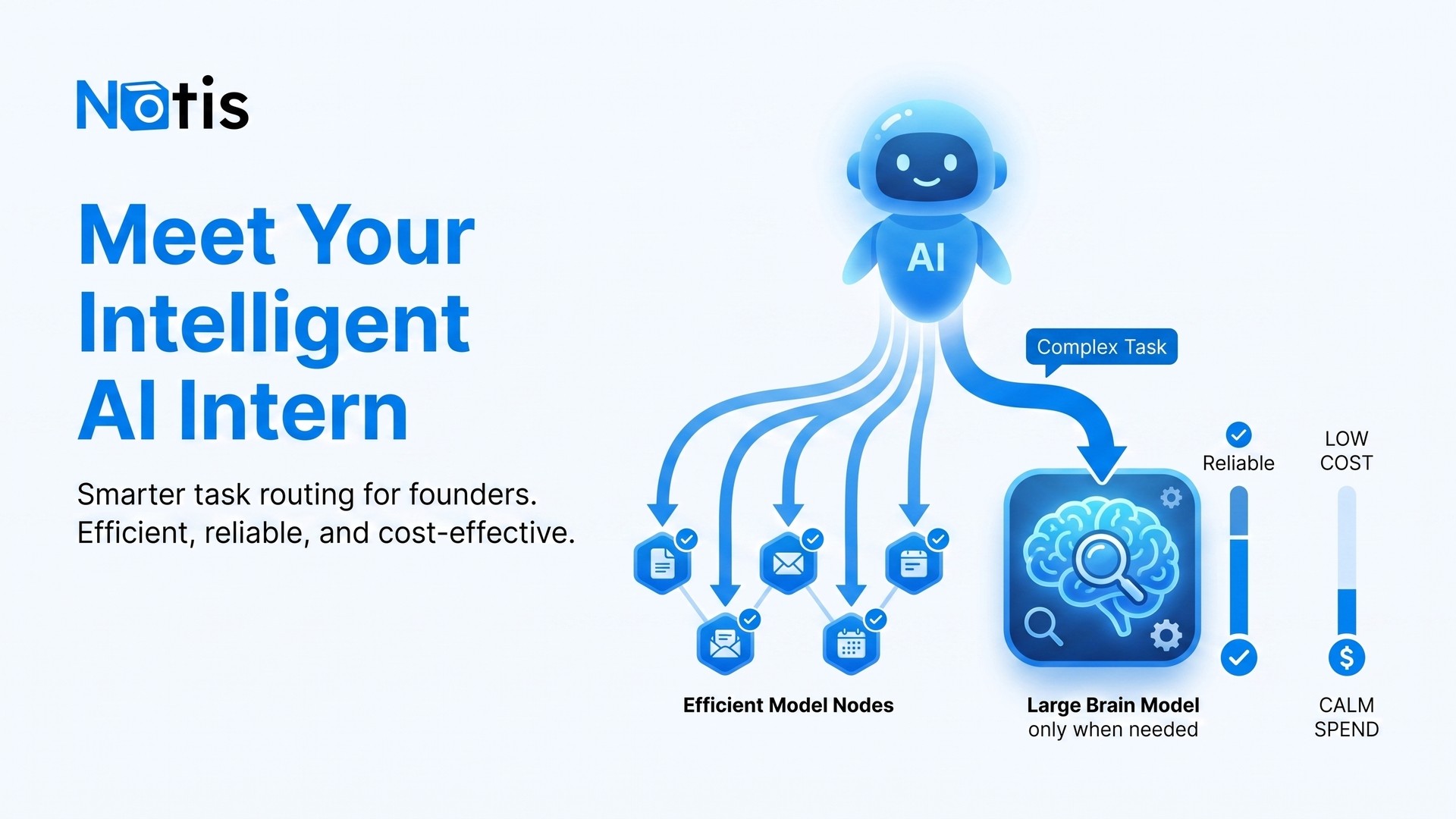
AI assistants are becoming multi-model systems whether users see it or not. The economics make that inevitable. Providers publish token-based pricing, caching, and batch options because inference cost is a real operating variable, not a footnote (Anthropic pricing documentation). Technical teams increasingly think in terms of routing: which task deserves the expensive model, which task can use a cheaper model, when to retry, when to escalate, and when to ask a human.
For users, the details should disappear. Nobody wants to manage a model dropdown while trying to run a business. The assistant should quietly decide when a small fast model is enough and when a bigger reasoning model is worth the spend.
The hard part is not cost. It is trust.
Cheap output that breaks trust is expensive. If the assistant saves money by sending weird emails, missing constraints, or forgetting context, the founder pays in anxiety. The actual metric is not cost per token. It is cost per reliable completed task.
That means a good AI assistant needs checks around the model, not just a model inside the product. Did the reply match the user’s tone? Did the output satisfy the instruction? Did it use the right context? Did it avoid sending when approval was needed? Did it recover when the thread was messy? Reliability research increasingly treats AI evaluation as more than one benchmark score; robust systems need task success, constraint satisfaction, calibration, and human spot checks, not just vibes and a leaderboard.
Small models are perfect for the boring magic
A lot of assistant work is boring in the best way. Classify this email. Extract the date. Turn this voice note into a clean task. Draft a simple reply. Rename the note. Find the right database. These jobs need consistency, speed, and low cost more than philosophical depth.
This is where routing shines. If an assistant can use cheaper intelligence for small jobs, it can afford to do more work for the user. More captures. More follow-ups. More memory updates. More tiny pieces of operational glue. That matters for solo founders because the assistant’s value is often the pile of small tasks you no longer carry in your head.
Big models should appear when the stakes justify it
There are moments where the bigger brain matters. Strategy. Sensitive emails. Legal-ish wording. Investor updates. Complex research. Multi-step planning. Anything where nuance, judgment, and context compression matter. For those tasks, spending more intelligence is not waste. It is insurance.
The trick is not to worship the premium model. The trick is to reserve it. A founder-friendly AI intern should be cost-aware without making the founder feel cheap. It should spend when quality matters and stay efficient when the task is routine.
What model routing means for Notis users
Notis is built around the idea that founders delegate through messages. That creates a different routing problem from a blank chat app. A voice note may need transcription cleanup, intent detection, memory lookup, tool selection, a draft, and maybe a follow-up automation. Some steps are simple. Some require judgment. The assistant should not treat every step like a board-level strategy memo.
This is also why memory matters. Search Console data for Notis.ai includes long-tail queries about remembering customer conversations across tools like Claude, ChatGPT, Gmail, Superhuman, Granola, HubSpot, and Notion. That is the real pain. Users do not only want a smarter model. They want context to survive across the messy systems where work happens.
The founder test: would you trust it with the small stuff?
The best AI assistant is not the one that produces the most impressive answer in a demo. It is the one you trust with unglamorous work every day. If you trust it to capture bugs, prep meetings, follow up, update notes, and route tasks correctly, then it becomes operational leverage. If you only trust it after reading every word twice, it is just an expensive autocomplete with better posture.
Model routing is not a nerdy backend detail. It is how AI assistants become affordable, reliable, and present enough to matter. The future is not one giant brain doing everything. It is an AI intern that knows when to be fast, when to be careful, and when to ask you before touching the big red button.

Flo is the founder of Mind the Flo, an Agentic Studio specialized into messaging and voice agents.