Content
Why we rebuilt Notis around an agentic workspace
I’ve spent a lot of time thinking about what kind of product Notis actually wants to become.
For a while, the obvious answer was that we were building an AI assistant. That description was convenient, but it also started to feel too small. Assistants answer questions. They summarize. They occasionally trigger an action. Useful, yes. But not enough.
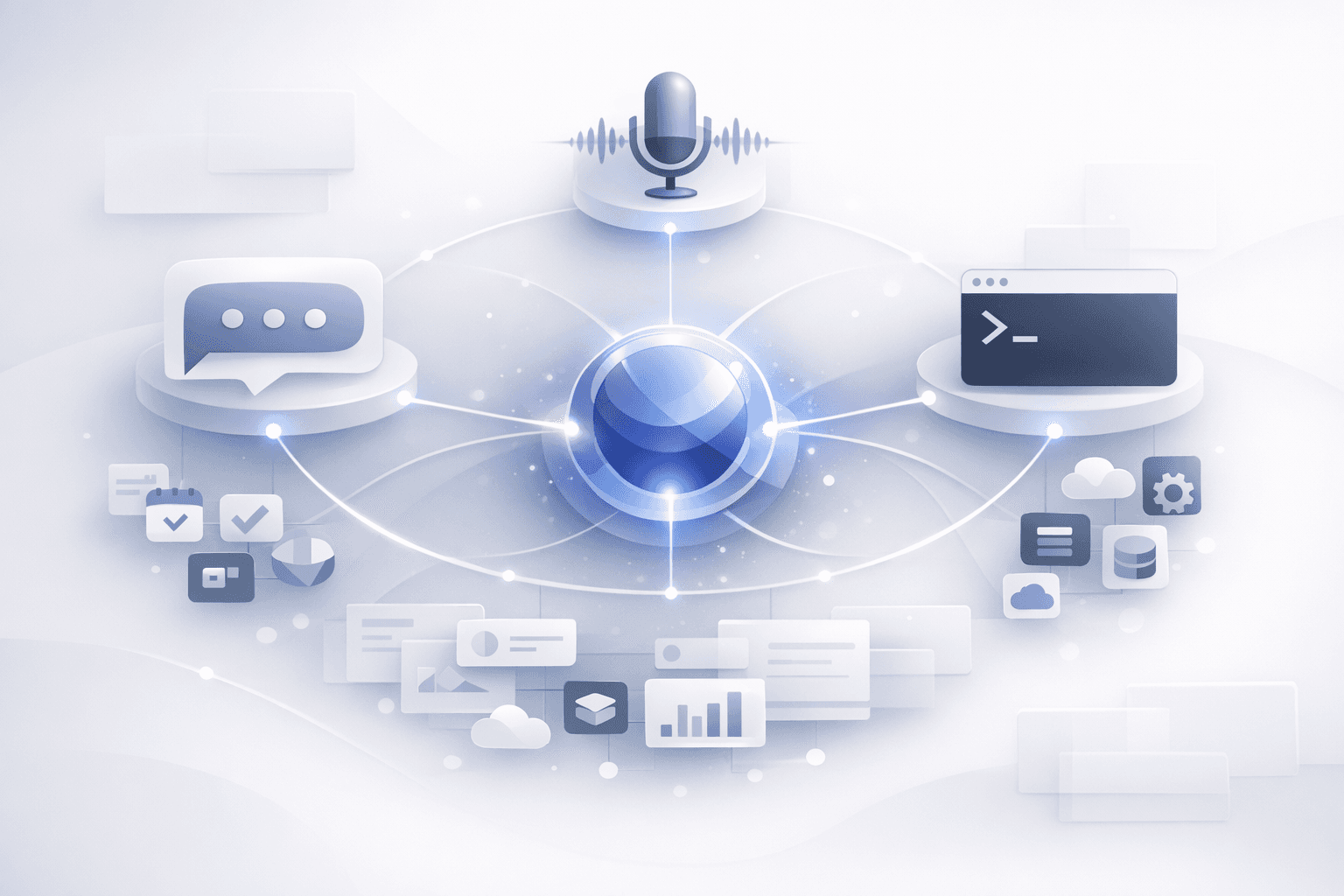
What we are building now is something much more opinionated: an agentic workspace. A system where apps, databases, memory, and integrations are not sitting next to each other like disconnected tabs, but are deeply connected and can act together.
That shift is the reason we rebuilt a big part of the architecture.
The old shape was not good enough anymore
As a product matures, you eventually hit the point where shipping another feature is no longer the hard part. The hard part is making the whole system coherent.
That was the real wall we hit.
Notis was growing across multiple surfaces at once. Text mattered. Voice mattered. The command line started to matter too. Each of those interfaces looked different on the surface, but the bigger issue was what happened underneath. If each mode starts developing its own logic, its own tool access, its own behavior model, you slowly create three products pretending to be one.
That is a terrible foundation for an agentic product.
So we stepped back and rebuilt the architecture around three meta-tools that unify tool calling across text, voice, and CLI. Not because the phrase sounds smart, but because it solves a real product problem. The interface can change. The environment can change. The user intent does not. We needed one underlying system that could understand the job to be done and route actions consistently, no matter where the request came from.
In practice, this gives us a much cleaner substrate for everything that comes next.
The interface is not the product anymore
One thing I believe more strongly every month is that the chat box is not the product.
It is an entry point. Voice is an entry point. The CLI is an entry point. But if the intelligence only lives at the surface, the experience breaks as soon as the task gets real.
The actual product is the connected layer behind the interface. It is the part that knows which tools exist, which database matters, what context should be carried over, what memory is useful, what app needs to be updated, and what sequence of actions should happen next.
That is where the value compounds.
This is also why the idea of an agentic workspace feels more accurate to me than assistant, copilot, or chatbot. The goal is not to make chatting with software slightly better. The goal is to make the workspace itself more executable.
Why we are hiding more of the AI, not less
A lot of AI products still make users manage the machine instead of benefiting from it. They expose model names, settings, switches, and endless choices that create the illusion of power while quietly pushing system design work onto the user.
I think that is backwards.
Most people do not want to become dispatchers for a fleet of models. They want to get something done. They want to capture an idea, turn a conversation into an artifact, update a system, produce a deliverable, or move a project forward.
So one of our product choices is to hide more of the complexity.
That does not mean reducing capability. It means moving complexity to the right place. If Notis understands the context, the tools, and the type of task, then Notis should make better decisions under the hood. The user should describe the outcome. The system should handle the orchestration.
To me, that is what good AI UX looks like. Not a cockpit. More like power steering.
The next release is about making the system legible
The coming weeks, we are targeting the release of a new Notis manager and a new skills experience.
That matters because architecture alone is never enough. You can have a beautiful internal system and still ship a confusing product. Users do not experience your abstractions. They experience whether the thing feels obvious, useful, and trustworthy.
The manager is a step toward making the system easier to direct. Skills are a step toward making it easier to understand what Notis can actually do and to package that value into repeatable behaviors.
I have become increasingly convinced that agent products need stronger productization than people first assume. Raw capability is impressive for five minutes. What creates retention is clarity. People need to feel that the product already knows how to help them in concrete situations.
That is why templates, packaged skills, and opinionated entry points matter so much. They do not reduce flexibility. They prove value faster.

Why templates matter more than feature lists
A lot of software dies in the gap between potential and proof.
Users hear a broad promise, maybe even believe it, and then still have to assemble the value themselves. That gap is especially dangerous in AI, because modern systems are so flexible that they can do many things in theory while remaining vague in practice.
I do not think the answer is to keep adding generic capabilities and hope people connect the dots.
I think the answer is to ship concrete apps, templates, and skills that make the value immediately visible.
A well-designed template does something subtle but important. It turns abstraction into confidence. It tells the user, here is one useful thing that already works, here is the structure behind it, and here is how you can make it yours.
That is a much better onboarding motion than asking people to invent a workflow from a blank page.
The builder side matters too
Another part of this evolution is the CLI and MCP bridge we are building toward.
I think this matters for a simple reason: the future of software creation is becoming more agentic too. Builders are increasingly working with coding agents, local environments, MCP servers, and tool-rich workflows that blur the line between writing code and directing systems.
If Notis wants to become a serious substrate for agentic work, it cannot stop at a polished end-user interface. It also has to become legible and useful to creators building their own apps, workflows, and operational layers on top of it.
The CLI matters because it is still the cleanest high-agency interface we have. MCP matters because it creates a common way to expose tools and context to intelligent systems. Together, they open a path where creators can use their own coding agents to build on top of Notis instead of being confined to a closed product surface.
That is a very exciting direction for me, because it means Notis can become both a product and a platform without becoming bloated.

What this milestone actually means
The short version is that we are getting closer to a version of Notis that feels internally aligned.
The architecture is catching up with the ambition. The manager and skills experience are making that system easier to use. The product vision is getting sharper. And the category we are building for is becoming easier to name.
Notis is not trying to become a prettier wrapper around models. It is trying to become a workspace where intelligence is embedded in the operating layer itself.
That means the real work is not just generating text. It is connecting tools. Structuring context. Packaging capability. Making execution portable across interfaces. Making software feel less like a collection of screens and more like a system that can move with you.
I think that is where this category is heading.
And I think we are finally building Notis in a way that matches that belief.

Flo is the founder of Mind the Flo, an Agentic Studio specialized into messaging and voice agents.