Content
Why an AI Automation Tool Keeps Failing Founders
The AI Automation Tool That Works Until You Need It
Every founder has a version of this story.
You sign up for an AI automation tool after a demo that makes it look effortless. You spend a weekend building workflows. One tool connects your CRM to your inbox. Another enriches new leads automatically. You feel productive. You feel like you have finally gotten ahead of the operational drag.
Three weeks later, the automation breaks. A field changes in your CRM. An API update shifts a parameter. The tool that was supposed to save you time now requires attention every time something changes downstream. Unlike an employee who notices when something is wrong, the automation runs silently into failure, producing bad data until someone (you) catches it.
The promise was time saved. The reality was a new maintenance job.
Why AI Automation Tools Were Never Built for Founders
AI automation tools — Zapier, Make, n8n, and their newer AI-native equivalents — were designed around a specific premise: that business processes are repetitive and predictable. Set up the trigger, define the steps, execute at scale. The model works perfectly for marketing teams sending 10,000 emails per week, or e-commerce operations syncing inventory across warehouses.
That is not how a founder's work actually flows.
Founders deal in the ad-hoc. The call that changes the deal. The insight from a coffee meeting that needs to land somewhere useful before it evaporates. The investor update that needs three different inputs from three different tools. The follow-up that depends on context only you have. None of this fits a trigger-action workflow, because the trigger is never the same twice and the action requires judgment about what matters in this specific moment.
An ai automation tool optimizes for volume and repeatability. Solo founders have neither. They have constant context-switching, irregular tasks, and a 90-second window to offload anything before the next thing takes over their attention.
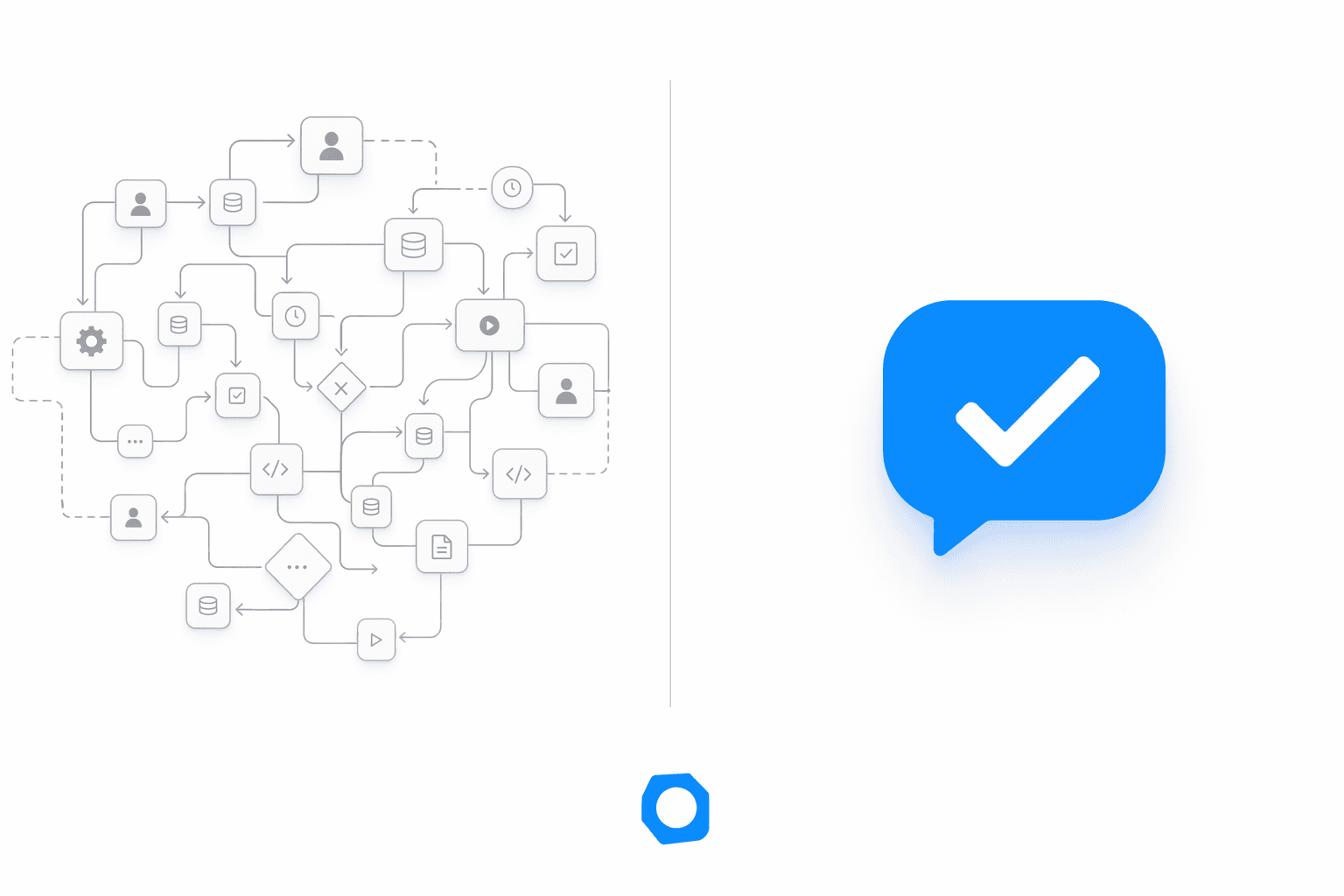
Trying to automate a founder's workflow is like building a conveyor belt for a kitchen where every order is different. The infrastructure is impressive. It works for exactly one dish.
Automation Is Not the Same as Delegation
This is the distinction most productivity content glosses over, and it is the one that matters.
Automation is the elimination of human input from a predictable process. If X happens, do Y. It is a rule, not an intelligence. The tool executes because it was programmed, not because it understood your intent.
Delegation is the transfer of responsibility for a task to something capable of figuring out how to execute it. You say "handle this" and walk away. The judgment about what "handle this" means in this specific context is part of what you are delegating.
Founders need the second thing, not the first. The work actually dragging them down — the CRM updates, the follow-up drafts, the voice note that needs to become a Notion page — requires something that can interpret context, map it to the right tool, and execute without a pre-built workflow waiting for it.
That is not an AI automation tool. That is an AI intern.
What an AI Intern Does Differently
The delegation gap — the category of work too low-leverage for your attention but too context-specific to automate away — requires something different from a workflow tool. It requires something that can receive a natural-language instruction, understand what it means, and execute it across whatever tools are involved.
Here is what that looks like in practice. A call ends. You stay on the line for 30 extra seconds and send a voice note via WhatsApp:
"Spoke to Marcus at Foundry Capital. He wants Q1 numbers before moving forward. Update HubSpot, move him to Proposal stage, set a follow-up reminder for two weeks."
That is a four-step task involving three different apps, and the input is an unstructured voice recording. No workflow tool handles that. No automation can be pre-built for it, because the contact changes, the stage changes, the timing changes, and the context arrives as speech rather than a structured form.
Notis.ai executes it — from WhatsApp, Telegram, iMessage, Slack, or email, across 800+ integrations, with no dashboard to open and no workflow to maintain. You send the message. The task is done. You get a confirmation.
The Maintenance Problem Nobody Talks About
There is a hidden cost to any AI automation tool that shows up slowly. Every workflow you build is a system you now own. It needs monitoring. It breaks when third-party APIs change. It produces silent failures that surface only when someone checks the data. It requires updates every time your tools evolve.
For a team with an ops hire, that maintenance cost is manageable. For a solo founder running everything, it is another job. The irony of automation tools at the solo founder scale is that maintaining the automation can cost more time than the automation saves.
An AI intern does not have this problem. There is no workflow to maintain. You send a message. The task executes. If something goes wrong, you get a message back. The feedback loop is instant rather than discovered three days later when you notice the CRM is wrong.
This is why the comparison between AI assistants consistently shows that founders abandon workflow tools and keep messaging-native ones. Not because the workflow tools are bad. Because the overhead of ownership is invisible until it is not.
The Right Question to Ask
Before choosing any AI productivity tool, one question cuts through most of the noise: does this tool come to you, or do you go to it?
Tools you go to — dashboards, platforms, workflow builders — require deliberate attention. You visit them when you have time, which is rarely the moment the task arises. Tools that come to you exist in the channel where you already operate: your messaging apps, your email, the context you are already inside.
The distinction sounds small. At the daily level, it compounds into the difference between a tool you actually use and a tool you pay for while meaning to use it more.
Most founders who describe themselves as "bad with productivity tools" are not disorganized. They adopted tools that require them to change where they work, and they resisted that change because their actual work lives in messaging apps. That resistance is rational.
The Bottom Line
An AI automation tool is good at what it is good at: high-volume, repeatable, predictable processes. If that describes your workflow, the setup cost is worth it.
Most founders' workflows are not that. They are irregular, context-dependent, and time-sensitive in ways that do not fit trigger-action logic. For those founders, the right answer is not a better automation tool. It is an AI intern that takes a natural-language instruction, interprets the context, and executes across the tools that matter — without a workflow waiting to be built first.
Pro starts at $13/month on annual billing. First task in under two minutes.
Try Notis.ai free at notis.ai.

Flo is the founder of Mind the Flo, an Agentic Studio specialized into messaging and voice agents.