Content
Where Good Ideas Go To Die (And How To Save Them)
Most teams do not have an information problem. They have an activation problem. Every day, your team is on calls, in meetings, inside customer conversations, hearing the things that actually matter: the hesitation before a renewal, the frustration behind a feature request, the pattern hidden inside five small complaints that are not small at all.
And then what happens? The call ends. The notes get saved. The transcript gets archived. Everyone moves on. The insight survives just long enough to be searchable, but not long enough to change what happens next.
Where good ideas go to die
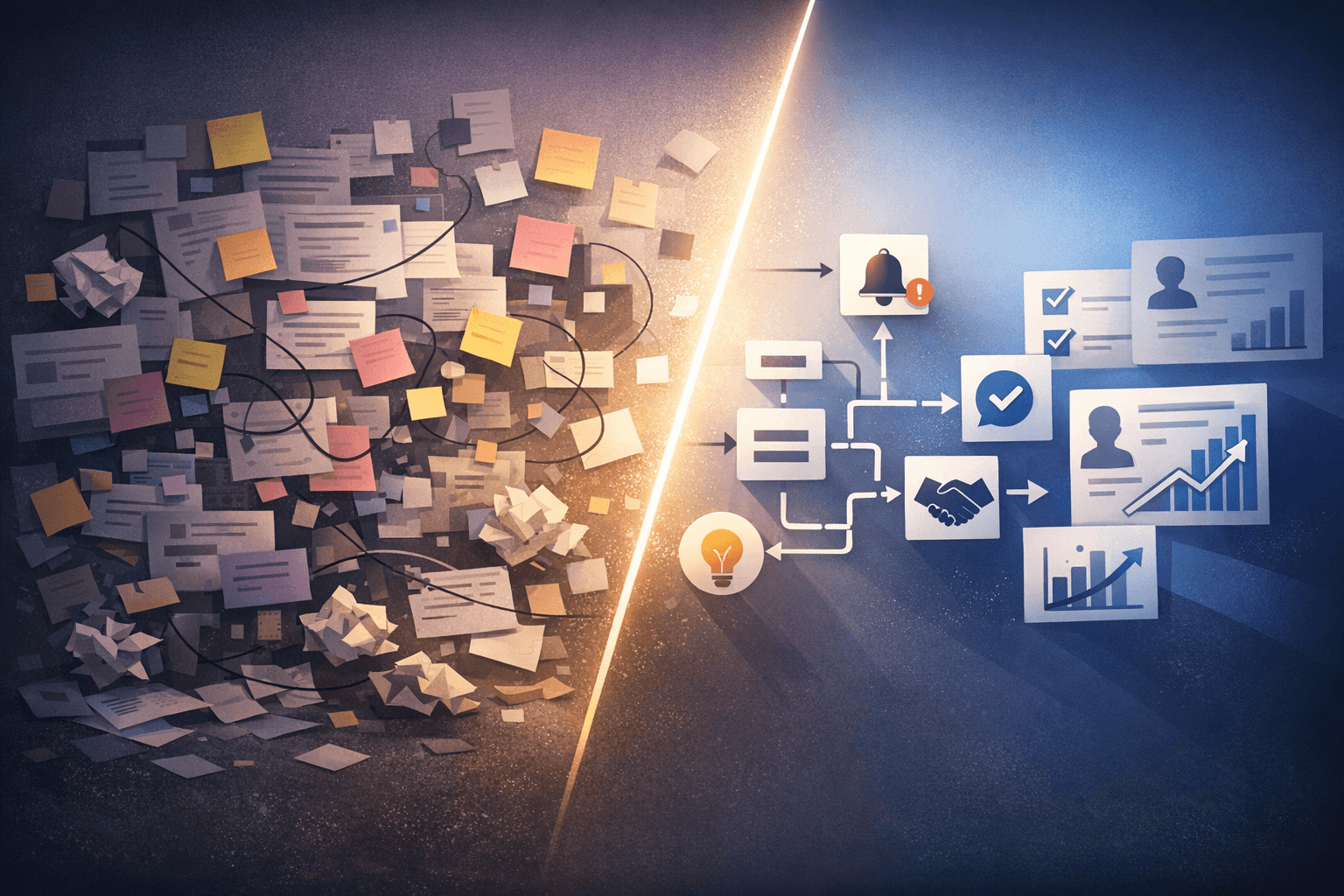
The notes app is where good ideas go to die. That sounds brutal, but most teams know it is true. We have never been better at capturing information. Between meeting recorders, AI transcripts, CRM notes, Slack messages, and docs, companies are producing an absurd amount of raw signal every single day. But very little of it becomes action.
The problem is not that the signal does not exist. The problem is that it stays trapped in tools built to store information rather than operationalize it. A client says they are unsure about the value they are getting. A prospect repeats the same objection your sales team has heard three times this week. A customer success manager notices usage dropping before the account actually churns. A product complaint keeps resurfacing in calls, but because it lives across scattered notes, nobody sees the pattern early enough to react.

Notes are not knowledge
Capturing a conversation is not the same thing as learning from it. This is where most note-taking systems fail. They do a decent job preserving what was said, but they do almost nothing to make sure the right person sees the right insight at the right time. That last mile is everything.
If your notes never become a follow-up, a warning, a summary, a pattern, a decision, or a task, then they are not part of your operating system. They are just digital storage. And storage does not compound. Action does.
The hidden cost of unused notes
What makes this dangerous is that the cost is mostly invisible. You rarely notice the opportunity you failed to act on. You do not know which customer might have stayed if the early warning signs had been elevated sooner. You do not know which product decision would have been easier if feedback had been synthesized before it became a backlog mess. You do not know which salesperson would have closed more deals if the team had turned objections into shared intelligence instead of private notes.
This is why I think better note-taking is the wrong frame. The real question is much more operational: how do you turn everyday conversations into business intelligence?
What changes when notes become operational
This is exactly the shift we built Notis for. Notis is not another place to dump notes. It is the layer that turns captured information into action done for your business. If your team is already producing notes every day, that is enough raw material. The opportunity is not to capture more. The opportunity is to do more with what you already have.
Now imagine connecting Notis to your agency or your company workflow so it can review the notes produced by your team continuously. Not just to summarize them. To look for what matters: patterns, risk, follow-up opportunities, repeated objections, customer sentiment, and signals of churn. That is when your notes stop being static records and start becoming active infrastructure.

A simple example: early churn detection
Let’s make this concrete. Your team talks to customers every day. Some of those conversations contain weak signals that a human can notice in isolation, but an organization often misses in aggregate. A customer says they are not using the product as much as expected. Someone mentions internal confusion around implementation. Another team says they are evaluating alternatives. A champion hints that adoption never really happened. None of these comments looks catastrophic on its own.
But taken together, they tell a story. And most companies only recognize that story once the account is already halfway out the door. If Notis can review the notes produced by your team every day, it can detect those early signals and elevate them to the business owner before the outcome is locked in. That changes the game completely. You move from reactive account management to proactive intervention.
This applies far beyond churn
Churn is only one use case. The same principle applies everywhere your business depends on conversations. In sales, it means turning objections into shared positioning intelligence. In product, it means surfacing repeated friction before it becomes roadmap debt. In operations, it means identifying process failures that show up first in team notes. In leadership, it means getting a clearer picture of reality without needing to sit in every meeting.
Your team is already doing the hard part. They are close to the customer. They are hearing what is changing. They are capturing what feels important in the moment. The mistake is letting that context evaporate into disconnected notes that never make their way back into the business.

The future is not more notes. It is better escalation
I do not think the future of work is about recording more meetings or generating longer transcripts. We already have enough raw material. The future is about building systems that know how to extract signal from that material and route it into action. That is the leap from note-taking to business intelligence.
And once you see it that way, it becomes obvious why most teams feel slower than they should. They are not lacking insight. They are lacking a mechanism to convert insight into momentum. A knowledge system should not just help you remember. It should help your business respond. Because ideas are not valuable when they are captured. They become valuable when they change what happens next.

Flo is the founder of Mind the Flo, an Agentic Studio specialized into messaging and voice agents.