Content
What Is an AI Personal Assistant? The Founder's Answer in 2026
What Most People Get Wrong About AI Personal Assistants
The category is real. The confusion around it is worse.
When most people search "ai personal assistant," they're picturing something like Siri — a voice command interface that sets timers, plays music, and occasionally misunderstands you. That's not what the category means anymore, and it hasn't meant that for at least two years.
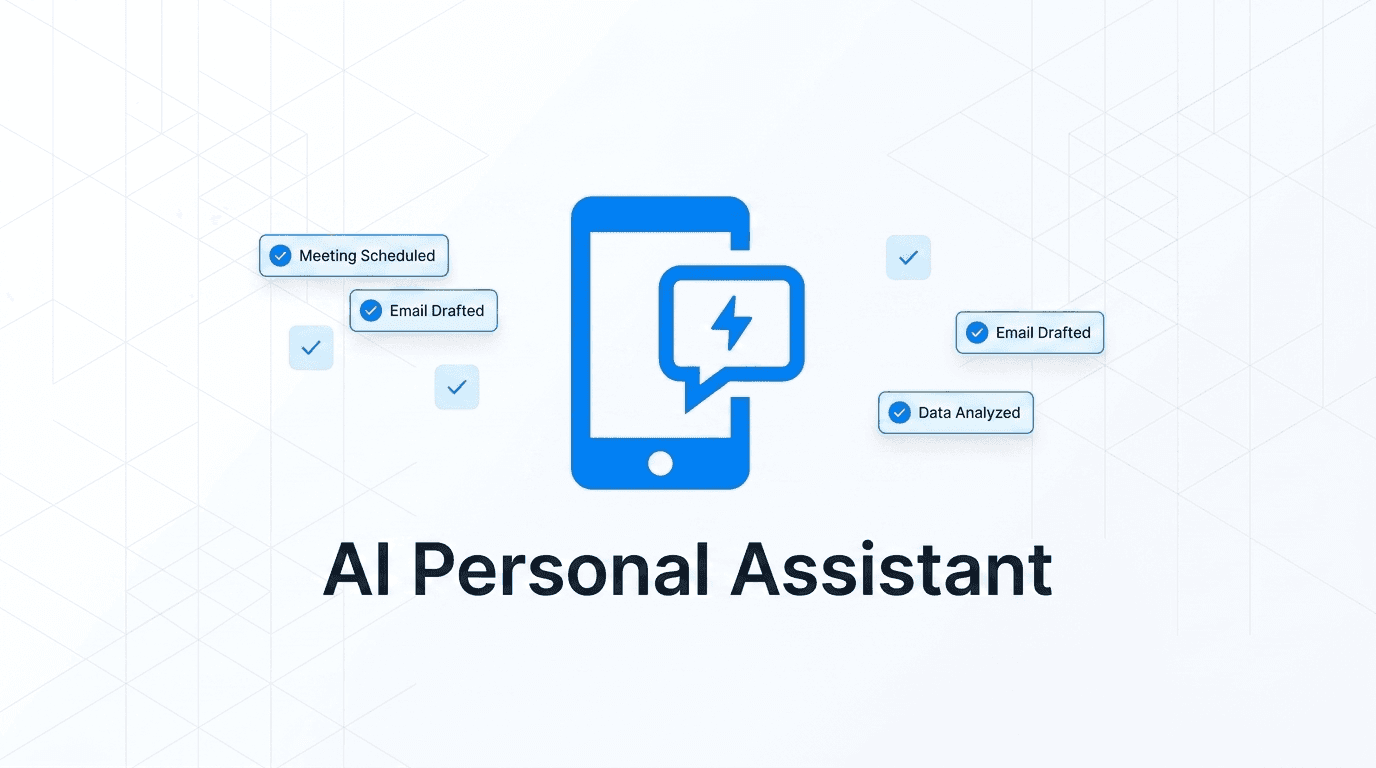
An AI personal assistant in 2026 is software that receives a task from you in natural language and executes it — across your calendar, your email, your CRM, your project management tools, your notes. It doesn't give you advice about how to update the contact. It updates the contact.
That's the distinction that matters. Advice vs. execution. Answering vs. acting. If your tool does the first, you still have to do the second. If it does the second, you have an assistant. If it only does the first, you have a very expensive autocomplete.
The Two Types of AI Personal Assistant
The market in 2026 has effectively split into two camps.
On-demand AI assistants — ChatGPT, Claude, Gemini, Perplexity — respond when you ask. They're exceptional at research, drafting, and thinking problems through. But every interaction ends with you. You still have to take what they produced and put it somewhere. Update the CRM yourself. Send the email yourself. Add the task to Notion yourself.
Autonomous AI personal assistants — the kind Notis.ai, Lindy, and a few others represent — receive a task and handle the full execution cycle. You describe what needs to happen. The assistant figures out which tools to touch, takes the actions, and confirms when it's done. No clipboard required.
For founders, the second category is the only one that moves the needle on actual time savings. Faster access to better answers still requires you to act on them. Autonomous execution removes you from the operational loop entirely.
The One Question Worth Asking Before You Pick One
Before feature lists, before pricing comparisons, before free trial sign-ups: where will you actually use this?
This question sounds obvious. It completely changes the answer.
Most AI personal assistants are platforms — web apps, desktop tools, browser extensions. To use them, you go somewhere. You open the app, log in, navigate to the right feature, and delegate. That's the intended workflow.
For founders who run their businesses from their phones — who are in WhatsApp between calls, Telegram during travel, iMessage at 7am before the first Slack notification hits — this model has a silent problem. The moment of delegation is almost never at a desk in front of a browser.
It's the 90 seconds after a call ends. The flash of insight mid-commute. The decision that needs to be logged before three other things land on top of it. In those moments, opening another app is friction. And friction means the task stays in your head.
The best AI personal assistant for a founder is the one that lives exactly where the founder already is.
What an AI Personal Assistant Should Actually Do for Founders
The standard feature set for most tools in this category: calendar management, email drafting, task creation, reminders. That baseline has existed for years.
What separates the useful tools in 2026 is integration depth — specifically, whether the assistant writes back to your business tools, not just reads from them.
Here's a concrete example. You get off a discovery call. You want to:
Log the conversation and next step in HubSpot
Add the follow-up to Google Calendar
Drop a brief note in your Notion deal tracker
Draft a quick recap email
A capable AI personal assistant handles all four from a single voice note sent via WhatsApp. You describe what happened. It distributes the work. You close the loop on the call before the next thing starts.
If the tool you're evaluating can't write back to HubSpot, can't push to Notion, can't draft the email and stage it for review — it's a partial solution. Partial solutions don't change your daily admin overhead. They add another tab to your browser.
Notis.ai connects to 800+ integrations, runs entirely from messaging apps you already have open, and handles exactly that sequence without you touching a single other tool. That's what an AI personal assistant should mean for a founder.
The Criteria That Actually Matter When Choosing One
Skip the ones that don't: AI model quality (most serious tools use the same foundation models), UI polish, number of templates, mobile app rating.
The criteria that separate useful tools from decorative ones:
Where does it operate? Does it require a new interface, or does it meet you in the tools you already use? The answer determines how often you'll actually delegate to it.
Does it execute or advise? After you send a task, does the tool complete it — or does it give you instructions that you then follow yourself?
What can it write back to? Read-only integrations are interesting. Bidirectional integrations are the product. If your assistant can pull data from your CRM but can't update it, you still have to do the second half of every task.
How fast does it start? Time to first value is predictive of whether you'll build a habit around the tool or abandon it after two weeks. The tools with the lowest friction to start — one message, no configuration sprint — stick. The ones that require a setup weekend rarely survive it.
The delegation gap that costs founders roughly one day per week isn't a knowledge problem. Founders know what needs to happen. It's a friction problem. Every extra step between intention and execution is a task that stays undone.
What This Looks Like with Notis.ai
Notis is an AI personal assistant that lives in WhatsApp, Telegram, iMessage, Slack, and email. There's no platform to visit. There's no dashboard to configure. Setup is one message, and the AI intern is live from that point.
You send a text or voice note. Notis handles the execution — across 800+ integrations including HubSpot, Notion, Google Calendar, Gmail, Linear, Airtable, and more. The confirmation comes back to the same messaging thread.
For founders who are already in messaging apps all day — which is to say, most founders — this architecture eliminates the friction cost that kills every other tool category. The habit forms naturally because it doesn't require changing where you work.
Trusted by 17,000+ founders. Pro starts at $13/month on annual billing. For a side-by-side look at how this compares against nine other options in the category, the AI virtual assistant comparison covers the full field.
The Short Version
An AI personal assistant is only as useful as the frequency with which you actually delegate to it. That frequency depends entirely on how much friction stands between intention and execution.
The right tool is the one that lives where you already are, handles the full execution cycle without requiring you to touch another app, and integrates with the business tools you actually run on.
If those criteria describe what you're looking for, try Notis.ai free at notis.ai. First task in under 60 seconds.

Flo is the founder of Mind the Flo, an Agentic Studio specialized into messaging and voice agents.