Content
What Is an AI Intern? The Founder's Answer in 2026
Two Types of People Search "AI Intern"
One of them wants a job. They're looking for a machine learning internship at a tech company. Good luck to them.
The other is a solo founder at 7am, between calls, wondering if there's something that could just handle the operational layer of their business so they can get back to the work that actually matters.
This article is for the second person.
An AI intern — in the founder context — is an AI agent that handles execution tasks on your behalf. Not answering questions. Not generating text you then have to paste somewhere. Actually completing the task: updating the CRM, logging the note, scheduling the follow-up, drafting the email. Done. Confirmed. No further input required from you.
That distinction matters more than it sounds.
What "AI Intern" Actually Means
The term is specific for a reason.
An AI assistant answers. An AI agent acts. An AI intern acts on everything a competent, zero-overhead junior team member would handle — the execution layer of your business that doesn't require your judgment, just your context.
Think about what a good intern actually does. You give them a task: "After this call, update the deal in HubSpot, add a follow-up for two weeks, and draft a one-line summary for Notion." They do it. You don't need to explain what HubSpot is or how to format the note. You speak in natural language. They figure out the rest.
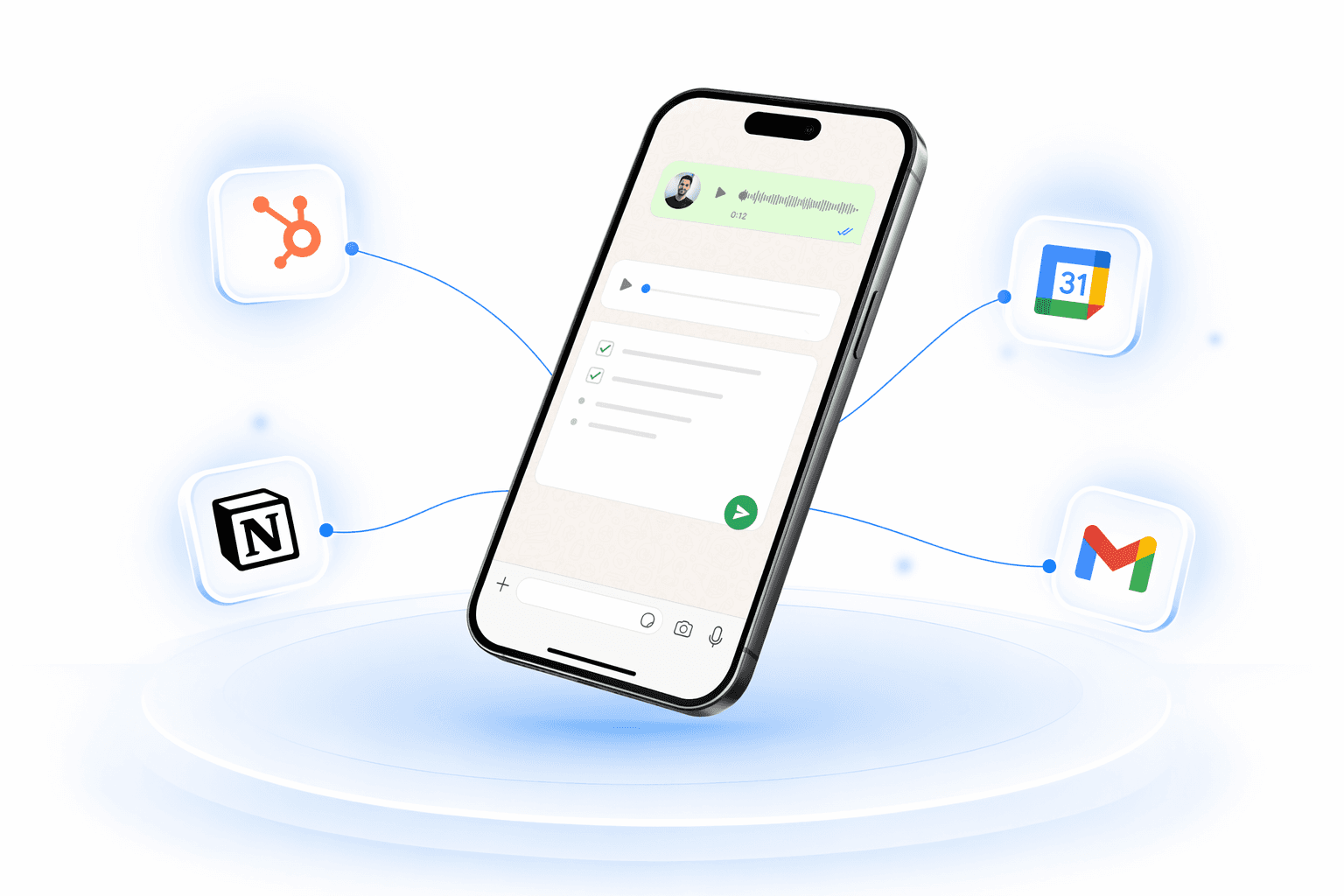
That is exactly what a well-built AI intern does in 2026. You send a message — voice note or text — and it maps your intent to the right tools, executes the task, and confirms when it's done. No app to open. No interface to navigate. No waiting until you're "back at your desk."
What an AI Intern Does That a Chatbot Doesn't
Most tools in the AI productivity space are chatbots: they generate text in response to a prompt. Useful, but limited. You still have to take the output and do something with it.
An AI intern crosses the line from generation to execution.
The difference is integrations. A chatbot lives inside a chat window and gives you answers. An AI intern connects to your actual tools — HubSpot, Notion, Google Calendar, Gmail, Slack, Linear, and hundreds more — and writes back to them on your behalf.
Send it a voice note: "Update Marcus in HubSpot, move the deal to proposal stage, add a task to draft the pitch deck by Friday." The result is a completed HubSpot update, a new calendar task, and a confirmation in your chat. You didn't open a single app.
That is the operational difference between a chatbot and an AI intern. One helps you think. The other does the work.
What Tasks to Delegate to an AI Intern
The right mental model: anything a smart, connected junior team member could handle without needing your judgment goes to the AI intern.
In practice, that looks like:
CRM updates after calls. "Log the call with Sarah at Sequoia, move to proposal stage, follow up in ten days."
Second brain captures. "Add to my Notion: product insight on retention — users who connect three or more integrations in week one have 40% higher retention. Tag it product hypothesis."
Calendar management. "Block three hours of focus time on Thursday, no meetings before 10am next week."
Draft generation. "Draft a follow-up email to the investor I just met, reference that we're launching Pro+ next month."
Task logging. "Add these three action items from the team sync to my Notion task list."
Content drafts. "Draft a short LinkedIn post about the retention insight — keep it founder-to-founder."
None of these require your judgment. All of them are currently eating your time.
The delegation gap — roughly one day per week that founders spend on tasks that don't need their skills — is almost entirely made up of exactly this type of work.
Is an AI Intern Better Than Hiring a Real Intern?
For execution tasks: yes, for most founder situations.
A human intern needs onboarding, management, feedback loops, and context transfer. They make mistakes at a rate that requires your oversight. They work specific hours. They don't scale instantly.
An AI intern is available at 7am when the thought hits. It handles the task in the channel you're already in — WhatsApp, Telegram, iMessage, Slack. It doesn't need training on what HubSpot does or how your Notion is structured. And it doesn't require you to become a manager to unlock value from it.
That said: human interns bring judgment, curiosity, and creative initiative that can genuinely surprise you. If your bottleneck is strategic research or original problem-solving, a human intern is the right call. If your bottleneck is execution — the constant stream of admin that piles up between decisions — an AI intern closes the gap faster and cheaper.
What to Look for in an AI Intern Tool
Three things separate a real AI intern from a productivity tool that just markets itself as one.
Messaging-native interface. If you have to open a new dashboard to delegate, it will fail. The tools that stick for founders are the ones already open. A real AI intern lives in WhatsApp, Telegram, Slack, or iMessage — wherever you already communicate.
Bidirectional integrations. Reading your tools is not enough. The AI intern has to write back to them. HubSpot updates, Notion page creation, calendar events, email drafts — all confirmed and executed, not just drafted.
Low context cost. You should be able to delegate in natural language, imprecisely, from a voice note at a traffic light. If you're reformatting prompts or filling templates to make it work, it's not an intern. It's a more elaborate version of copy-paste.
The comparison with other AI intern tools shows how this plays out in practice: messaging-native architecture isn't a feature choice — it's the architectural decision that determines whether you actually use the tool every day.
How Much Does an AI Intern Cost?
Not $13/hour.
The tools in this category range from free trials to subscription plans starting around $13–39/month. For context: a human EA in a major city costs $4,000–$7,000/month. A part-time VA runs $800–$2,000/month. A quality intern — when you factor in management overhead and onboarding time — still costs attention most solo founders don't have to spare.
An AI intern at $13–39/month, available around the clock, with deep integrations across your full tool stack and zero management overhead, is not a comparison that requires a spreadsheet to win.
The Short Version
An AI intern is the execution layer your business needs but can't afford to hire. It handles everything between the decision and the outcome — CRM updates, task logging, second brain captures, calendar management, follow-up drafts — from the messaging app you're already in.
For founders who've been carrying this work themselves: the category is real, the tools are mature, and the setup takes under two minutes.
Notis.ai is trusted by 17,000+ founders as their AI intern of choice. Works in WhatsApp, Telegram, iMessage, Slack, and email. Connects to 800+ apps. Pro starts at $13/month. First task in under 60 seconds.

Flo is the founder of Mind the Flo, an Agentic Studio specialized into messaging and voice agents.