Content

The Right Way vs. the Wrong Way to Automate Your Business
Most businesses don’t have an automation problem. They have a judgment problem. The tools are getting easier every month, which means the technical barrier keeps collapsing. But that doesn’t magically make people better at deciding what should be automated, what should stay human, and where the real leverage actually is.
That’s the part almost everyone skips. They see a shiny new AI tool, wire it to a few workflows, and call it transformation. Then three weeks later they’re drowning in low-quality output, awkward customer interactions, and content that technically shipped but somehow made the brand feel cheaper. That’s not because automation doesn’t work. It’s because bad automation scales mistakes faster than humans ever could.
The wrong way to automate
The wrong way starts with the fantasy that the business should run itself if you just connect enough tools together. That fantasy is especially seductive in anything customer-facing. Social media is the classic example. A founder signs up for some miracle platform, lets it scrape the website, asks it to post everywhere, reply to mentions, and maybe even comment on other people’s content. On paper, that sounds efficient. In reality, it often produces the digital equivalent of hiring an intern, giving them no context, and letting them speak for the company unsupervised.
Yes, it is automation. But it is automation without discernment. It confuses activity with progress. It removes friction in the exact place where friction was useful, because that friction was forcing a human to review tone, timing, accuracy, and relevance. When you remove that checkpoint, you don’t get freedom. You get spam with your logo on it.
This is why so many automation stories end with people quietly switching the system off. The workflow worked mechanically, but not operationally. It produced output, but not trust. And in business, trust is usually the asset you were trying to protect in the first place.

The real skill is deciding what deserves automation
As platforms get easier, the scarce skill stops being technical implementation. The scarce skill becomes workflow design. You need a framework for deciding which parts of the business deserve automation and which parts still need human attention. Not every repetitive task should be automated immediately. Not every painful task is painful for the same reason. Sometimes the bottleneck is execution. Sometimes it’s clarity. Sometimes it’s bad data entering the system upstream.
A good operator doesn’t begin with the question, "What can AI do?" They begin with a better one: "Where are we wasting human judgment on repetitive mechanics, and where do we still need human judgment because the stakes are real?" That single distinction changes everything.
If the work is repetitive, high-volume, and structurally predictable, AI is usually excellent at handling the heavy lifting. If the work affects brand perception, strategic direction, hiring, sensitive communication, or any output where nuance matters, humans should remain explicitly accountable for the final result. That does not mean doing everything manually. It means designing the workflow so the machine accelerates the work while the human owns the standard.
The right way is human-AI partnership
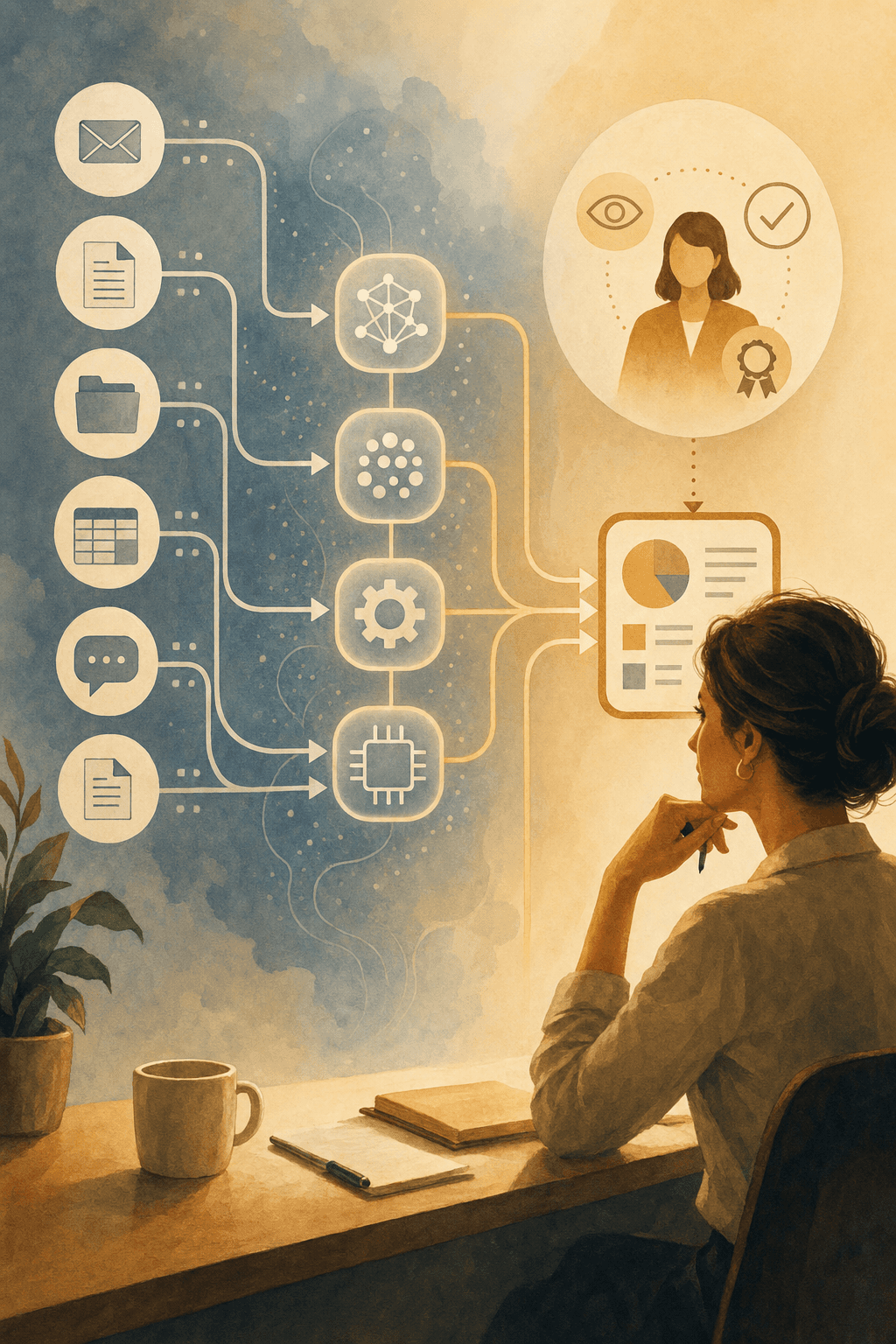
The best automation is not fully autonomous. It is collaborative. That’s the part I care about most. In a healthy system, AI handles the repetitive steps, the formatting, the drafting, the routing, the first pass, the synthesis, the memory retrieval, and all the tedious glue work that burns time. But the workflow still has a human in the loop who is responsible for what comes out the other side.
That human does not need to be a prompt engineer. They do not need to architect the system from scratch. They do not even need to be especially technical. But they do need to understand the output, own the result, and retain the authority to validate, reject, or improve what the system produces. That’s where automation becomes leverage instead of liability.
This is also why the most valuable automation projects rarely begin with software. They begin with observation. You sit with the people doing the work. You look at the handoffs, the dead time, the copy-paste loops, the bottlenecks, the approvals, the repeated explanations, the forgotten follow-ups. Then you ask how the workflow could be redesigned so people spend less time on the mechanics and more time on the judgment, relationships, and creativity that actually move the business forward.
Automation should increase responsibility, not erase it
A lot of founders secretly want automation to remove responsibility. That’s usually the trap. They want fewer decisions, fewer reviews, fewer things to think about. Fair enough. We all want that. But if you automate a workflow that matters, responsibility does not disappear. It just becomes less visible until something breaks publicly.
The better model is to make responsibility explicit. Every meaningful workflow should still have a human owner. Someone is accountable for the newsletter that went out. Someone is accountable for the outreach sequence. Someone is accountable for the CRM updates, the sales notes, the hiring pipeline summaries, the client follow-ups, the content calendar, the support replies. AI can do most of the repetitive motion. But ownership cannot be outsourced.
When you build automation this way, you get the best of both worlds. You move faster without becoming careless. You save time without losing taste. You reduce busywork without lowering the bar. And perhaps most importantly, you avoid becoming a victim of your own automation.
A simple test before you automate anything
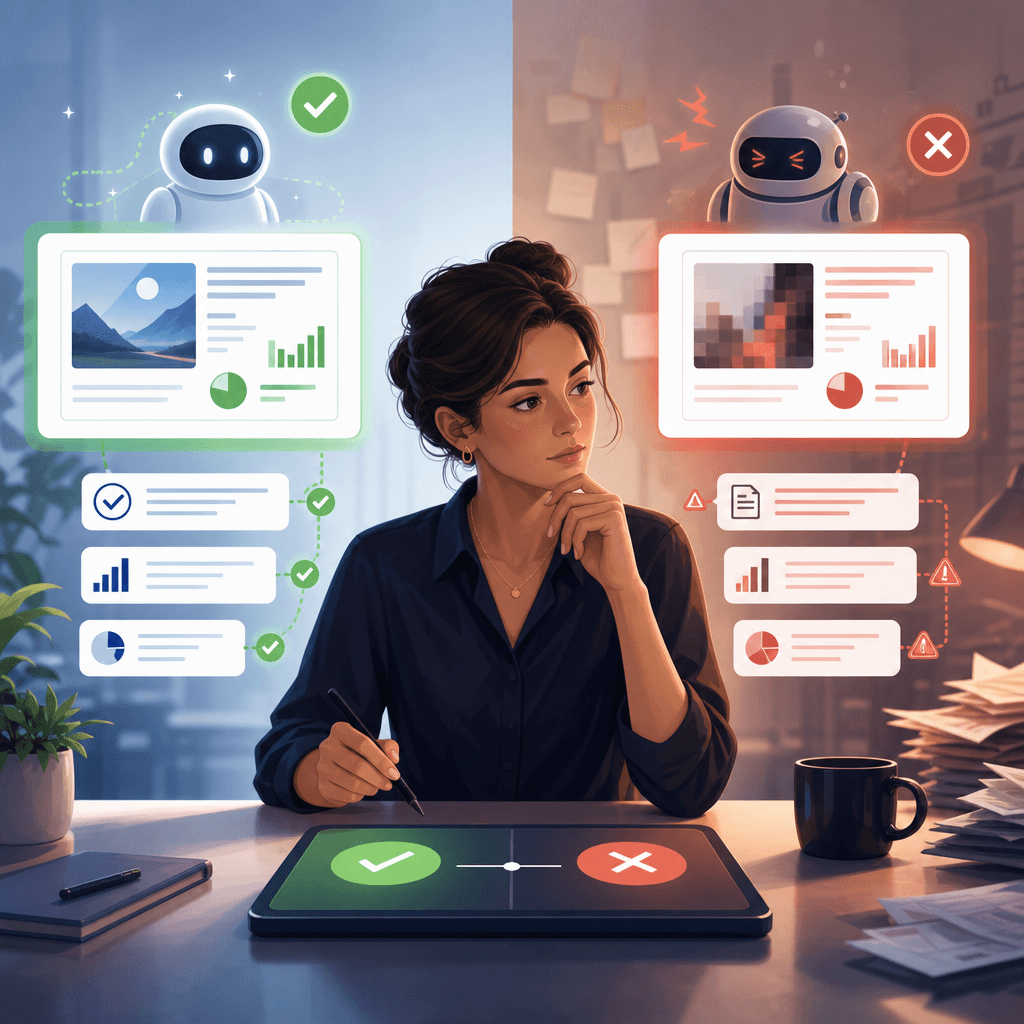
Before automating a workflow, ask four brutally practical questions. First, is this task repetitive enough to benefit from systemization? Second, if the output is wrong, what is the actual cost? Third, who owns the final quality bar? Fourth, does this automation remove low-value effort, or is it removing a useful moment of human judgment?
If you can’t answer those four questions clearly, you probably shouldn’t automate it yet. Or at least not fully. The goal is not to automate the maximum number of actions. The goal is to create a business that runs with more clarity, more consistency, and less wasted human energy.
That’s why I’m so bullish on AI and so skeptical of lazy automation at the same time. The opportunity is massive. But only if we stop thinking about automation as a tool that replaces people and start thinking about it as a design discipline for better human systems.
The future belongs to companies that keep humans in control
The businesses that win with AI won’t be the ones that automate everything. They’ll be the ones that automate deliberately. They’ll know where speed matters, where taste matters, where risk matters, and where a human signature still needs to exist. They’ll use AI to compress the boring parts of work, not to abandon responsibility for the meaningful parts.
That, to me, is the right way to automate your business. Not with reckless delegation to bots. Not with blind trust in generic workflows. But with thoughtful systems where AI does the repetitive work and humans stay accountable for the outcome. That’s how you save time without losing control. And frankly, that’s how you build a company that still feels human when everyone else is busy automating themselves into mediocrity.

Flo is the founder of Mind the Flo, an Agentic Studio specialized into messaging and voice agents.