Content
The Best Tasklet Alternative for Founders Who Execute in Real Time
Tasklet Is Having a Moment. Here's Why Founders Are Still Looking
Tasklet hit $10M ARR in May 2026. It raised $20M from USV and Lightspeed. Its CEO, Andrew Lee, went on the Cognitive Revolution podcast and explained that Tasklet is "one of three kinds of software that survives AI." The product grew 1,200% in Q1. By any measure, Tasklet is a legitimate player.
So why are founders still searching for Tasklet alternatives?
Because "cloud agent OS" and "actually useful in your day" are not the same thing.
What Tasklet Is, Exactly
Tasklet is a browser-based AI agent platform. You describe what you want in plain English, and a single agent figures out which tools to use and executes the task. It connects to apps and APIs, runs file-system context, and handles agentic search. The free tier covers basics; $35/month unlocks computer-use and higher limits.
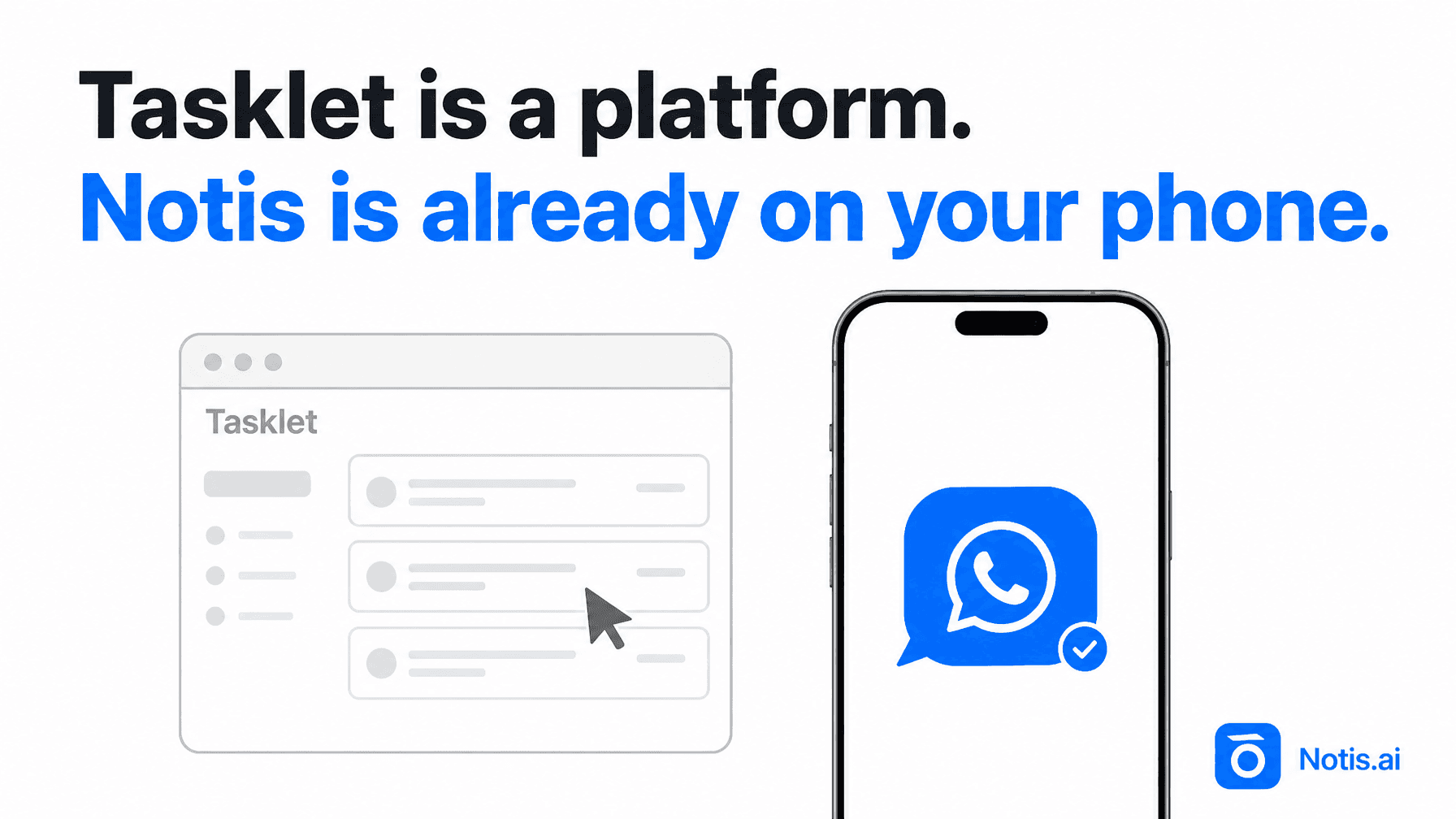
Andrew Lee frames it as a "horizontal platform" — the category of software that organizes everything else. On paper, that sounds compelling. In practice, it means Tasklet is a place you go to. You open a tab. You type a prompt. You wait. It works, you get results, and then you close the tab and go back to your actual work.
That model works well for planned, deliberate tasks. It works less well for the chaotic, real-time execution that defines founder life.
The Activation Cost Problem
Here is the friction Tasklet does not talk about: activation cost.
Activation cost is the gap between the moment a thought appears in your head and the moment your AI assistant acts on it. For Tasklet, that gap involves opening a browser, navigating to the app, constructing a prompt from scratch with zero context about what you were just doing, and submitting it.
If you are an ADHD founder, that gap is where tasks go to die.
The 20-minute context window after a meeting is the most valuable productivity moment in your day. The brief thought you have while waiting for coffee is a genuine idea if captured immediately. The action item from a call that you do not record within 90 seconds is gone.
Tasklet assumes you will remember to go somewhere and do something. That assumption does not hold.

How Notis Solves This Differently
Notis is a messaging-native AI. It lives in WhatsApp, Telegram, iMessage, Slack, and email — the tools you already have open. You do not go to Notis. Notis is already there.
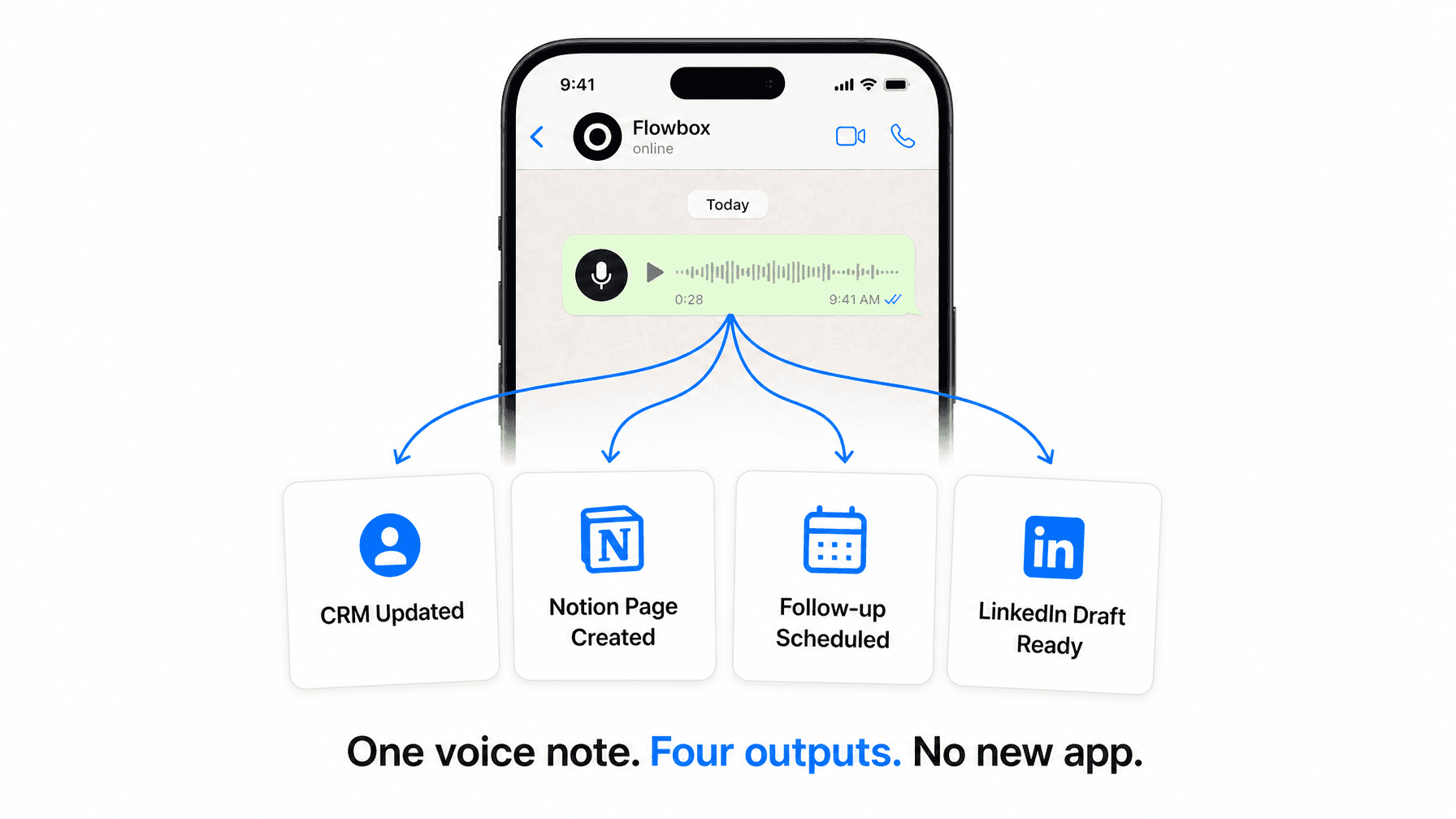
Send a voice note after a call: "Add to CRM, schedule follow-up for Friday, create a Notion page with the key points, and draft a LinkedIn post from the recap." Notis handles all four. You keep walking.
That is not a feature comparison. That is a fundamentally different design philosophy. Notis treats your existing communication channels as the interface. The tool fits your workflow. You do not adapt your workflow to fit the tool.
17,000+ founders are using Notis this way. The most common thing they say: "I stopped thinking about it." That is what tool invisibility actually looks like.
Tasklet vs. Notis: Where They Diverge
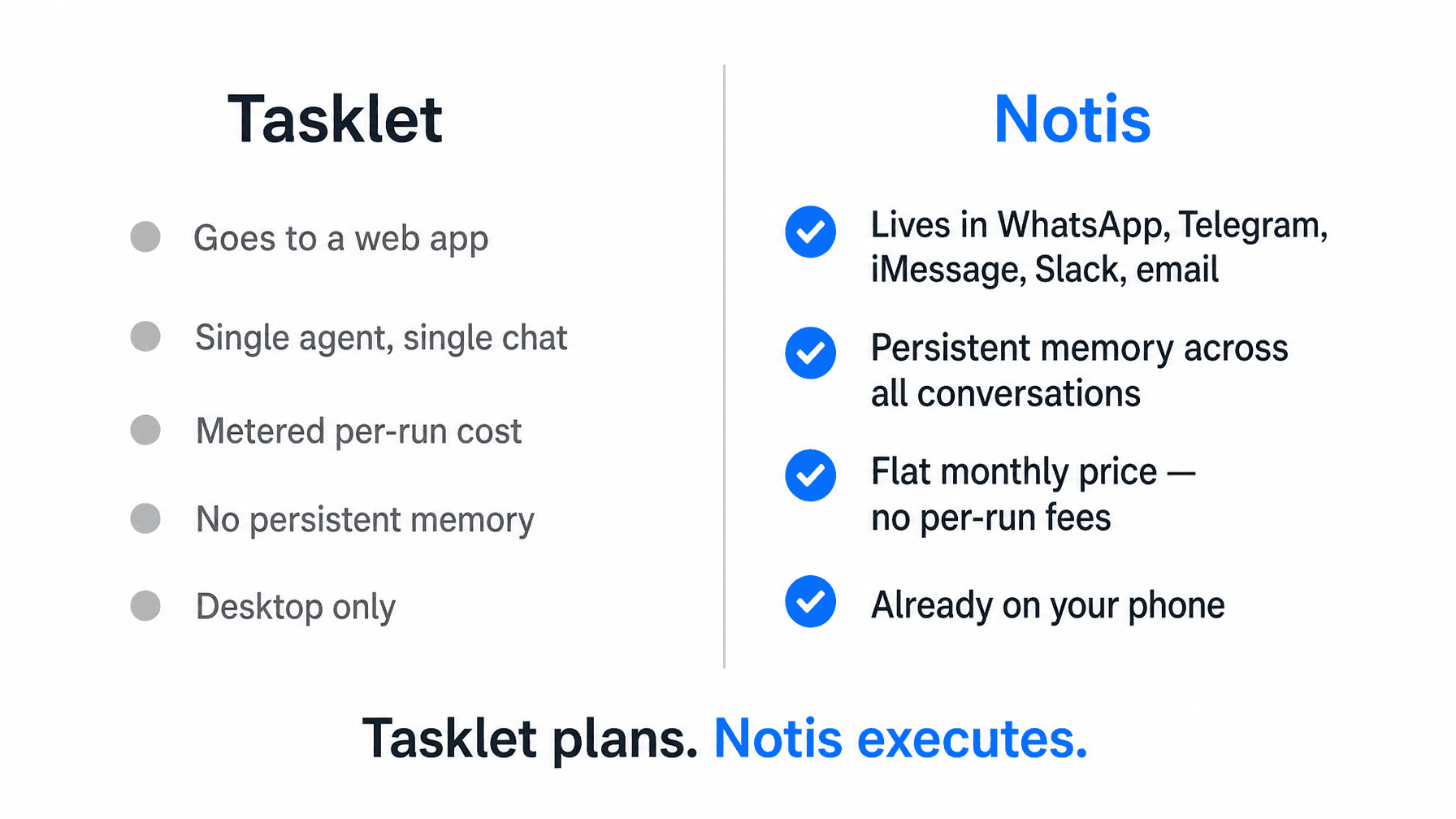
Interface: Tasklet is a web app you visit. Notis lives in your phone.
Execution model: Tasklet uses a single-agent, single-chat session. Each interaction starts fresh. Notis maintains persistent memory across every conversation — it knows your CRM contacts, your Notion structure, your recurring meetings, and your communication style.
Pricing model: Tasklet meters usage per run. Heavier automation hits per-run limits fast. Notis charges a flat monthly rate — $13/month on the Pro plan, $39/month for Pro+, $99/month for Ultra. No per-run fees.
Channels: Tasklet is desktop-only. Notis works on every messaging platform you already use.
Use case fit: Tasklet is genuinely good for deliberate, planned automation — research, dataset analysis, structured multi-step processes. Notis excels at real-time, reactive execution: the kind that happens during your day, not before it.
Who Should Actually Look for a Tasklet Alternative
If you are a solo founder or operator and your work happens across WhatsApp threads, iMessage, email chains, and voice notes — Tasklet is not built for you. It is built for teams who plan ahead and execute in a dedicated interface. That is a different product for a different problem.
The founders who switch to Notis are typically not unhappy with Tasklet's execution quality. They are unhappy with the activation cost. They want an assistant that is one message away, not three tabs away.
They also want memory. Tasklet does not retain context between sessions. Every prompt starts from zero. For a tool that is supposed to handle your business operations, starting from zero every time is a significant friction point.
The Honest Comparison
Tasklet is a strong product. The $20M raise and 1,200% Q1 growth are not accidents. If you need a configurable cloud agent OS that handles structured, enterprise-style workflows from a web interface, Tasklet is worth your time.
But if you are building a company from your phone, managing chaos in real time, and want an AI that shows up where you already are — Tasklet is a platform you have to maintain. Notis is an intern you already hired.
The difference is not features. It is where your attention goes when things get busy. When you are running late to a call, you send a voice note. You do not open a browser and compose a prompt.
Notis was built for that moment.
Try Notis for Free
If you have been looking for a Tasklet alternative because Tasklet requires too much intention to use, try Notis at notis.ai. Setup takes 30 seconds. No server, no configuration, no new app to learn. Your first AI intern is one WhatsApp message away.

Flo is the founder of Mind the Flo, an Agentic Studio specialized into messaging and voice agents.