Content
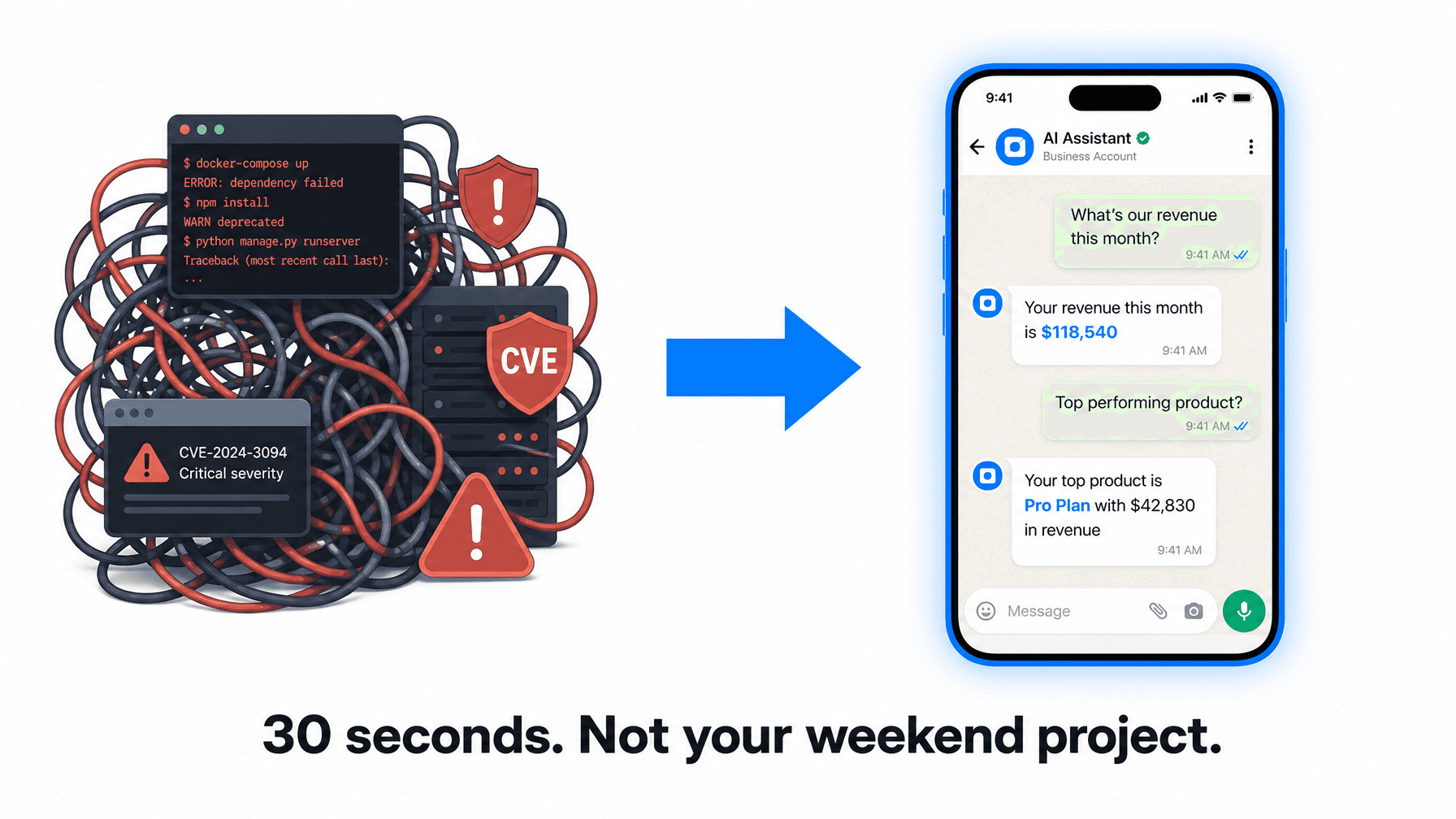
The Best OpenClaw Alternative for Founders in 2026 (30 Seconds. Not Your Weekend.)
TLDR
OpenClaw is impressive engineering. It is also a self-hosted project with 2,000+ documented CVEs, a 15-minute setup tutorial, and a server requirement. If you are a founder who wants an AI agent that handles your CRM, your Notion, your calendar, and your follow-ups — all from a WhatsApp voice note — there is a simpler path. Notis (notis.ai) connects to your messaging apps in 30 seconds and does the work without touching your hardware.
Why Founders Are Searching for an OpenClaw Alternative
OpenClaw arrived in late 2025 and broke every GitHub growth record. An Austrian software engineer released an autonomous agent that could text it a task and watch it get done: email management, meeting scheduling, web browsing, multi-step automations. Within 48 hours, it had 100,000 stars. Within weeks, it had changed the conversation about what a personal AI could be.
The problem is the fine print.
OpenClaw runs on your own server. That means you need a machine capable of running it, a safe setup, ongoing maintenance, and enough DevOps intuition to manage credentials and API keys on hardware you control. For developers who live in terminals, that is fine. For founders running a business in between Slack messages and investor calls, it is a weekend project that never ends.
The search for an OpenClaw alternative is not a rejection of what OpenClaw does. It is the reasonable question: does the outcome — an AI that handles tasks from your phone — really require all of that infrastructure?
The Setup Reality
OpenClaw's most popular tutorial runs 15 minutes. That is the optimistic version, with a clean machine and no configuration issues.
In practice, founders report:
Installing Docker or Python environments they have never touched before
Managing API key storage in local config files
Debugging webhook connections to WhatsApp or Telegram
Updating the agent stack when new CVEs drop
As of mid-2026, OpenClaw has accumulated over 2,000 CVEs, including 7 rated critical. Cisco's security team has publicly described it as "a security nightmare" — not because the underlying concept is flawed, but because running an autonomous agent with broad system access on your own hardware creates an attack surface that grows every week the project adds features.
Self-hosting is a trade-off, not a moral stance. The trade-off is: maximum control and flexibility, in exchange for the responsibility of operating it securely. For the ADHD founder who already has 14 browser tabs and a voice note backlog, that trade-off is rarely worth it.
What Founders Need From an AI Agent
Strip away the architecture debates and the question is simple: does it help you get things done without adding complexity to your day?
The AI agents that stick for founders share a few traits. They live where the founder already works — usually a messaging app. They handle real business tasks, not just reminders or web searches. They have memory, so you are not re-explaining context every session. And they take action across the tools the business already runs on: Notion, Gmail, calendars, CRMs.
The friction cost of a tool is as real as the price tag. An AI agent that requires infrastructure to run, credentials to manage, and weekend patches to maintain adds to cognitive load rather than reducing it.
Notis: The OpenClaw Alternative Built for Founders
Notis is a messaging-native AI agent that lives in WhatsApp, Telegram, Slack, iMessage, and email. You send it a message. It does the work. That is the entire interface.
Setup is 30 seconds. No server. No Docker. No config files. You connect your messaging app, grant integrations, and your AI intern is active. The same task OpenClaw handles after a 15-minute setup, Notis handles after one WhatsApp message.
The capabilities are not a watered-down version of what OpenClaw offers to developers. Notis connects to 1,000+ integrations, handles real business tasks — CRM updates, Notion entries, calendar blocks, blog drafts, investor updates — and carries long-term memory with source ingestion from Notion, Gmail, your website, and Google Drive. 17,000+ founders already use it daily.
Because Notis is hosted, none of your credentials sit on a machine you operate. There is no local exploit surface, no CVE patch cycle to manage, and no server that goes offline when you close your laptop. The security model is the opposite of OpenClaw by design.
OpenClaw vs Notis: A Direct Comparison
Setup time: OpenClaw 15+ min (server required) vs Notis 30 seconds | CVE exposure: OpenClaw 2,000+ documented vs Notis none | WhatsApp support: OpenClaw via webhook config vs Notis native | iMessage: OpenClaw plugin setup vs Notis native | Memory: OpenClaw local storage vs Notis cloud + Notion/Gmail/Drive | Integrations: OpenClaw plugin ecosystem vs Notis 1,000+ verified | Maintenance: OpenClaw ongoing patches vs Notis zero | Pricing: OpenClaw free (pay in time + server) vs Notis from $13/mo
The pricing comparison deserves a note. OpenClaw is open-source, but "free" means you pay in time, server costs, and the overhead of managing it. Notis at $13/month is the cost of one hour of your time — likely less than a single OpenClaw debugging session.
Who Should Still Consider OpenClaw
OpenClaw is the right choice if you are a developer who wants to build custom agent logic, run local models to avoid sending data to external APIs, or contribute to an open-source ecosystem. The project is genuinely impressive and the community around it is active.
It is not the right choice if your primary goal is getting business tasks done without thinking about the infrastructure doing them.
The Verdict
If you found this article searching for an OpenClaw alternative because you want an AI that handles real work from your phone — not a project that requires you to become a part-time infrastructure engineer — Notis is the straightforward answer.
30 seconds. Not your weekend project.

Flo is the founder of Mind the Flo, an Agentic Studio specialized into messaging and voice agents.