Content

The Best AI Assistant for ADHD Founders Is the One You Don’t Have to Open
Most AI assistant demos are designed for the kind of person who already has their life in neat little boxes. Open the dashboard. Configure the workflow. Check the queue. Review the agent run. Congratulations, you now have another productivity system to maintain. For an ADHD founder, an AuDHD operator, or an autistic builder already spending half the day wrestling context, that is not help. That is a very pretty new tab with a monthly subscription.
The best AI assistant for ADHD founders is not the one with the biggest feature grid. It is the one you do not have to open.
That is the positioning shift we are leaning into with Notis: less app, more execution. The assistant should live where the thought already appears, whether that is WhatsApp, Slack, Telegram, email, a voice note, or the downloadable Notis app when you actually want a control plane. If your brain is already fighting task initiation, time blindness, and “wait, why did I open this tab again?”, the interface is not a detail. The interface is the product.
Why another app is the wrong default
Adult ADHD is not just “being distractible.” The CDC’s adult ADHD overview describes real difficulty with organization, completing tasks, and managing attention. The NIMH’s adult ADHD guide talks about planning, prioritizing, and self-control problems that can follow people into work and relationships. In founder terms, this is the difference between having a brilliant idea during a walk and actually sending the follow-up, filing the bug, updating the CRM, and remembering the person you promised to email.
Autistic and AuDHD people can have their own version of this friction. Research on executive function in autistic adults shows that cognition and behavior do not always line up cleanly with what the outside world expects. NICE’s guidance on autism in adults is very careful about individualized support for a reason. Different nervous systems do not need another generic productivity ritual. They need lower-friction systems that respect how energy, context, sensory load, and attention actually behave.
This is where most AI assistant products accidentally recreate the problem they claim to solve. They say, “Let us save you time,” then ask you to move your work into a new interface. They say, “We remember everything,” then require you to remember to check them. They say, “Just automate it,” as if the hardest part was the automation and not the moment when your brain refuses to cross the tiny, stupid bridge between intention and action.
The ADHD founder search intent is not “give me a dashboard”
If someone searches for the best AI assistant for ADHD, the obvious intent is tool discovery. But underneath that search is a more honest question: what can I use when my brain is fast, inconsistent, allergic to admin, and very good at losing important thoughts at exactly the worst moment?
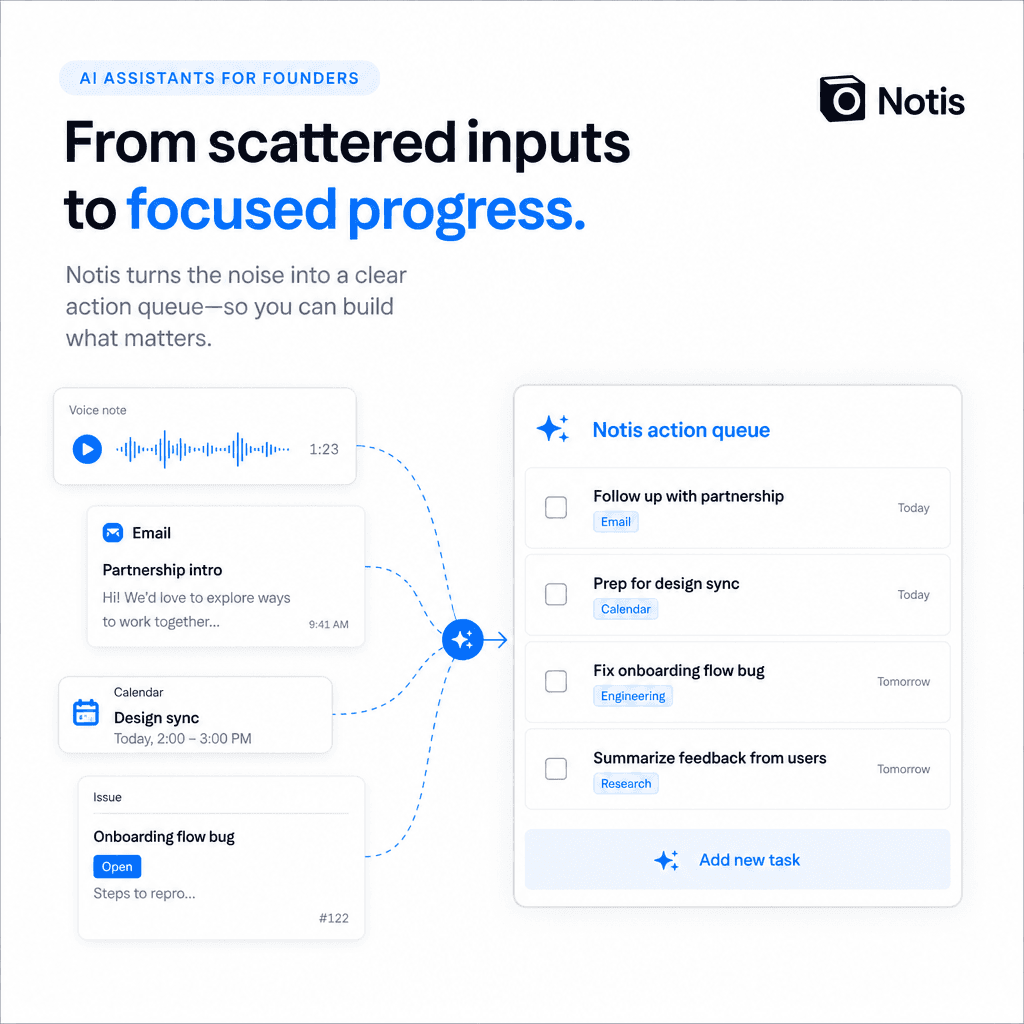
That person does not need a motivational calendar skin. They need a way to externalize memory before it evaporates. They need delegation that starts from a sentence, a messy voice note, a forwarded email, or a screenshot. They need the assistant to know enough context to do the next step, not just summarize the thing. And they need the system to be forgiving when the input is chaotic because, sorry, the input will be chaotic. That is the job.
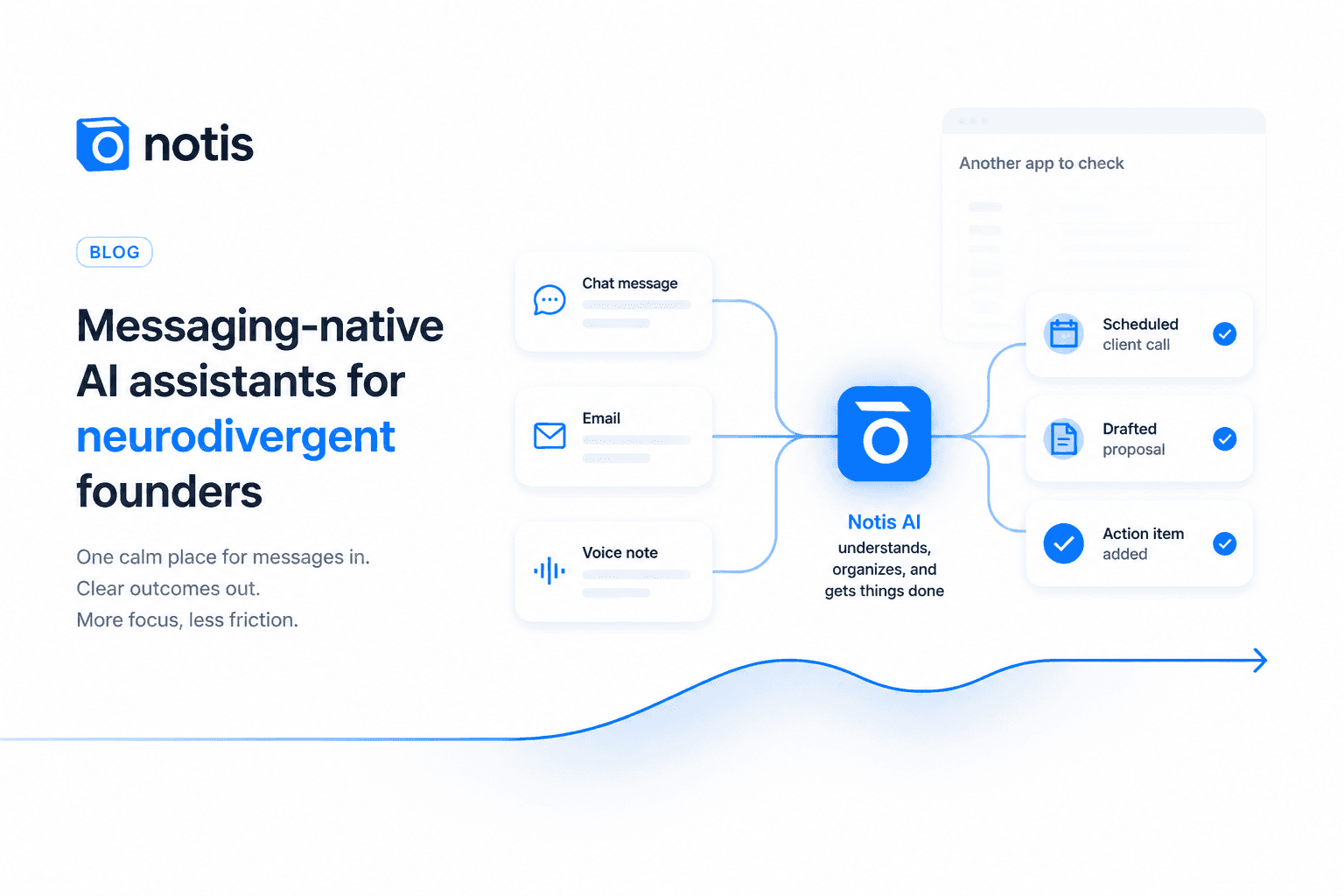
This is why messaging-native matters. Not because WhatsApp is trendy. Not because Slack is cute. Because messaging is the lowest-friction capture surface humans already use. Notis works across channels like WhatsApp, Telegram, Slack, and email, and the desktop and web app becomes the downloadable Notis app: a home base when you want it, not another cage where every thought must report for duty.
For neurodivergent founders, that distinction is massive. A dedicated app can be useful when you are in review mode. It is terrible as the only entry point for capture mode. The capture surface should be wherever the thought arrives. The review surface can be calmer, more structured, and optional.
The product principle: capture anywhere, execute somewhere, report back everywhere
The old productivity flow was capture, organize, review, execute. It looks sensible on a whiteboard. It collapses beautifully in real life because it quietly assumes you have a spare executive assistant living in your prefrontal cortex.
The Notis flow should be simpler: capture anywhere, delegate the next step, let the agent do the annoying middle, and report back in the channel where you started. That is where skills, automations, integrations, and memory become more than feature words. Skills define how Notis should work for you. Automations define when it should run. Integrations let it touch the systems where the work lives. The magic is not that each feature exists. The magic is that the founder does not have to consciously assemble them every time their brain produces a half-formed task at 11:47 PM.
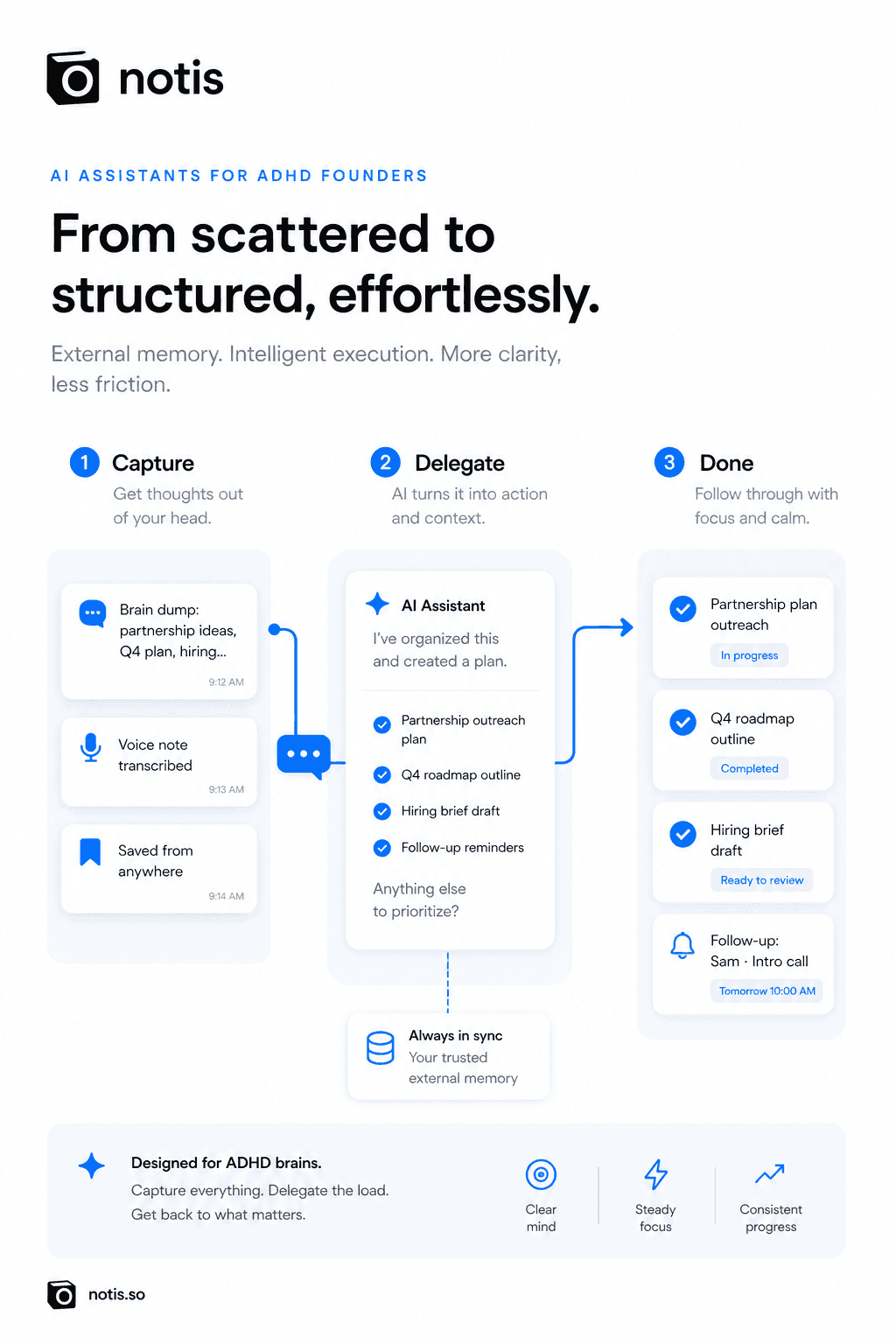
This also explains why the upcoming Notis roadmap matters. Computer use and agent sync are not just shiny agent features. They are part of the shift from “AI as chat window” to “AI as execution layer.” Notis apps push that further by letting workflows become packaged, repeatable systems. For an ADHD or AuDHD founder, that means fewer fragile personal rituals and more reusable external structure. Less “I need to remember my process.” More “the process is there when my brain is not.”
Autism, ADHD, and the risk of lazy positioning
There is a bad version of this article. It says “ADHD people are distracted, so use our app.” Kill it with fire.
Neurodivergent positioning has to be more precise and more respectful than that. ADHD, autism, and AuDHD are not marketing costumes. They are lived realities with wildly different profiles. Some people need stimulation. Some need predictability. Some need less sensory noise. Some need external accountability. Some need fewer transitions. Many need all of those depending on the week, the sleep, the medication, the deadline, and whether their calendar has committed crimes against humanity.
So the Notis angle should not be “we fix neurodivergence.” Gross. The Notis angle is that a messaging-native AI assistant can reduce specific kinds of executive friction: capturing thoughts before they disappear, turning fuzzy input into concrete next actions, remembering context across tools, and reducing the number of interfaces a founder must babysit.
That is useful for everyone. It is especially useful for the people who feel every extra click as a tax.
What to look for in an AI assistant if your brain hates admin
Start with the capture surface. If the assistant only works after you open its app, it is already asking too much for high-friction moments. Then look at execution depth. A note-taking assistant is fine, but a founder often needs the next step done: send the email, draft the brief, file the task, check the calendar, summarize the thread, prepare the meeting, remember the preference.
Then look at memory and control. The assistant should be customizable without forcing you into a no-code maze. It should support repeatable workflows without requiring a Sunday-night productivity ceremony. It should be able to operate through messaging when you are moving fast and through a desktop app when you want to review calmly. That combination is the sweet spot: low friction at capture, high structure at review.
The next Notis website should say this plainly
The website work ahead is not just header and footer polish. It is a positioning decision. The desktop app should be framed as the downloadable Notis app, not as the whole product. The channel landing pages should prove the deeper truth: Notis is useful because it shows up in the places founders already communicate, then turns those messages into done work.
Dedicated ADHD, AuDHD, and autism landing pages are worth testing because the problem is real and the fit is sharp. But the pages must be practical, not performative. They should speak to founder workflows: the bug captured mid-walk, the partnership follow-up sent from a voice note, the calendar prep created before a call, the scattered idea turned into a draft without forcing the founder through yet another app funnel.
That is the product promise I can defend: Notis is not trying to become the fanciest place to manage your productivity. It is trying to become the assistant you can interrupt with messy human input and trust to move the work forward.
The takeaway
If you are a neurodivergent founder choosing an AI assistant in 2026, do not start with the feature list. Start with the moment you are most likely to drop the ball. Is it when an idea arrives while walking? When an email needs a follow-up? When a meeting requires prep? When a message should become a task but your brain refuses to open the task app?
The best assistant is the one that meets you there. Not after you become organized. Not after you build the perfect workflow. There.
For Notis, that means going deeper on messaging-native execution, neurodivergent-friendly defaults, and a downloadable app that supports the system without becoming the system. Less dashboard worship. More finished work. Honestly, that is the only kind of AI assistant I want to use.

Flo is the founder of Mind the Flo, an Agentic Studio specialized into messaging and voice agents.