Content

The Best AI App Builders for Operators Who Want Output, Not More Tabs
Most “AI app builder” posts are written like every founder has the same problem: make a screen, connect a database, deploy a thing, celebrate. Cute. But operators do not wake up wanting one more app. They wake up needing fewer broken handoffs, fewer tabs, fewer tiny admin jobs, and fewer places where work quietly dies.
So the right question is not “which AI app builder makes the prettiest demo?” The right question is: which tool gets you from idea to working business system with the least human glue?
Short answer: there are three different markets hiding under one keyword
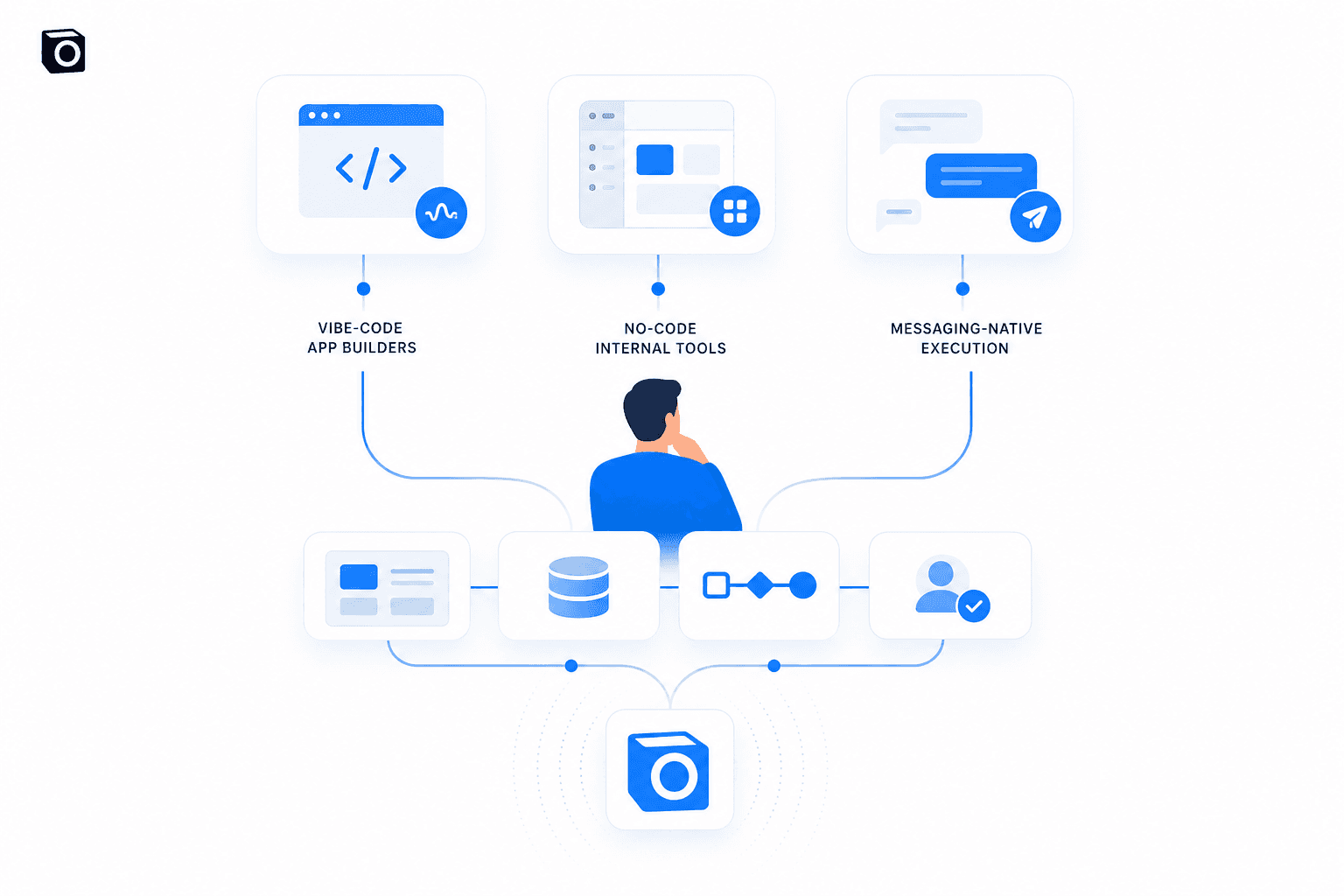
After looking at the current crop of AI app builders, I’d split the category into three buckets. First, vibe-code builders like Lovable, Bolt, Replit Agent, Cursor, and v0 that turn prompts into editable software. Second, no-code and internal-tool builders like Base44, Bubble, FlutterFlow, Softr, Glide, Airtable Interfaces, and Retool that help non-engineers assemble useful business apps. Third, workflow layers like Zapier, Make, and Notis that care less about the screen and more about getting the work done.
That distinction matters for SEO, but it matters more for sanity. If you are a founder trying to create a customer portal, Lovable or Bolt may be fantastic. If you need an internal CRM or vendor dashboard, Softr or Retool may be the boring correct answer. If your real bottleneck is “I have 19 tools and no reliable execution layer,” another generated app will not save you.
The operator test I use
For this list, I’m not rewarding tools for producing a nice onboarding screen. I’m looking at five operator questions: can it ship a usable first version quickly, can it handle real data and authentication, can it connect to the stack you already run, can a non-specialist maintain it after the demo high wears off, and does it reduce coordination work instead of creating another place to check?
That last one is where many app builders quietly fail. They help you create the interface, but the operator still becomes the API between the app, inbox, CRM, Notion, calendar, Slack, support conversations, payment tools, and the actual humans involved. This is why I’m biased toward systems that connect UI, data, automation, and delegation instead of worshipping the app as the final artifact.
The best AI app builders for operators in 2026
Tool | Best for | What it does well | Watch-out | Operator verdict |
|---|---|---|---|---|
Lovable | Founder MVPs and full-stack web apps | Fast prompt-to-app flow, Supabase support, GitHub sync | Still needs product judgment, QA, and security review | Best pure app-builder pick for non-technical founders who want speed |
Bolt | Fast web prototypes and JS/TS apps | Browser-based build, deploy, hosting, databases, and domains | Great for momentum, less ideal if nobody owns the code | Excellent for technical operators who want a quick working web app |
Replit Agent | AI IDE plus deployment | Builds, debugs, stores secrets, and deploys in one cloud workspace | The workflow is still developer-environment shaped | Best if you want an AI coding workspace, not a no-code toy |
Cursor / v0 | Engineering-led product teams | Superb code and UI generation inside a real dev workflow | Not really operator-first unless engineering is involved | Use when quality code matters more than no-code convenience |
Base44 / Bubble / FlutterFlow | No-code apps, web apps, mobile apps | Visual app building with faster AI-assisted starts | Platform constraints and maintenance tradeoffs matter | Good when the app itself is the product or workflow surface |
Softr / Glide / Retool | Internal tools, portals, dashboards | Turns structured data into usable team interfaces | Less magical, but often more operationally useful | Best for boring-but-profitable internal systems |
Zapier / Make | Workflow automation around apps | Huge connector ecosystems and AI workflow mapping | Automation sprawl becomes its own job | Use when the workflow matters more than the interface |
Notis | Messaging-native execution for founders | Turns requests into actions across tools, memory, docs, databases, automations, and channels | Not trying to replace every visual app builder | Best when you want output from your operating system, not another tab |
My honest picks by founder type
If you are a solo founder validating a SaaS idea and you can tolerate rough edges, start with Lovable. It has the strongest “describe the product, get a real app shape” feel, especially when the use case is a web app with authentication, database logic, and a product-ish interface.
If you are technical or technical-adjacent, Bolt and Replit are more comfortable because they do not hide the fact that software is still software. Bolt is great for momentum in a browser. Replit is better when you want the build, debug, deploy loop in one AI-assisted environment. Cursor and v0 belong in the same conversation, but they are really for teams that already accept code as the operating layer.
If you are building internal tools, I would not over-romanticize vibe coding. Softr, Glide, Airtable Interfaces, and Retool exist because many operational apps are basically permissions, tables, forms, approvals, dashboards, and a few workflows wearing a trench coat. That may sound less sexy than prompt-to-product, but boring tools often survive contact with a team better than a beautiful prototype nobody maintains.
If your problem is automation across existing apps, Zapier and Make still matter. Zapier Canvas is especially interesting because it admits what operators actually need: not one isolated app, but a map of how Zaps, Tables, Interfaces, Chatbots, and Agents fit together. The danger is that you can end up with a beautiful spaghetti diagram that only one person understands.
Where Notis fits, without pretending it is Lovable
Notis is not trying to win the “who can generate the prettiest CRUD app from one prompt” contest. Lovable, Bolt, and Replit are better answers if the only job is to create an app canvas from scratch. Notis becomes interesting one layer later, when the founder asks: who is actually going to run this thing?
The Notis bet is that operators do not need more surfaces as much as they need a delegation layer. You ask from WhatsApp, Telegram, Slack, email, iMessage, or the desktop app. Notis can research, write, update docs, create database entries, trigger automations, remember context, and coordinate with connected tools. In that world, an app is not the destination. It is one artifact inside a larger operating system.
That matters because the real enemy is not “lack of apps.” Founders already have too many apps. The enemy is fractured execution. A customer call becomes a note in one place, a task in another, a follow-up in Gmail, a product idea in Notion, and a half-forgotten Slack message. If your AI app builder creates yet another place to check, it may make the problem worse.
The SEO opportunity I’d write for
Search data for Notis already shows traction around practical automation intent: queries like “notion automation,” “notion workflow automation,” “notion ai automation,” “notion webhook automation,” and “notion ai agents pricing” are getting impressions, often with weak click-through. That tells me the opportunity is not another generic “best AI tools” list. It is a more specific article for founders comparing app builders, internal-tool builders, and automation layers because they want an operating system that actually produces work.
So the target keyword is “best AI app builders,” but the angle is sharper: best AI app builders for operators. That lets Notis enter the conversation honestly. We are not claiming to replace every builder. We are saying the app is only half the job, and the execution layer around the app is where operators win or lose.
Final take
If I had to choose today, I’d use Lovable for a founder MVP, Bolt or Replit for a technical prototype, Softr or Retool for an internal tool, Zapier or Make for connector-heavy automation, and Notis when the real problem is coordinating work across the whole business without living in more tabs.
That is the uncomfortable truth behind the AI app builder boom. Generating software is becoming cheaper every month. Operating the business is still expensive. The winners in 2026 will not be the tools that make the flashiest demo. They will be the ones that help founders turn messy intent into shipped, maintained, connected output.

Flo is the founder of Mind the Flo, an Agentic Studio specialized into messaging and voice agents.