Content
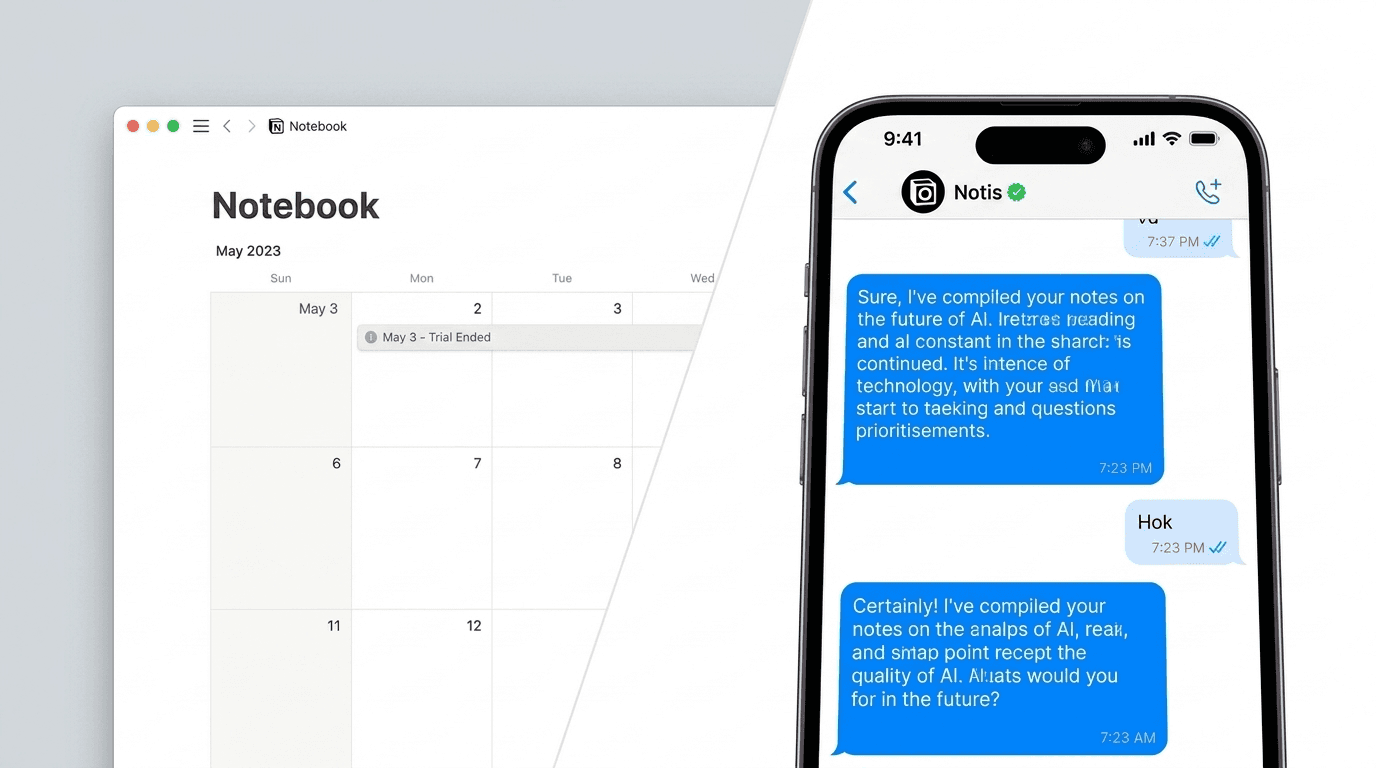
Notion's AI Agent Was Free. Here's What Founders Do Next.
The trial is over. The decision starts now.
On May 3, Notion's Custom Agents stopped being free. If you spent the last few weeks testing Notion's AI agent setup, you now face a real decision: pay for a credit system that wasn't part of the base subscription, or take a hard look at what the rest of your founder stack is actually built for.
This isn't about Notion being a bad product. It isn't. If your team runs deep in Notion, it will keep running deep in it. But the moment a trial expires is a useful forcing function: now that the pricing is real, does this tool solve the problem you actually have?
What Notion Agents actually do — and where they stop
Notion's Custom Agents are genuinely impressive inside the Notion ecosystem. They enrich databases automatically, run skills you define, schedule meetings using your calendar, and trigger automations from your task boards. The Claude Opus 4.7 integration made multi-step reliability noticeably better.
The constraint is structural, not a bug. Notion Agents live in Notion. They operate on Notion databases, Notion tasks, and Notion workflows. When something happens outside Notion — a WhatsApp voice note from a potential partner, a Slack message that needs a CRM update, an email thread that should become a task — the Notion Agent isn't in that conversation. You are.
That gap is where most solo founders spend the majority of their working day.
The credit model and why founders are reacting
When Notion users started seeing the real credit cost of Custom Agents — and discovered credits aren't included in the base Business subscription — the reaction online was predictable. The tool works. The pricing model creates friction that wasn't visible during the free trial.
This pattern repeats across enterprise-adjacent products. The demo is smooth, the trial is free, the real cost surfaces later. That's not deceptive — it's how enterprise pricing matures over time. But founders are not enterprise procurement teams. They need to know exactly what they're paying, exactly what they get, and whether it works from minute one without a setup session.
The case for messaging-native AI
Notis lives in WhatsApp, Telegram, Slack, iMessage, and email. It is not a new app. There's no dashboard to check in on, no tab to keep open, no agent workflow to configure before your first task runs.
You send a message. The work happens. The result lands back in whatever tool you're using — Notion, your CRM, your calendar, a draft in your email. Notis is in the conversation, not waiting at the end of one.
Here's what that looks like in practice. You finish a client call and send a WhatsApp voice note: "Follow-up — send the proposal by Friday, add them to the CRM as warm lead, drop a note in Notion under Q2 pipeline." That single message triggers three separate actions across three tools. No context-switching, no tab-opening, no workflow configuration.
17,000 founders are using this pattern. Not because it's novel — because it removes the moment where you have to stop what you're doing and go find your AI.
Pricing that stays clear
Notis Pro starts at $13/month on the annual plan. Pro+ is $39/month. Ultra is $99/month. That's the full price. No credit system. No task that costs more because it touched a third-party API. No separate line item that wasn't visible on the pricing page during signup.
The tools that earn long-term founder trust in 2026 are the ones whose economics are stable from the start. "Free until [date]" is a valid go-to-market approach — but the founders reading this have seen that movie before. Clarity wins.
If you run deep on Notion — this is the complement play
Notis and Notion are not mutually exclusive. The Notis Second Brain System was built specifically for founders who live in Notion. Voice notes, tasks, research, and CRM updates flow from a WhatsApp message into structured Notion databases automatically.
If you're a heavy Notion user, the real question isn't "Notion Agent or Notis." It's "what layer of AI do you want above your Notion setup." Notion Agents handle what's already inside Notion. Notis handles what's everywhere else. The two together are a clean, non-redundant stack.
What to do now if the trial didn't click
If Notion's Custom Agents trial ended and you're not sure the credit spend makes sense: try Notis. Setup is 30 seconds. Connect WhatsApp or Telegram, link your Notion workspace if you use it, and send your first task. Most founders have a result within two minutes of signup.
No trial clock. 800+ integrations. A clear monthly price. And it's already in the app you opened 40 times today.

Flo is the founder of Mind the Flo, an Agentic Studio specialized into messaging and voice agents.