Content
How We Killed Weekly Standup Meetings (And Saved 10 Hours Per Week)
If your weekly standup still requires ten people to stop what they’re doing, join a call, wait for their turn, and repeat the same ritual every Monday, you don’t have a standup. You have a tax.
Last week we built a workflow for a fully remote team of ten that had exactly this problem. The founder had almost no visibility on what people were doing. The team had plenty of context individually, but the operating system of the company was broken: updates were trapped inside people’s heads unless everyone synchronized at the same time.
So we killed the meeting.
Not the accountability. Not the visibility. Not the rhythm. Just the part that wastes time.
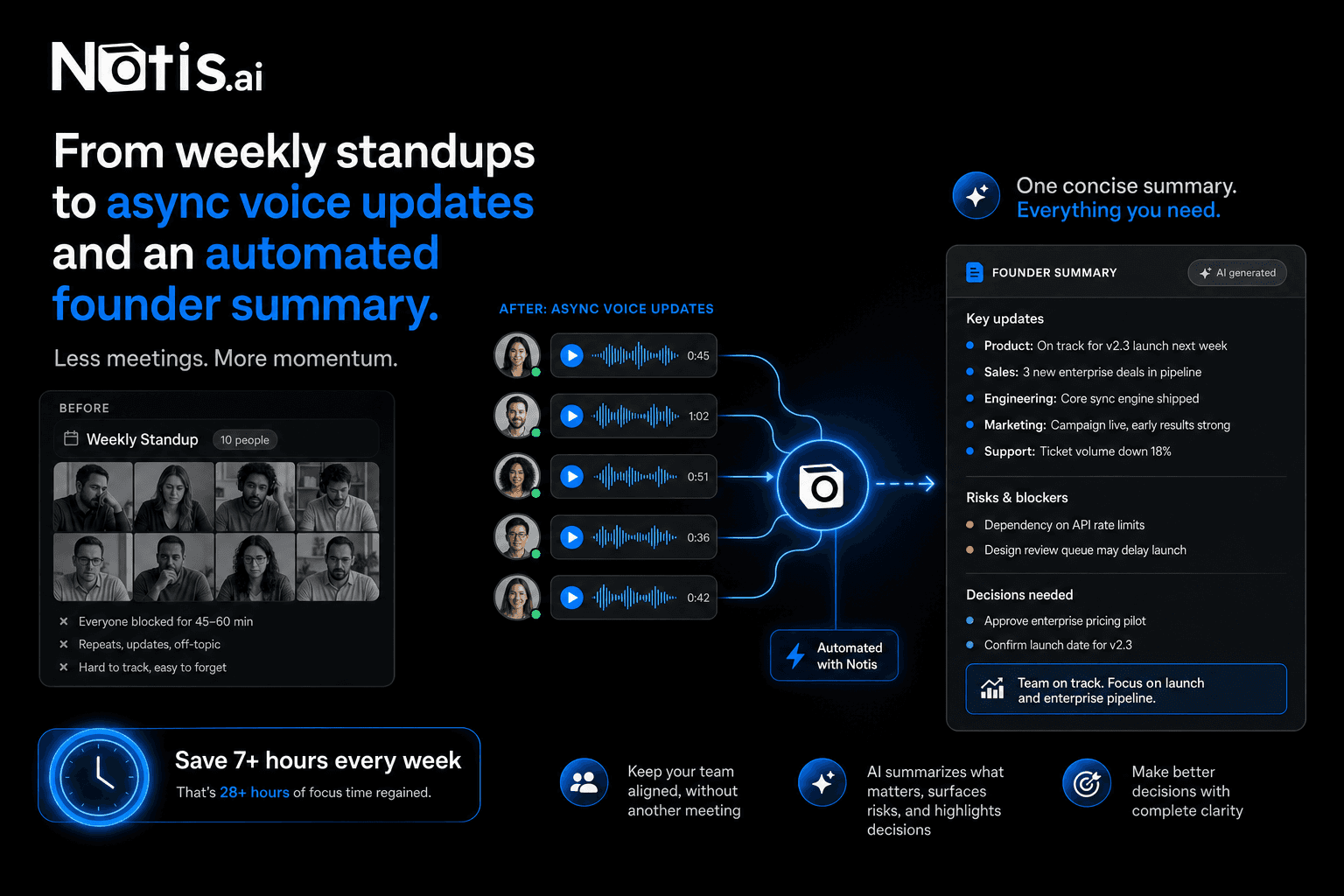
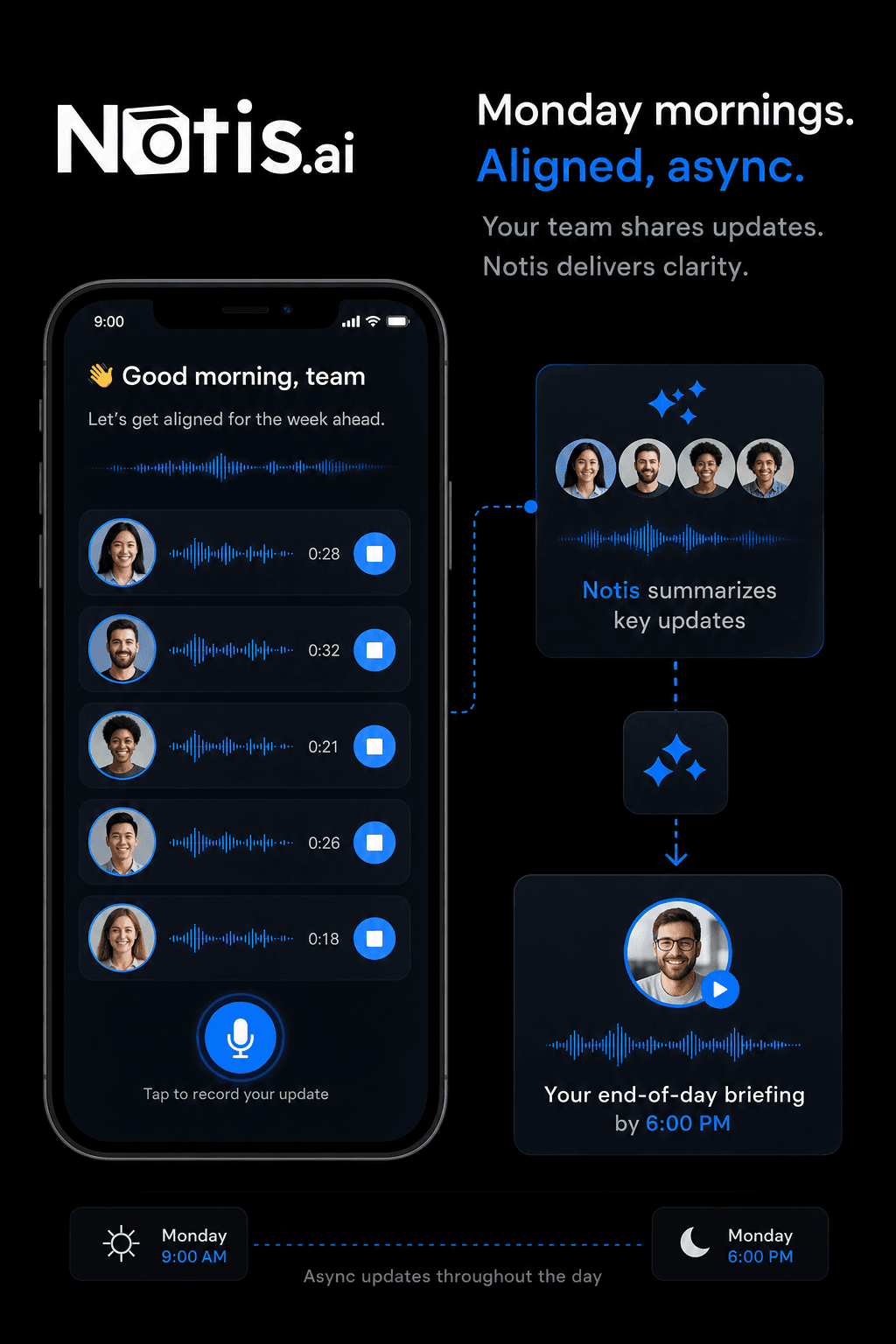
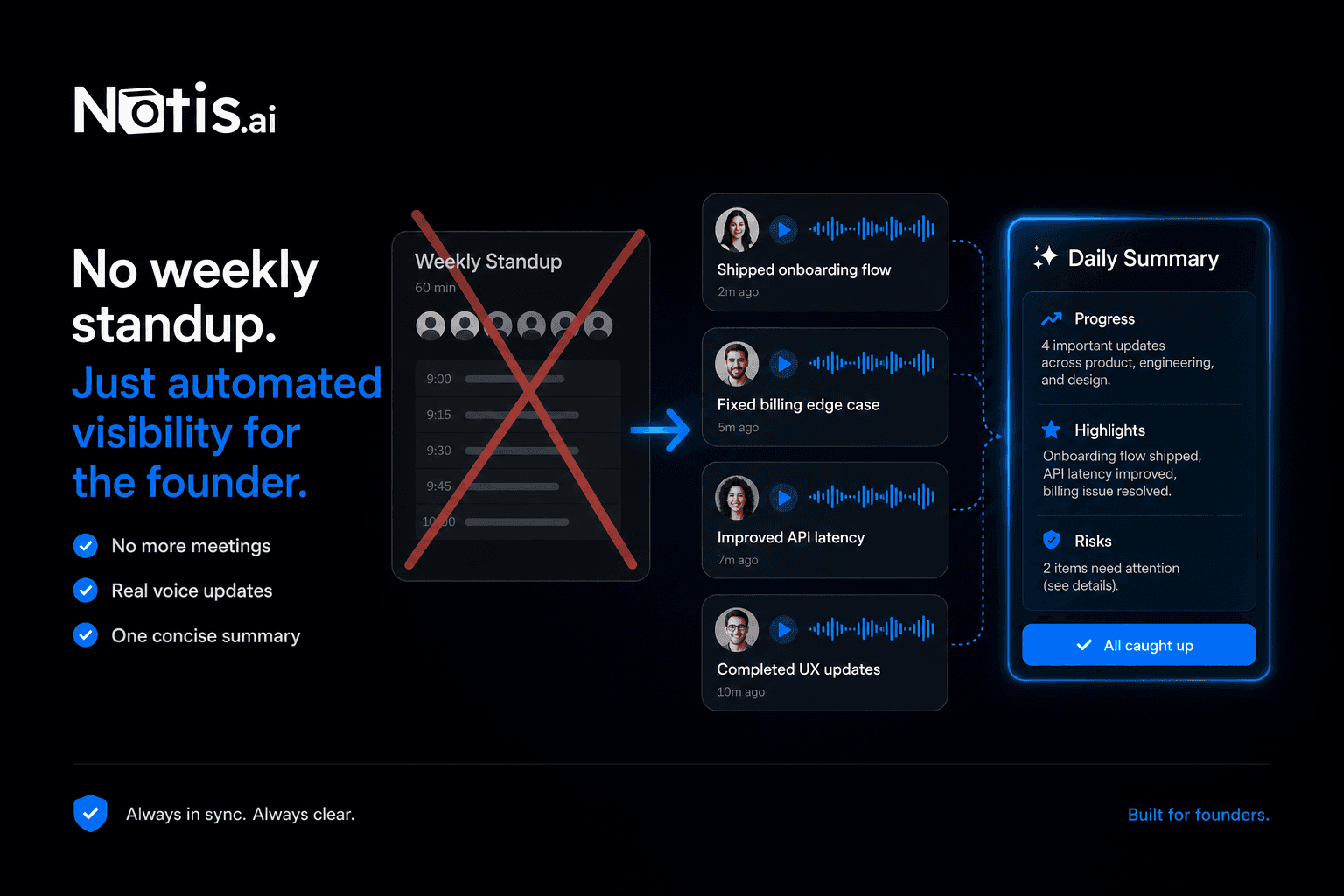
Instead, we replaced the recurring standup with a simple async workflow: every Monday at 9:00 AM, each team member gets a reminder to send a voice update. At the end of the day, the founder gets one synthesized voice summary of what happened across the team, what people are focused on, and where momentum is building or stalling.
That’s it. No calendar Tetris. No fake urgency. No ten-person meeting that should have been a process.
Why weekly standups break as soon as teams go remote
Weekly standups are supposed to create alignment. In practice, most of them create interruption.
In a remote team, especially one spread across different schedules, the standup becomes less about clarity and more about coordination overhead. Everyone has to be available at the same moment. Everyone has to package their work into a live performance. And the founder or manager still has to translate ten fragmented updates into one coherent picture of what’s actually going on.
That’s the real problem. Meetings don’t magically create visibility. They just create a moment where information is spoken out loud. Someone still has to structure it, interpret it, and turn it into insight.
Once you understand that, the obvious question becomes: why are we still doing this synchronously?
The async standup workflow we built
The workflow itself is almost embarrassingly simple, which is usually a good sign.
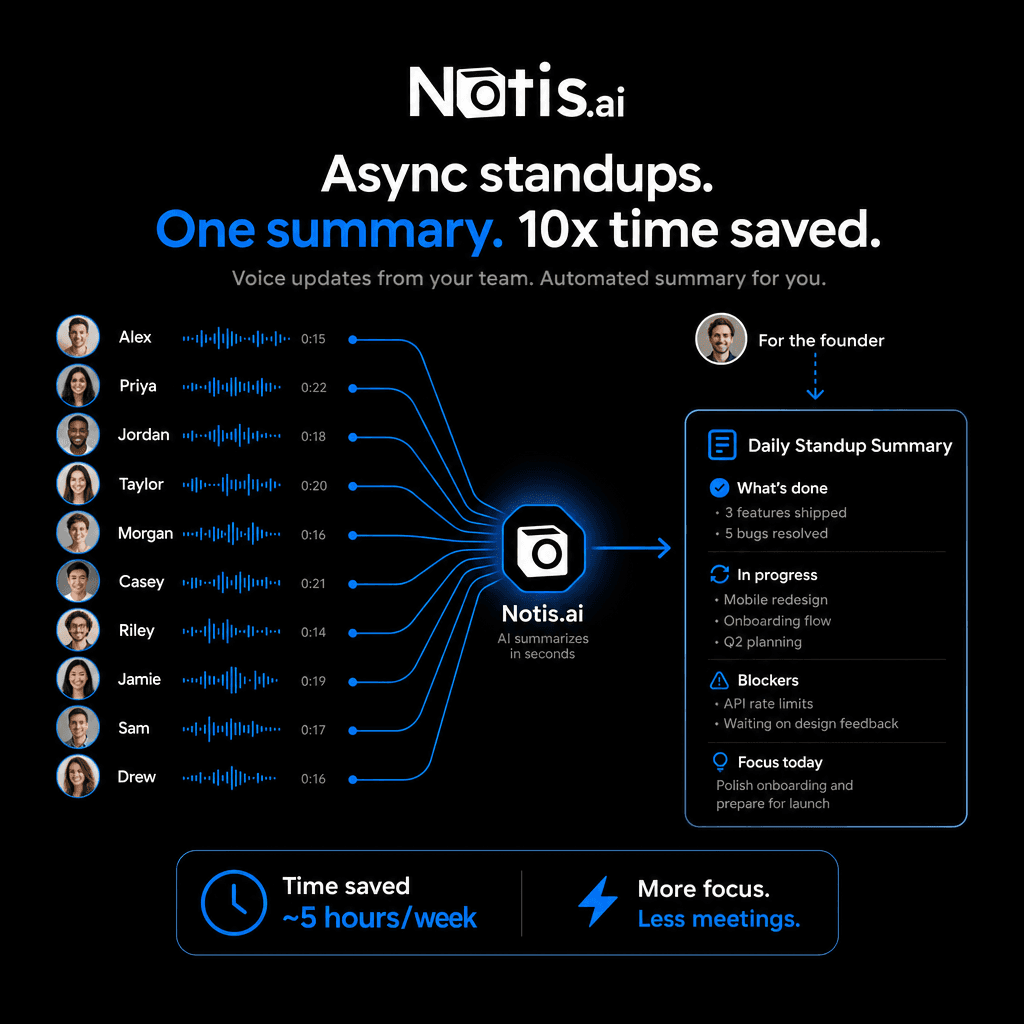
Every Monday morning at 9:00 AM, Notis sends a reminder to each person on the team asking them to record a short voice message. Nothing fancy. Just a quick update on what they worked on, what they’re focused on now, and anything blocking progress.
Because it’s voice-first, people answer quickly. They don’t need to open a doc, write a polished report, or pretend they enjoy filling in yet another form. They just talk.
Then later in the day, another automation kicks in. It collects those updates, analyzes the overall signal, and generates a single voice summary for the owner. Instead of listening to ten scattered updates one by one, the founder receives one concise briefing with the current team dynamic, the main themes, and the areas that deserve attention.
This is the part people miss when they think automation is about replacing communication. It’s not. It’s about compressing low-value coordination into something more natural, faster, and easier to consume.
Where the ten hours actually disappear
People often underestimate how expensive recurring meetings are because they only count the calendar slot itself.
A ten-person weekly standup that lasts one hour is already ten hours of team time. But that’s still conservative. Real meetings start late, drift off topic, and create follow-up interruptions before and after the call. They also fracture the day. A meeting in the middle of a deep-work block doesn’t just cost the hour. It costs the ability to focus before and after it.
By turning the update into an async voice habit, you keep the signal and remove the synchronization penalty. Each person can send their update when it fits their flow. The founder can absorb the summary when it’s useful, not when the calendar says so.
That’s how you save the time. Not by communicating less, but by communicating in a format that respects how people actually work.
What the founder gets instead of a meeting
This was the founder’s real requirement from the beginning, even if it wasn’t phrased that way: visibility without babysitting.
Most founders don’t want more meetings. They want to know whether the team is moving, where the energy is, what’s stuck, and whether priorities are drifting. The traditional standup is just a crude mechanism for trying to get that visibility.
A synthesized end-of-day voice recap is better because it’s already processed. Instead of manually assembling a mental dashboard from ten live updates, the founder receives a structured narrative. What happened. What matters. What needs attention.
And because it comes as a voice message, it feels lightweight. You can listen while walking, commuting, or between tasks. It behaves more like a private operator briefing than another artifact demanding your screen.
Why voice is the secret weapon
I’m increasingly convinced that a lot of broken internal processes survive only because companies default to text and meetings.
Text is great when precision matters. Meetings are useful when decisions need debate. But for routine weekly updates, both are often the wrong medium. Text creates friction because people over-edit. Meetings create friction because everyone has to attend.
Voice sits in a sweet spot. It’s faster than writing, more expressive than a form, and less disruptive than a call. People speak more naturally than they write, which means updates are often more honest and more useful. You hear confidence, hesitation, ambiguity, and momentum in ways a typed status update completely flattens.
When you combine that with automation, voice stops being a passive medium and becomes structured operational input. That’s where it gets interesting.
This is what I mean by running the business through Notis
The bigger lesson here has nothing to do with standups.
The point is that a lot of recurring management rituals are really just information-routing problems disguised as meetings. Once you see them that way, you can redesign them.
A reminder becomes a trigger. A voice note becomes input. An AI summary becomes management visibility. And the whole thing runs without requiring everyone to gather in the same room, at the same time, every week, forever.
This is exactly the kind of blueprint I love building with Notis. Not because it’s flashy, but because it removes operational drag in a way people immediately feel. You get less noise, better signal, and a workflow that actually matches the pace of a modern remote team.
If your company is still using meetings to compensate for missing systems, don’t optimize the meeting. Replace it with a better system.

Flo is the founder of Mind the Flo, an Agentic Studio specialized into messaging and voice agents.