Content

From Voice Note to Finished Work: The AI Shift ADHD Founders Need
The most dangerous productivity illusion is a beautifully organized database you still have to act on.
I say this as someone who genuinely likes Notion, voice notes, and structured systems. A clean workspace feels good. A tagged idea feels less lost. A transcript sitting in the right folder creates the warm little dopamine hit of “I handled that.”
But then Monday happens. The follow-up still needs writing. The prospect still needs updating. The investor note still needs turning into an email. The bug still needs reporting. The content idea still needs becoming a draft. The system captured the thought, but the work is still staring at you from across the room like a disappointed accountant.
That is the shift AI agents are forcing now: from capture to execution. Not “voice note to Notion.” Not “brain dump to a tidy page.” Those were useful steps. But they were not the destination. The destination is voice note to finished work.
Why ADHD founders do not need another filing cabinet
For ADHD founders, the gap is rarely “I do not know what to do.” The gap is usually between knowing and starting. The National Institute of Mental Health describes adult ADHD symptoms as including difficulty staying on task and being organized, which is a polite clinical way of saying: the pile of obvious next steps can still feel impossible to initiate. You can read the NIMH overview here: ADHD in Adults: 4 Things to Know.
Most productivity software pretends the problem is storage. Capture the thought. Sort the note. Add the tag. Place the task in the correct project. Congratulations, you now have a better map of the mountain you still have to climb.
That helps some people. It helped me for years. But if your bottleneck is initiation, a better archive is not enough. You do not need a museum of your intentions. You need a way to turn an intention into the first usable output before your brain has time to negotiate its way out of it.
That is why voice notes are such a powerful interface. Speaking is fast. It happens in motion. It does not require sitting down, opening the right page, remembering the right database, and pretending your brain is a small enterprise resource planning system. You say the messy thing while the messy thing exists.
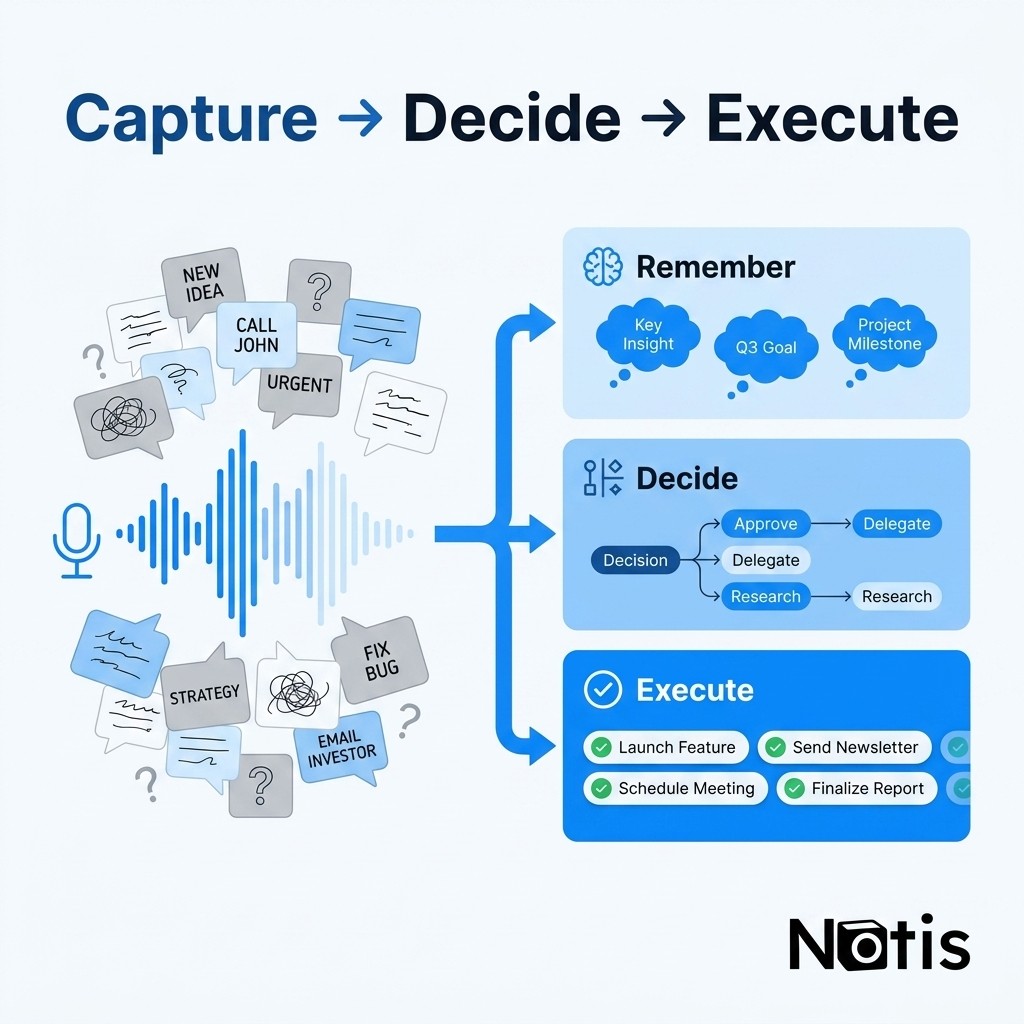
But the real magic starts after capture.
Voice notes were the bridge. Agents are the road.
The first wave of AI productivity tools made voice notes easier to store. Dictate an idea, get a transcript, send it to Notion, maybe summarize it. That was already better than typing on a phone like a raccoon trying to file taxes.
Search Console data for Notis shows there is still clear demand around that job. Over the last 90 days, Notis appeared for queries like “voice to notion” with 64 impressions at an average position around 7.6, “notion voice” with 88 impressions around position 7.0, and “voice notes to notion” with 35 impressions around position 10.6. The existing Notis post 6 Best Ways to Transcribe Voice Notes into Notion is already capturing part of that intent.
But the more interesting search intent is beginning to move one step downstream. People do not only want a transcript. They want an assistant that understands the transcript, decides what matters, uses tools, and brings back something useful.
That is what the word “agent” is supposed to mean. OpenAI describes agents as systems that independently accomplish tasks for users, with tools like web search, file search, and computer use making it possible to build workflows instead of one-off answers. Function calling and structured outputs exist for the same reason: to connect models to external tools and make the action layer more reliable. The important bit is not the word agent. The important bit is action.
A note-taking assistant says, “Here is your organized thought.” An execution assistant says, “Here is the draft email, the updated CRM record, the task created in the right place, and the research summary you asked for.”
That second version is the one ADHD founders actually need.
The four-step loop that actually works
The workflow is simple, but it changes the whole feeling of work.
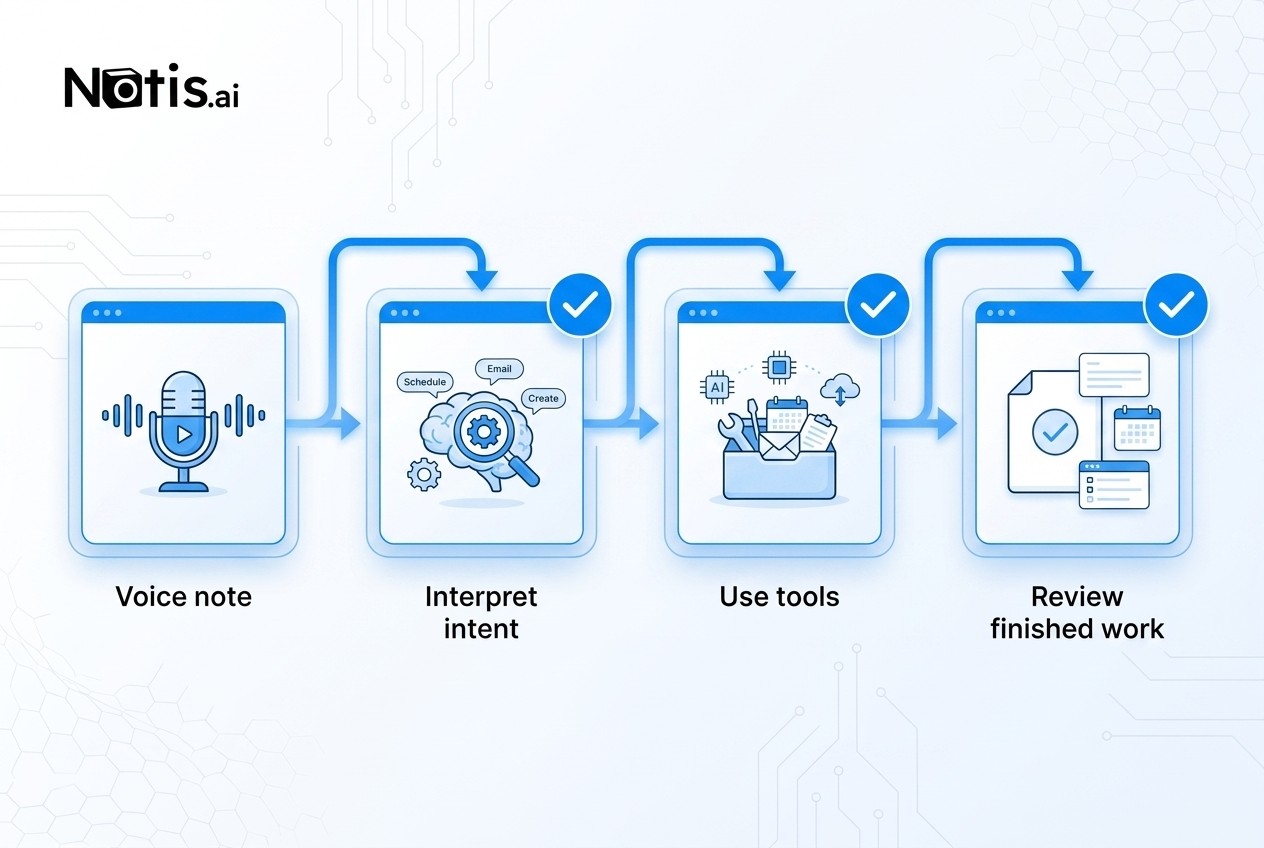
First, you capture the raw thought where you already are. For Notis, that can be WhatsApp, Telegram, Slack, iMessage, or email. You do not open a dashboard. You do not enter a productivity cathedral. You send the message like you would text a teammate.
Second, the assistant interprets intent. This is the difference between transcription and delegation. “Follow up with Sarah about pricing, add the thing to pipeline, and remind me next week” is not a note. It is a bundle of actions hidden inside a sentence.
Third, the assistant uses tools. It searches, drafts, updates, creates, schedules, stores, and routes. This is where the work leaves the pretty-note universe and enters the messy reality of calendars, inboxes, CRMs, docs, databases, and whatever other operational chaos your company currently calls a stack.
Fourth, you review finished work. Not because humans should disappear from the loop. Quite the opposite. The founder should be in the judgment loop, not the admin loop. Your best energy should go into approving, editing, deciding, and steering. Not copying the same detail into five places because software companies collectively decided tabs build character.
That is the founder-grade version of “voice note to finished work.” Capture, interpret, execute, review.
What this looks like in real founder life
Imagine you finish a call while walking outside. Your brain is full of loose pieces: a pricing objection, a product request, a promised intro, a follow-up email, and a vague sense that one of those details matters later.
The old workflow is to record a voice note, transcribe it, store it in Notion, and trust Future You to return as a disciplined project manager with a hot beverage and unusually strong executive function. Cute fantasy.
The new workflow is different. You send Notis a voice note that says what happened and what you want done. By the time you are back at the desk, the contact is updated, the follow-up is drafted, the reminder is set, the product feedback is captured, and the open question is turned into a research task or brief.
You still review. You still decide. You still own the work. But you are no longer doing the tiny administrative translations that kill momentum.

This is the part most productivity advice misses. ADHD founders do not need more motivation posters about consistency. They need systems that respect the moment when intent is alive. If the thought appears while you are moving, capture it while moving. If the work can be started by an agent before you sit down, let the agent start it. Do not make your future self rehydrate the context from a sterile bullet point three days later.
Notis is built around that idea. It is not trying to be another place you check. It is an AI intern you message from the places you already use, connected to the tools where work actually happens. The homepage puts it plainly: Notis helps founders dump busywork and work like a team of ten, from messaging apps like WhatsApp. That positioning matters because interface is not cosmetic. Interface decides whether the habit survives contact with Tuesday.
The practical test for any AI assistant
If you are an ADHD founder evaluating AI tools, stop asking only “what can it do?” Ask “what happens after I speak?”
If the answer is a transcript, useful. If the answer is a categorized note, better. If the answer is finished work waiting for review, now we are talking.
The tool should reduce activation cost. It should preserve context before it evaporates. It should live in the interface you already open without thinking. It should turn your messy spoken intent into concrete next steps across the tools you actually use. And it should keep you in the review seat, because judgment is where founders create leverage.
That is the AI shift ADHD founders need to understand. The future is not a more beautiful filing cabinet. It is not even a better task manager. It is the ability to say the thing once, in the moment, and come back to work that has already moved forward.
Try Notis at notis.ai if you want your next voice note to become something more useful than another well-organized regret.

Flo is the founder of Mind the Flo, an Agentic Studio specialized into messaging and voice agents.