Content

ADHD Hyperfocus Meeting Prep: Show Up Ready Without Breaking Focus
You do not need another productivity lecture telling you to “just block 15 minutes before every meeting.” If you have ADHD and you are in the good kind of deep work, that advice is technically correct and operationally useless. The problem is not that you do not understand calendars. The problem is that hyperfocus eats the transition between now and the thing you promised Future You would be ready for.
That is the meeting prep problem most tools ignore. They assume the responsible adult version of you will stop coding, writing, selling, or building at exactly the right moment, open the calendar invite, remember who the person is, search old emails, check the CRM, read your notes, and calmly walk into the call. Cute.
A better system does not ask your brain to become a project manager. It makes meeting prep happen automatically, then interrupts you only when the brief is actually useful.
The real problem is not meetings. It is the transition into meetings
ADHD is often discussed as distraction, but the opposite failure mode can be just as expensive: hyperfocus. You are not jumping between tabs. You are locked into one thing so hard that time becomes background noise. The CDC’s overview of adult ADHD describes attention, organization, and time-management challenges as part of how ADHD can show up in adults. The practical version is simpler: the meeting starts in two minutes and your brain is still inside the function you were debugging.
Time blindness is the nasty companion here. It is not laziness. It is the unreliable internal sense of how long things take, how close an event is, and when to switch contexts. CHADD’s workplace guidance on managing time blindness at work points toward external supports like timers, alarms, alerts, and checklists because relying on internal time awareness is exactly the part that breaks.
This is why “prepare before the meeting” is bad advice unless the system includes the transition. The workflow has to assume you will still be in hyperfocus until the last possible useful moment.

Why manual meeting prep fails ADHD founders
The classic setup is a pre-meeting ritual. Open the calendar. Read the invite. Search the person. Check the last email thread. Find your notes. Look at the CRM. Decide what matters. Write three questions. Join the call.
It is a good ritual. It is also a ritual that depends on consistency, and consistency is usually where ADHD productivity systems go to die.
Understood’s guide to ADHD and time blindness recommends externalizing time with tools and structure. That matters because the goal is not to become the kind of person who perfectly maintains calendar buffers. The goal is to design a workflow where missing the buffer does not ruin the meeting.
Founders make this worse because the context surface is enormous. A meeting is rarely just a meeting. It may connect to an old email, a sales conversation, a support issue, a document someone shared three weeks ago, a promise you made during another call, and a vague “we should talk” message you sent while walking to lunch. The prep work is not hard because it is intellectually difficult. It is hard because the context is scattered.
That is exactly the kind of job an AI assistant should do before you ever see the reminder.
The better workflow: explain it once, automate it forever
The useful version is boring in the best possible way. You tell your assistant the rule once: fifteen minutes before every meeting, research the person and the context, then send me a short brief where I already am.
From there, the system watches your calendar. When a meeting is coming up, it checks who is attending, looks for relevant email history, reviews previous calendar events, pulls notes from your CRM or workspace when connected, and compresses the mess into a briefing you can read in under a minute.
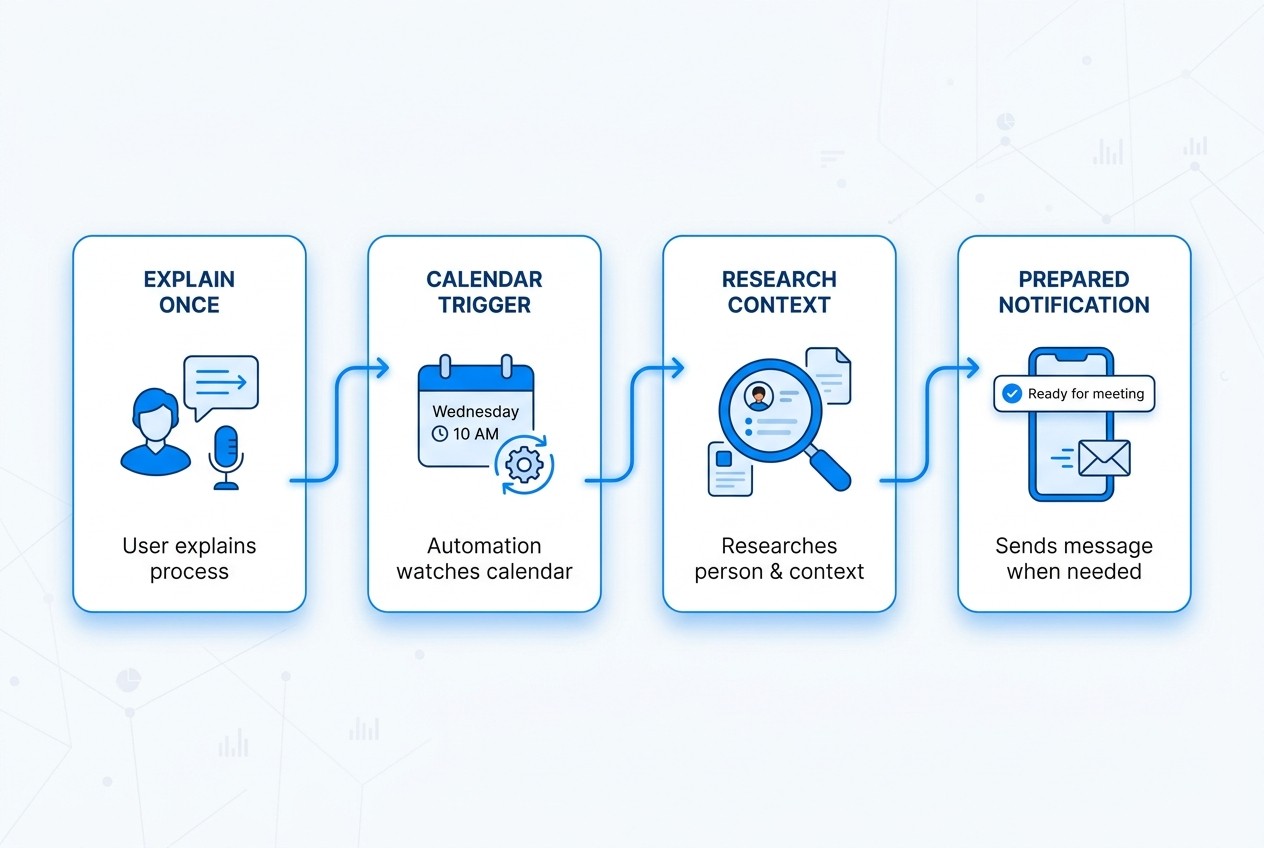
The point is not to create a perfect dossier. That would be another task. The point is to give you enough context to stop walking into calls cold. Who is this person? Why are we talking? What did we discuss last time? What are they likely expecting from me? What should I ask? What landmines should I avoid?
This is where AI meeting prep tools are becoming useful. Some products focus on sales and CRM briefings, and workflow templates like Zapier’s AI meeting prep briefing show the broader pattern: calendar event comes in, context gets gathered, a short prep document gets generated. The missing piece for ADHD founders is delivery and timing. A beautiful doc you have to remember to open is still a tax on executive function.
The Notis angle: the brief should come to you
Notis is built around a simple belief: your assistant should live where you already communicate. If you are in WhatsApp, Telegram, email, Slack, or the Notis desktop flow, that is where the meeting brief should arrive. Not in yet another dashboard you must remember to check. Not in a productivity temple that requires a morning review ceremony. In the channel that can actually interrupt you at the right moment.
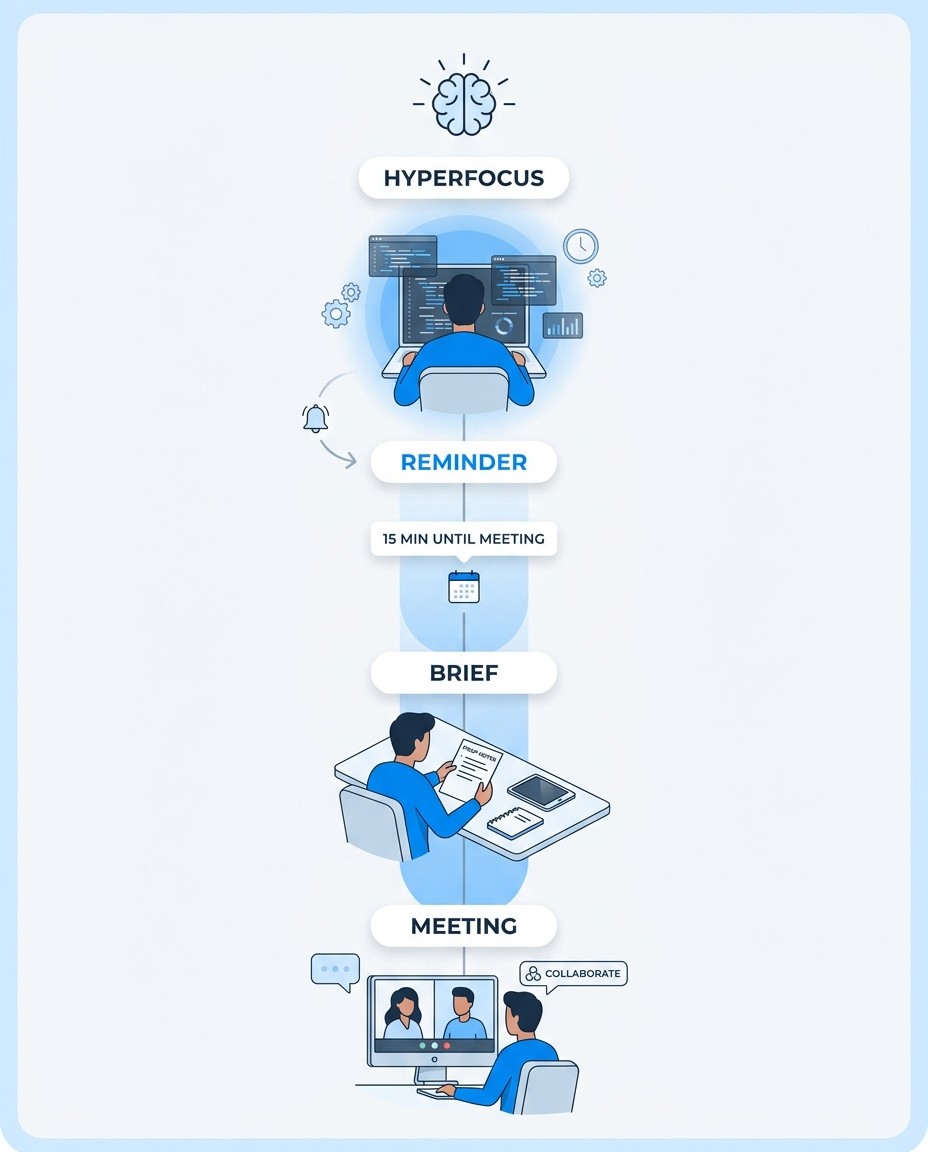
For me, the workflow is brutally practical. Fifteen minutes before a meeting, Notis can search my calendar, email, and connected context, then send a concise summary. I stay in hyperfocus until I genuinely need to switch. When the notification comes, I skim the brief, remember who I am meeting, and enter the call with enough context to be useful.
This is not a medical treatment for ADHD, and it should not be sold like one. The NIMH guide to ADHD is clear that evidence-based care can include professional treatment, therapy, medication, and skills support. A meeting prep automation is not a replacement for any of that. It is a workflow support. But good workflow support matters because work happens inside messy human constraints, not inside the fantasy version of your calendar.
What a useful AI meeting brief should include
A good brief is short enough to read while your coffee is still too hot. It should identify the meeting, the attendees, the likely purpose, the last relevant interaction, open commitments, and a few questions worth asking. It should also tell you what not to forget. If the assistant has to write a novel, it failed.
The best version is contextual, not generic. “You are meeting Sarah from Acme” is mildly useful. “Sarah asked last month whether Notis could pull context from Gmail before customer calls, and you promised to send an example workflow” is the thing that saves the meeting.
The brief should also be honest about uncertainty. If the assistant found no prior email history, it should say so. If it is guessing the meeting objective from the title, it should say that too. Confidence is useful. Fake confidence is how AI assistants become very expensive interns with a lying problem.
How to set this up without building a productivity shrine
Start with one rule, not a complete personal operating system. Pick one meeting type where being unprepared hurts the most. Sales calls, investor calls, customer calls, hiring calls, whatever creates the most panic when the reminder fires.
Then define the exact output you want. A useful default is one paragraph of context, the last known interaction, three likely discussion points, three questions to ask, and any open commitments. Set the trigger close enough to the meeting that you will read it, but not so close that you are already late. For many ADHD founders, fifteen minutes is the sweet spot because it respects hyperfocus instead of trying to destroy it.
Finally, deliver the brief somewhere you already look. This is the part most systems get wrong. ADHD productivity advice often adds more places to check. The better move is to reduce surfaces. The assistant should not become another app-shaped obligation.
Keep the superpower. Automate the blind spot.
Hyperfocus is not the enemy. It is often the reason the good work gets done. The blind spot is the transition out of it. If you design your meeting prep around a perfectly consistent version of yourself, the system will fail the first week you are excited about real work.
Design for the version of you that actually exists. Let the calendar trigger the research. Let the assistant gather the context. Let the brief arrive when you need it. Then you can stay in the work until the last responsible moment and still show up like someone who had their life together all along.
That is the whole trick. Do not fight the ADHD brain with another calendar ritual. Give it an external memory, a timed nudge, and a meeting brief that does the boring part before you have to.

Flo is the founder of Mind the Flo, an Agentic Studio specialized into messaging and voice agents.