Content

ADHD Founders Don’t Need More Willpower. They Need a Task Escape Hatch.

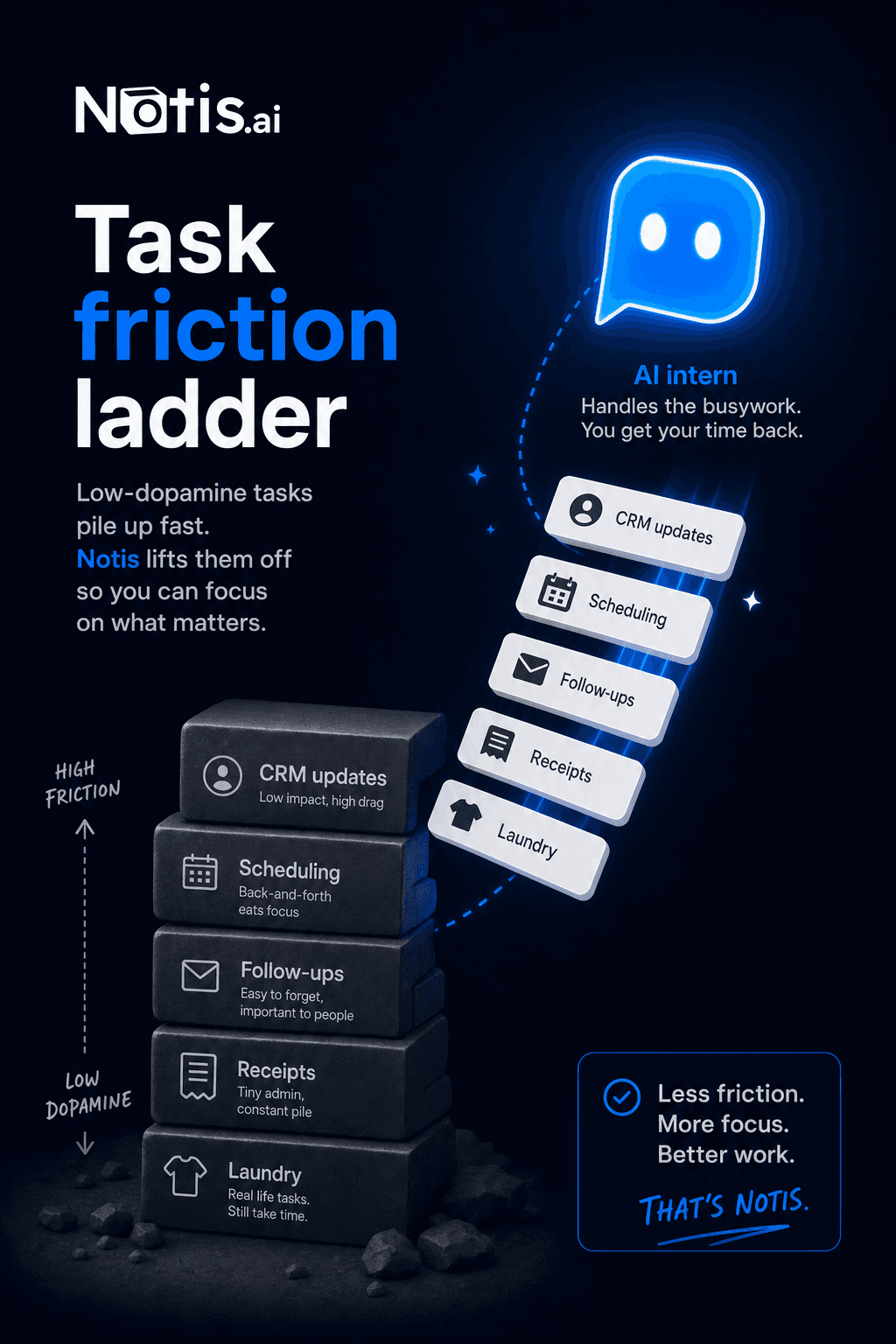
Some tasks do not feel small when you have ADHD. They feel like concrete. Laundry. Receipts. A calendar follow-up. Updating the CRM after a call. The tiny admin jobs that a neurotypical founder apparently “just does” can sit in your brain like unpaid emotional rent until the stress becomes louder than the task itself.
That is the part people miss when they say ADHD founders need better discipline. The problem is not that you do not understand laundry. The problem is that your brain may not assign enough reward, urgency, novelty, or emotional charge to start it before the pile becomes a crisis. Then you are not doing laundry. You are doing laundry plus shame plus panic plus the weird feeling that you are failing as an adult because of socks.
The better question is not “How do I force myself to care?” It is “How do I design a system where low-dopamine work stops accumulating in the first place?”
Why low-dopamine tasks become a founder problem
ADHD is not a cute preference for colorful calendars. It is a neurodevelopmental condition that affects attention, impulsivity, self-regulation, and executive function. The U.S. National Institute of Mental Health describes adult ADHD as a pattern that can interfere with work, relationships, and daily responsibilities, while clinical guidelines such as NICE’s ADHD guidance emphasize that treatment and support often need to address functional impairment, not just symptoms.
The dopamine story is real, but it is often oversimplified online. It is not accurate to say ADHD brains have “no dopamine” for laundry. Brains are not empty vending machines. A better version is this: ADHD is linked to differences in reward processing, effort, delay, and executive control. Research on motivation and effort in ADHD points to the way boring, delayed, or low-reward tasks can feel disproportionately hard to activate, while neuroscience reviews of reward prediction and effort explain why dopamine is involved in learning, salience, and behavioral activation rather than being a simple “pleasure chemical.”
That distinction matters. If you tell yourself dopamine is “absent,” you may feel doomed. If you understand that your system struggles with task initiation under low reward and high friction, you can redesign the system.
Founders make this worse by pretending everything is equally important. It is not. Shipping product, talking to users, writing strategy, closing a partnership, fixing a nasty bug: these are high-leverage tasks. Renaming a file, chasing a receipt, sending a polite follow-up, booking a call, and moving a note into the right database are often low-leverage but still necessary. They are not hard because they are complex. They are hard because they are friction.
The burnout loop starts with tiny avoidance
The dangerous part of low-motivation tasks is that they rarely stay tiny. One receipt becomes a messy accounting session. One unanswered email becomes a relationship wobble. One calendar ambiguity becomes a missed meeting. One laundry pile becomes a Sunday of resentment. This is how ADHD burnout often sneaks in: not through one dramatic failure, but through hundreds of open loops quietly consuming background RAM.
CHADD’s resources on executive function describe how planning, prioritizing, organizing, and self-monitoring can become performance bottlenecks for people with ADHD. That is exactly where founder life becomes spicy. A founder is not missing one boss’s deadline. A founder is the boss, the intern, the janitor, the strategist, the customer support person, and occasionally the person trying to find the clean T-shirt before a demo call.
When everything depends on you, low-dopamine tasks are not “personal chores.” They become operational risk.
This is why the usual advice is so annoying. “Just make a list.” Great. Now you have a list of things you still cannot start. “Break it into smaller steps.” Lovely. Now laundry is eight tasks instead of one. “Reward yourself after.” Cute, but if the reward is delayed and the task is boring, the engine still may not turn over.
I am not anti-tactics. Timers, body doubling, medication, coaching, environment design, and therapy can all be genuinely useful. But for founders, there is one extra move that is too often ignored: delegation without management overhead.
The goal is not to become better at suffering
A lot of ADHD productivity advice accidentally turns into moral weightlifting. Build more discipline. Create more structure. Try harder. Make the task fun. Put on music. Gamify it. Fine. Sometimes that works. But the founder goal is not to become spiritually impressive while doing admin. The goal is to get the work done without draining the cognitive fuel you need for the company.
The useful distinction is between tasks that deserve your brain and tasks that only need your permission. Writing a positioning memo deserves your brain. Deciding whether a customer follow-up should happen today deserves maybe ten seconds of your judgment. Actually drafting the follow-up, finding the email, remembering the context, and scheduling the reminder should not require a full context switch.
That is the Notis angle. Notis is a messaging-native AI assistant you can text or voice note from the place where the thought already appears. You do not open a new productivity dashboard. You do not build a complex automation flow while already overloaded. You send the task like you would send a message to a competent assistant: “Remind me to send the invoice tomorrow,” “turn this voice note into a task,” “summarize my open follow-ups,” “add this to Notion,” or “draft the reply and ask me before sending.”
The magic is not that AI suddenly makes laundry emotionally rewarding. The magic is that fewer tasks need to become emotional in the first place.
A practical escape hatch for zero-motivation tasks
Here is the workflow I like because it respects the ADHD brain instead of trying to shame it into being a spreadsheet.
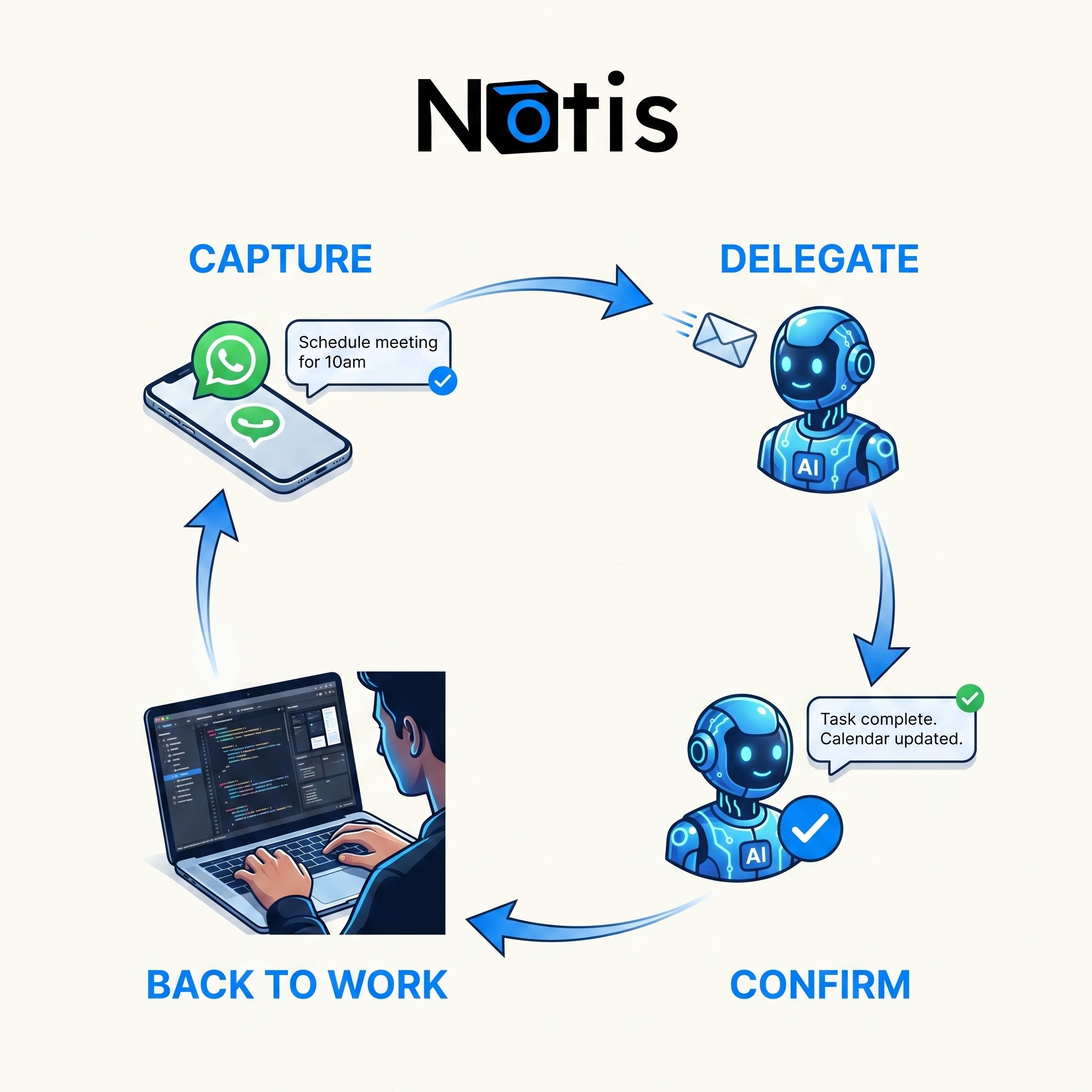
First, capture the task at the moment of awareness. Do not negotiate with it. Do not decide whether you should feel motivated. Send a voice note or message to Notis while the thought is alive. “I need to send Marc the deck after I fix slide five.” That is enough.
Second, delegate the next mechanical step. Not every task should be fully automated. But most low-dopamine tasks have a mechanical piece: find the document, create the reminder, draft the response, add the database entry, summarize the context, or prepare the checklist. Let the AI intern carry that part.
Third, keep a confirmation gate for anything sensitive. ADHD-friendly does not mean reckless. If money, customers, legal commitments, or reputation are involved, ask Notis to prepare the work and bring it back for approval. This gives you leverage without creating a chaos machine.
Fourth, go back to the high-value work. This is the point people forget. The win is not a beautifully organized task system. The win is that you did not spend twenty-five minutes falling out of flow because your brain remembered a receipt while you were building the product.
The founder rule: remove shame before you remove tasks
There is a softer, less tactical reason this matters. Shame is expensive. Every task you avoid starts charging interest in the background. You do not only lose the time it takes to do the thing. You lose the calm you need to choose what matters next.
This is why I prefer system design over willpower theater. If a certain class of tasks repeatedly creates the same failure pattern, stop treating each instance as a fresh character flaw. Name the class. Build the escape hatch. Make the default path easier.
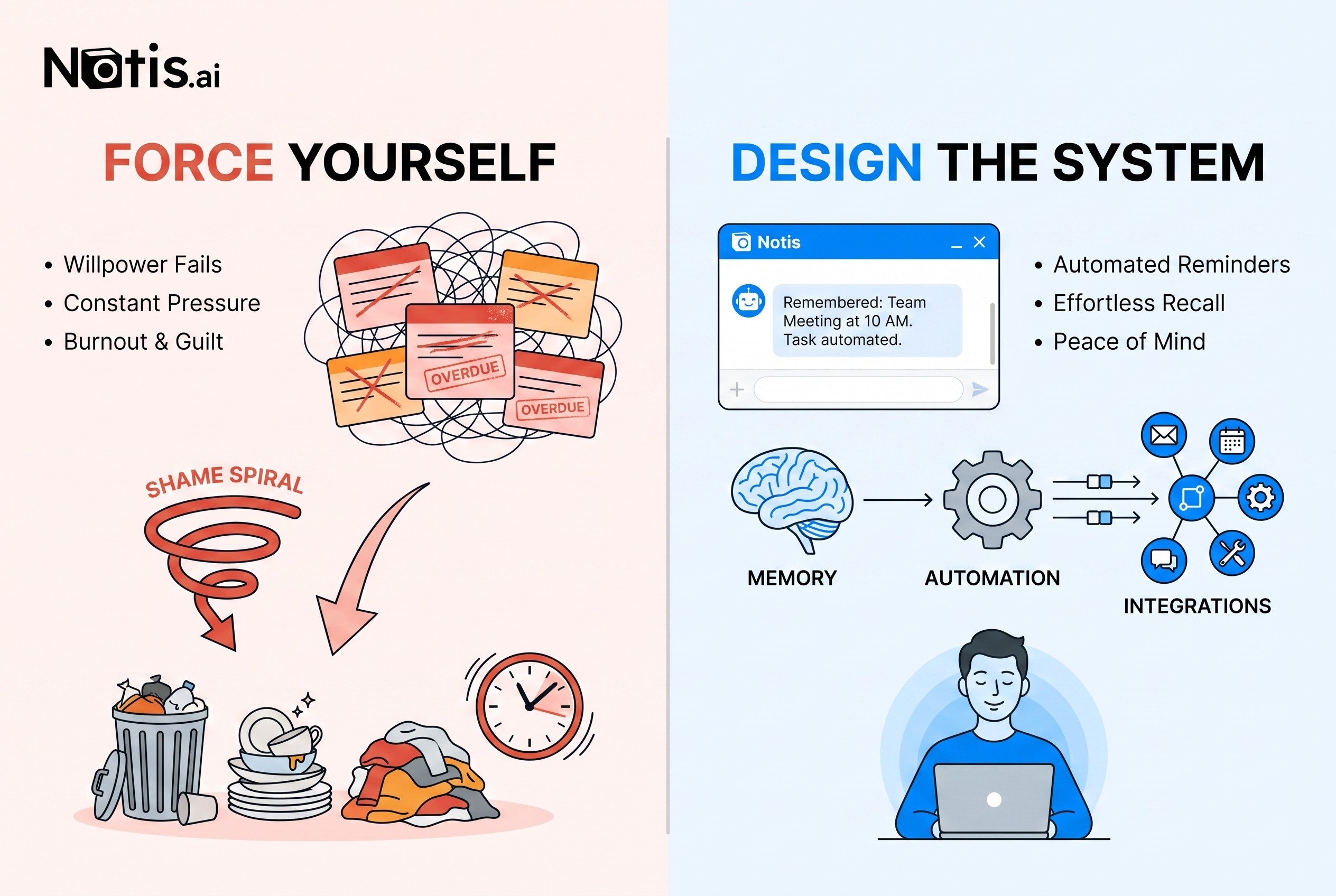
For some tasks, the right answer is still to do them yourself. For some, it is to delete them entirely. But for the annoying middle category—the admin that matters just enough to hurt you when ignored, but not enough to light up your brain—delegation is not a luxury. It is an accessibility layer.
Notis exists for that layer. Capture the thought in WhatsApp, Telegram, email, or wherever you already communicate. Let memory, integrations, skills, and automations carry the boring edges. Keep your judgment in the loop. Then get back to the work that actually deserves you.
If you are an ADHD founder, you do not need another app that proves you can organize your overwhelm into prettier columns. You need fewer open loops, fewer shame spirals, and a faster way to move zero-motivation tasks out of your head before they become burnout.
Start with one sentence. “Notis, handle this before I turn it into a personality defect.” That is not laziness. That is good operating system design.

Flo is the founder of Mind the Flo, an Agentic Studio specialized into messaging and voice agents.