

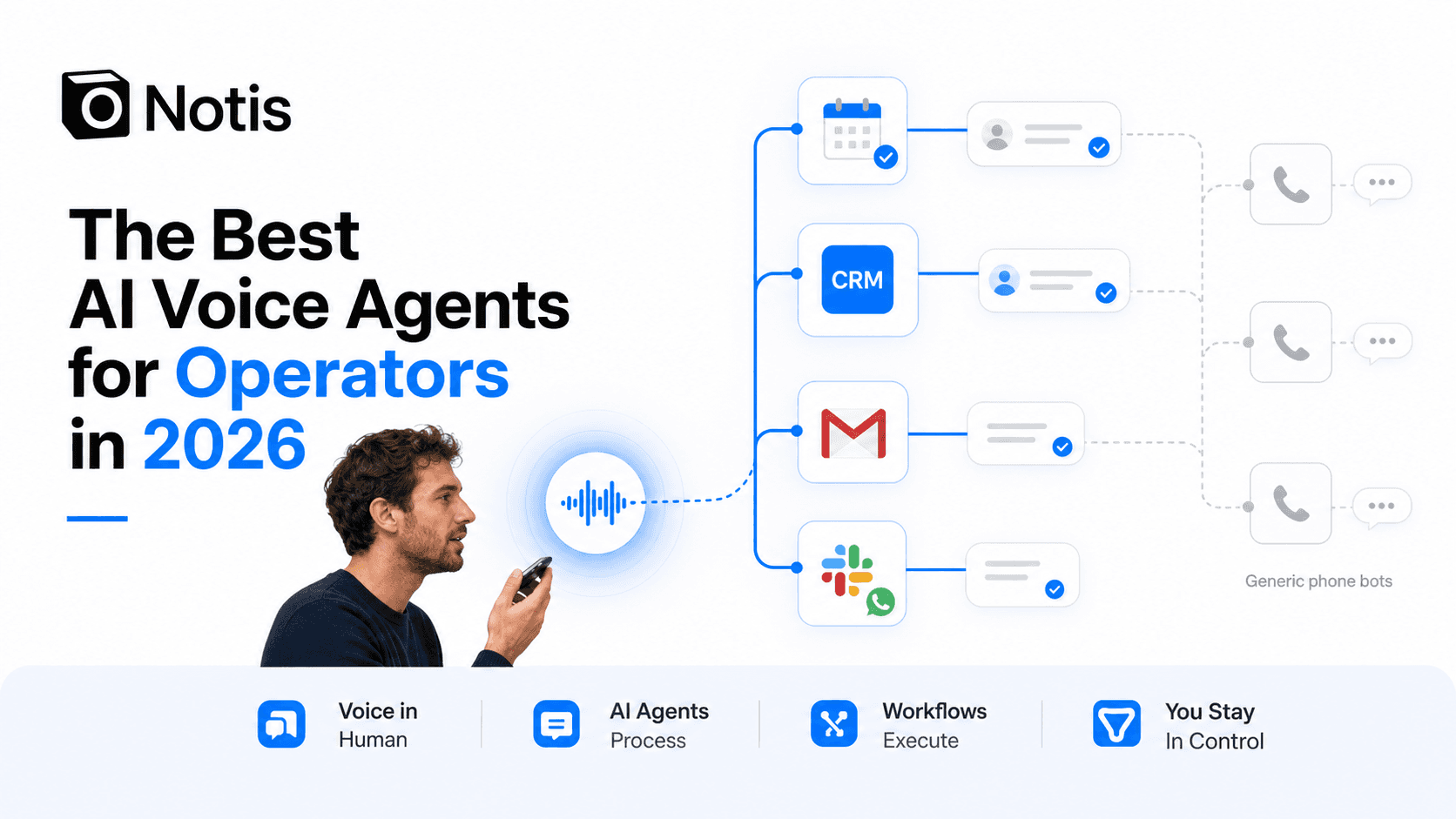
The Best AI Voice Agents for Operators in 2026
A founder-first comparison of the best AI voice agents in 2026, from Vapi and Retell to ElevenLabs, Bland, Synthflow, PolyAI, Cognigy, Sierra, Hume, OpenAI Realtime, and Notis. The real question: who turns voice into completed work?
The dirty secret of AI voice agents is that most of them still optimize for the demo, not the operator. A voice that sounds human is nice. A voice that books the meeting, updates the CRM, sends the recap, creates the task, and tells you what actually happened is leverage.
In Search Console, Notis already has proof that people are looking for this exact bridge between voice and work: “voice to notion” has 538 impressions, 72 clicks, and an average position of 2.6; “notion voice to text” has 647 impressions but only a 1.24% CTR; “notion voice notes” has 601 impressions and a 1.33% CTR; “notion voice recording” has 352 impressions and zero clicks; and the wonderfully specific “ai voice tool that logs sales activity into notion crm” has 414 impressions at position 2.8 with zero clicks. Translation: Google already thinks Notis belongs in the voice workflow conversation. The page just needs to stop sounding like a brochure and start answering the buying question.
The short version
If you want to build a custom phone agent, look at Vapi, Retell, ElevenLabs Conversational AI, Bland, Synthflow, or OpenAI’s Realtime API. If you run a contact center and need enterprise rollout, look at PolyAI, Cognigy, Sierra, or Decagon. If you are a founder or operator who mostly wants to capture voice, turn it into structured work, and push it across Notion, email, calendar, Slack, WhatsApp, reminders, and automations, Notis belongs in the shortlist because the “voice agent” is not the product. The completed workflow is the product.
That distinction matters. A phone bot can sound charming and still leave a human cleaning up the mess. An operator-grade assistant should understand the spoken input, extract the intent, write the recap, create the next action, route it to the right place, and come back with confirmation. Voice is the input layer. Execution is the moat.
What I actually looked at
I compared the category across five operator criteria: how fast you can launch, how much control developers get, whether the platform can take actions inside other tools, whether it is built for customer calls or internal operator workflows, and how predictable the pricing model is. I also sanity-checked the search angle against Notis Search Console data, because there is no point writing another “best tools” list that wins the founder’s approval and loses the actual search result.
The market splits into three lanes. The first lane is developer infrastructure: Vapi, OpenAI Realtime, and sometimes ElevenLabs Conversational AI when voice quality is the center of gravity. The second lane is managed voice-agent platforms: Retell AI, Bland AI, and Synthflow. The third lane is enterprise customer-service automation: PolyAI, Cognigy, Sierra, and Decagon. Notis sits in a different but adjacent lane: voice-to-workflow for operators who do not want another call stack, they want less operational drag.
Head-to-head comparison
Platform | Best for | Operator strength | Watch-out | My take |
|---|---|---|---|---|
Vapi | Developer-first voice agents | Flexible tools, custom flows, calendar/CRM actions through integrations | You own more of the stack | Best if you have engineering time |
Retell AI | Fast managed voice-agent pilots | Templates, analytics, webhooks, appointment booking, batch calling | Costs vary with minutes, LLM, add-ons | Strong default for phone-first teams |
ElevenLabs Conversational AI | Best-in-class voice quality | Natural speech, multilingual, knowledge base, telephony | Not always the whole operational system | Use when voice polish matters most |
Bland AI | Outbound/inbound call automation | Enterprise deployments, compliance posture, phone workflows | Less composable than pure APIs | Good for call-center-like automation |
Synthflow | No-code/low-code voice workflows | Per-second billing, workflow builder, business users can ship | Estimate usage carefully | Good for non-technical teams testing voice |
OpenAI Realtime | Custom voice experiences | Low-latency voice-to-voice, tools, guardrails via Agents SDK | You need to build product plumbing | Powerful, not plug-and-play |
Hume EVI | Emotion-aware voice UX | Empathic speech-to-speech, expression signals | More experience layer than operations layer | Interesting for coaching, wellness, sensitive conversations |
PolyAI / Cognigy | Enterprise contact centers | Routing, handoff, analytics, CCaaS/telephony integration | Enterprise procurement and implementation | Buy when call volume justifies it |
Sierra / Decagon | Customer-service agents | Support workflows, policy guardrails, customer context | Usually not self-serve founder tooling | Good for serious support orgs |
Notis | Founder/operator voice-to-workflow | Voice notes, Notion, email, calendar, Slack, WhatsApp, reminders, automations | Not a replacement for enterprise phone support | Best when the job is turning spoken intent into done work |
The best AI voice agents by use case
Choose Vapi if your team wants to build a real voice product and has developers available. Vapi is the “bring your own architecture” option: you can wire tools, calendars, CRMs, custom logic, and model choices into a voice agent without being trapped in a rigid no-code box. That is excellent when voice is part of your product surface. It is overkill if your real problem is “I say things while walking and then forget to execute them.”
Choose Retell AI if you want a production pilot without spending three weeks choosing speech-to-text vendors. Retell’s public pricing positions it as pay-as-you-go, and the platform includes practical pieces like templates, call analytics, transcripts, webhooks, appointment booking, and batch calls. For operators, the useful part is not the voice alone; it is the post-call analysis and webhook layer that can push outcomes into other systems.
Choose ElevenLabs Conversational AI when the voice itself is the brand experience. ElevenLabs has the strongest association with natural-sounding speech, and its agent pricing includes minutes, concurrency, workflow builder, knowledge base, multilingual support, and telephony across tiers. If your buyer will judge the product in the first five seconds of the call, voice quality matters. Just do not confuse “beautiful voice” with “operational reliability.”
Choose Bland or Synthflow when you want business users to ship call workflows quickly. Bland is positioned around enterprise-grade phone agents and an all-in per-minute model, while Synthflow leans into workflow building and documented per-second usage billing. Both are attractive when you want to automate inbound qualification, outbound follow-up, reminders, or booking without building every layer yourself.
Choose PolyAI, Cognigy, Sierra, or Decagon when you are solving customer-service volume, not founder memory. These platforms are designed for contact-center reality: routing, escalation, analytics, handoff, customer context, compliance, and enterprise integrations. They are not the first thing I would recommend to a five-person startup. They are exactly what a serious support org should evaluate before replacing pieces of its phone tree.
Choose OpenAI Realtime when you want maximum product control. The Realtime API and Agents SDK give developers a strong foundation for low-latency voice-to-voice agents with tools and guardrails. It is the same pattern as every powerful API: amazing if you can build the rest, disappointing if you expected it to be an operator out of the box.
Where Notis fits honestly
Notis is not trying to be the phone agent that handles 80,000 support calls a month. That would be dishonest positioning and, frankly, boring. Notis is for the founder, consultant, operator, or small team who already lives in messages and needs voice to become execution. You send a voice note, forward an email, drop a thought from WhatsApp or Telegram, and the assistant can turn it into notes, tasks, reminders, research, database updates, and follow-ups.
That is why the Search Console opportunity is so interesting. Queries like “voice to notion,” “notion voice notes,” “notion voice transcription,” “voice ai agent notion slack integration,” and “ai voice tool for notion crm sales logging” are not looking for a celebrity voice clone. They are looking for a work loop. They want voice in, structured output out, and fewer tabs in the middle.
The strongest Notis angle for this article is not “we are better than every voice-agent platform.” It is “most voice-agent platforms solve calls; Notis solves the operator’s follow-through.” That is a cleaner promise, and it is also easier to rank for because the page can capture both the broad comparison keyword and the long-tail intent around Notion voice workflows.
My recommendation
If you are building a voice product, start with Vapi or OpenAI Realtime and compare Retell if speed matters more than control. If you need the most polished synthetic voice, test ElevenLabs. If you need a managed business call workflow, look at Retell, Bland, or Synthflow. If you are an enterprise contact center, talk to PolyAI, Cognigy, Sierra, and Decagon.
If you are an operator and your real problem is that ideas, calls, meetings, and voice notes disappear into the swamp before becoming action, start with Notis. The best AI voice agent for you may not be the one that talks the most like a human. It may be the one that shuts up, understands what you meant, and gets the next step done.

Flo is the founder of Mind the Flo, an Agentic Studio specialized into messaging and voice agents.
Related posts
Notis vs. Zapia Max: The WhatsApp AI Agent Built for Founders, Not Errands
The Best OpenClaw Alternative for Founders in 2026 (30 Seconds. Not Your Weekend.)
The Best Claude Alternative for Founders Who Need Work Done
Most Claude alternatives are still chatboxes. If you want an AI that actually handles follow-ups, scheduling, and inbox work, you need a different lens.