

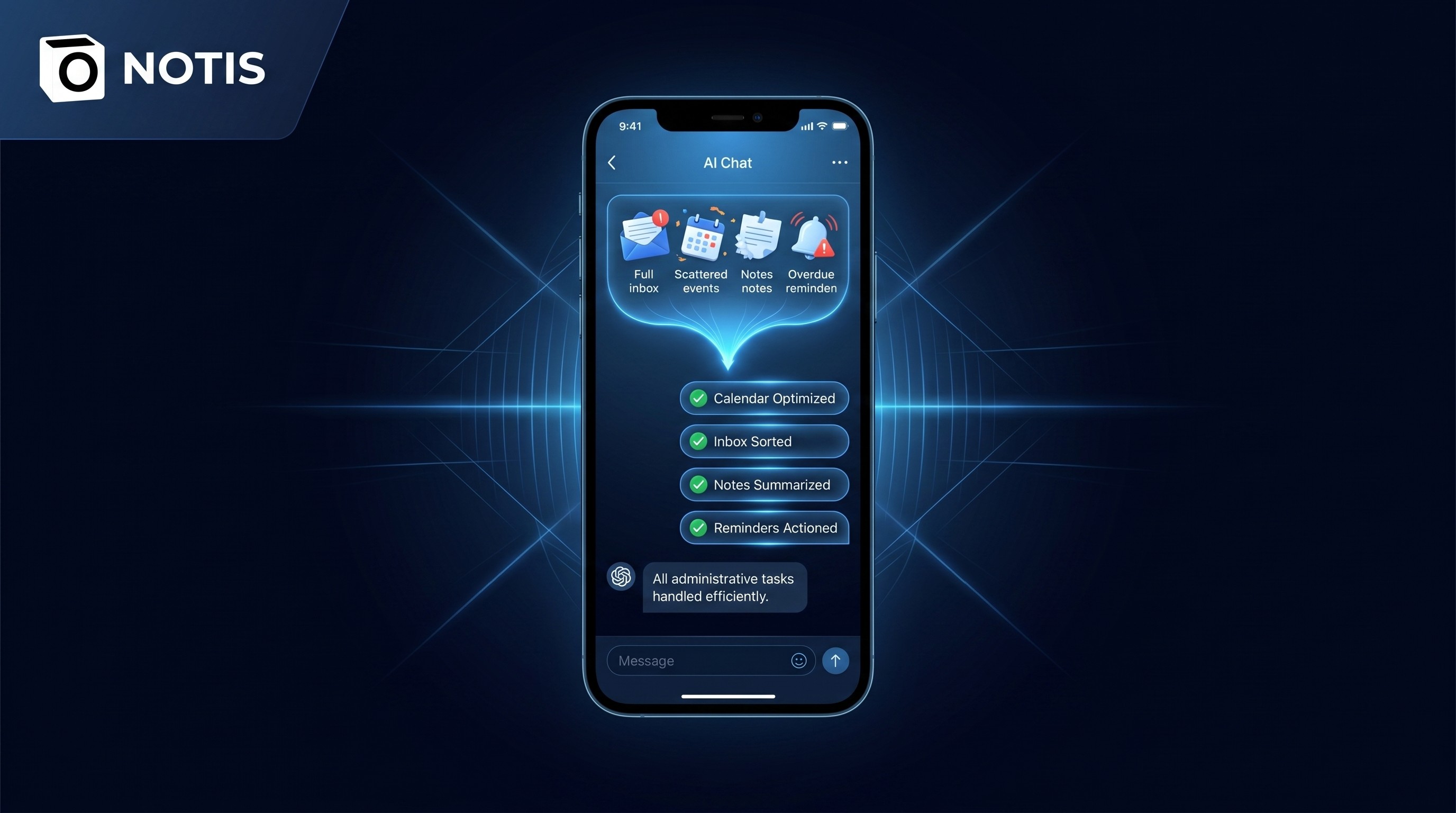
The Best AI Virtual Assistant for Administrative Tasks Is the One You Can Text
Solo founders do not need another dashboard. They need one place to dump admin work and get it done.
The problem with administrative work is not that it is hard. It is that it is scattered.
One minute you are replying to a vendor. The next you are hunting for a meeting note, checking your calendar, and trying to remember whether you already promised someone a follow-up. That is not “busy.” That is context switching with a tax on top.
If you are a solo founder, the winning AI virtual assistant is not the one that looks clever in a demo. It is the one you can text, trust, and forget about until the work is done.
Administrative work is a system, not a pile of chores
Most people treat admin like a to-do list. That is the mistake. Admin work is really a loop: capture the request, understand the context, decide what matters, take the next action, and make sure nothing falls through the cracks.
That loop touches your inbox, calendar, notes, reminders, meetings, and sometimes your CRM. If your assistant only helps with one of those surfaces, you still become the integration layer. And that is where founders lose time.
The better question is not “Can this AI help me with admin?” The better question is “Can this AI own the loop?”
What an AI virtual assistant actually needs to do
A real AI virtual assistant for admin work should do more than rewrite an email. It should understand what the message means, decide whether it is urgent, and then move the work forward without turning every request into a new app to manage.
That means it needs memory. It needs integrations. It needs a way to continue the task after the first reply. It needs to know the difference between “answer this now” and “turn this into a meeting, note, or reminder.”
That is why messaging matters so much. When the assistant lives in a thread instead of a dashboard, delegation becomes natural. You send the request once. You get the result where you already are.
Notis’s WhatsApp Voice Mode is built around that idea: talk naturally, hand off the task, and let the assistant keep working after the conversation ends. The documentation overview shows the broader pattern too: Notis is not just a note taker or a drafting tool. It is a system that can connect messaging, Notion, calendars, and other work surfaces.
Why inbox-only tools keep falling short
A lot of admin AI starts and ends with the inbox. That sounds useful until you realize the inbox is not the business. It is just where the noise arrives.
If a tool helps you draft a response but cannot schedule the meeting, create the reminder, or file the follow-up, you still end up doing the boring parts yourself. That is not automation. That is autocomplete with better branding.
Founders do not need more draft output. They need fewer loose ends.
The best admin assistant is the one that can turn a message into a sequence of actions. Reply, schedule, summarize, store, remind, and keep going. If it can only do one of those steps, it is a helper. Not an operator.
The Notis approach
The Notis angle is pretty simple: meet founders where they already communicate.
If you are in WhatsApp, text Notis there. If the request starts as a voice note, send the voice note. If the task needs context, let Notis search your workspace, pull in the right note, and come back with something useful instead of something generic.
The help center is clear about what that means in practice. During a WhatsApp voice session, Notis can access integrations, search the web, pull context from shared documents, and continue tasks in the background. That is a very different job from “write me a nicer email.” It is closer to a real AI intern than a writing assistant.
A practical starting point
If you want to use AI for administrative tasks without overbuilding it, start with the parts of your day that repeat.
Inbox triage is one. Meeting follow-ups are another. Scheduling is a third. Then add recurring reminders, note capture, and anything that currently lives in your head because no one else has the full context.
Do not try to automate your entire operating system on day one. That is how people end up with a shiny mess. Start with one thread, one workflow, and one clear outcome. If the assistant can take a messy request and return a completed action, you are on the right path.
The tradeoff is the point
There is a tradeoff here. Messaging-native assistants are not trying to be giant project management dashboards. Good.
Founders do not need one more place to inspect. They need one less place to check.
That is why the best AI virtual assistant for administrative tasks is not the one with the most buttons. It is the one that disappears into the thread, does the work, and comes back with something done.

Flo is the founder of Mind the Flo, an Agentic Studio specialized into messaging and voice agents.
Related posts
How to Unarchive Gmail Emails and Find Archived Messages Fast
Guide to quickly unarchive Gmail emails on desktop and mobile, locate archived messages with search operators, and restore single or multiple emails.
How I Stopped Losing CRM Updates to My Own Brain
A founder’s workflow to update CRM, tasks, and notes instantly via WhatsApp voice notes, eliminating friction and keeping data current in real time.
How to Transcribe Voice Notes Into Notion (AI-Powered in 2026)
Discover effective methods to transcribe voice notes into Notion in 2026, emphasizing workflows that minimize friction between capturing ideas and organizing them. Learn about tools like Notis for seamless integration, dedicated transcription apps for cleaner experiences, and DIY solutions for flexibility—all aimed at transforming fleeting thoughts into structured knowledge.