

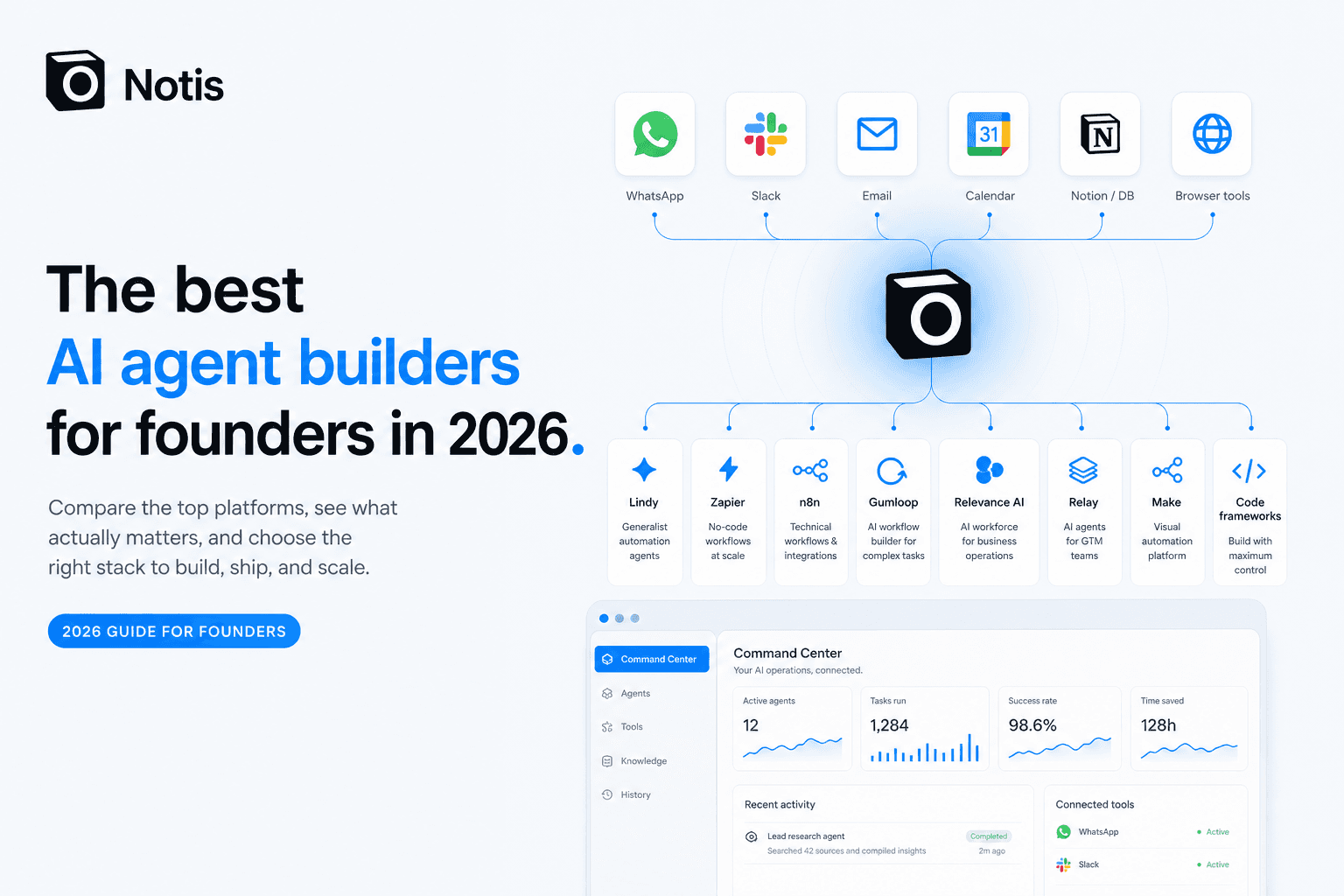
The Best AI Agent Builders for Founders in 2026
A founder’s practical guide to AI agent builders in 2026: what to use when you want agents that actually move work forward, not another tab pretending to be a teammate.
Most AI agent builder lists are written like the reader has unlimited time, unlimited patience, and a secret desire to become a part-time automation engineer. Founders do not. Founders want work to move: leads researched, emails drafted, meetings summarized, customers followed up with, notes filed, decisions remembered, and the boring bits handled without creating a second job called “maintain my agent stack.”
So I rewrote this guide with a simple filter: if I were a founder trying to get useful work done in 2026, which AI agent builder would I actually trust for which job?
Short version: there is no single “best AI agent builder”
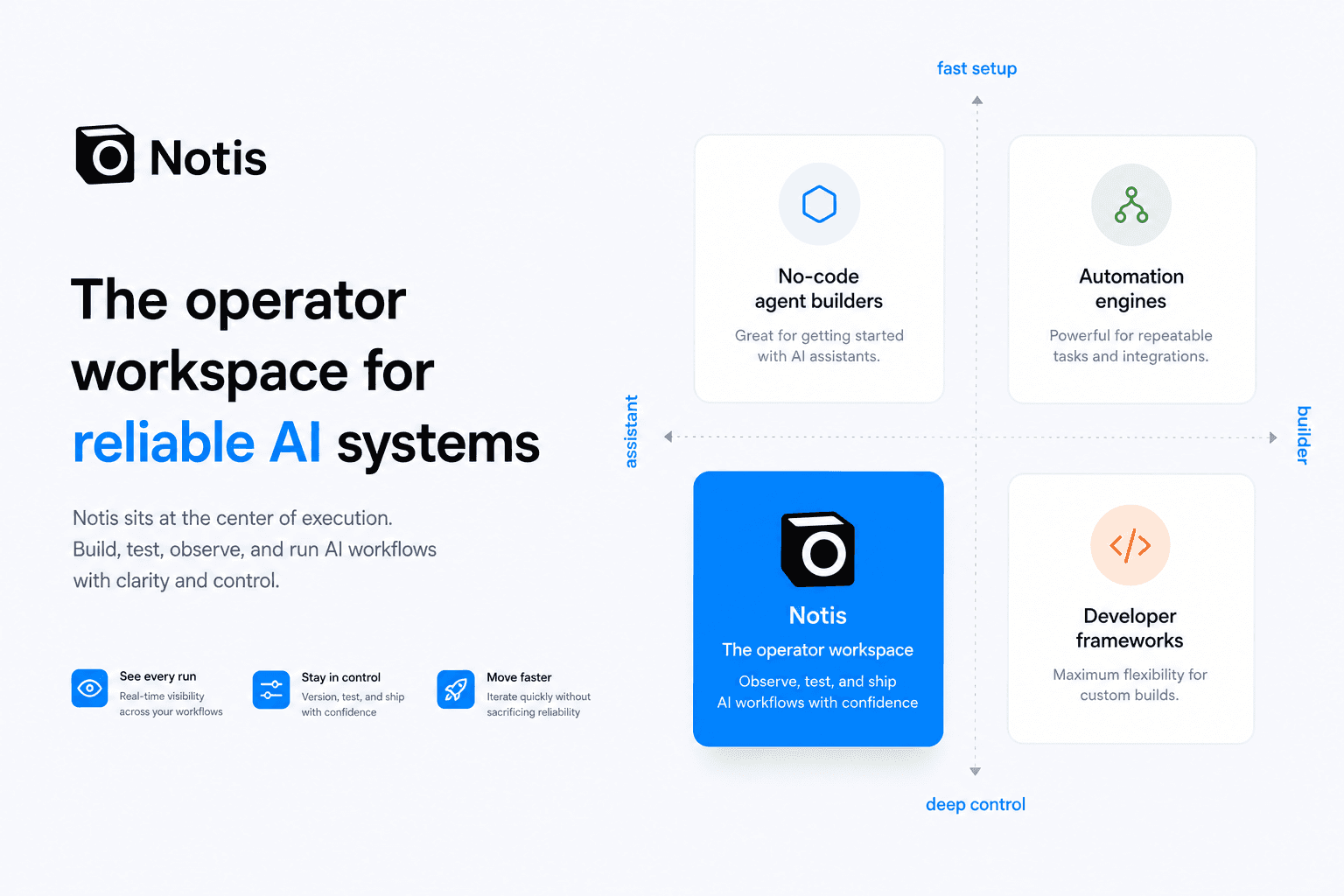
There are at least four markets hiding under that phrase. There are no-code agent builders like Lindy and Gumloop. There are automation engines adding agents, like Zapier, Make, Relay.app, and n8n. There are developer frameworks like LangGraph, CrewAI, OpenAI’s Agents SDK, and Google Vertex AI Agent Builder. Then there are operator workspaces like Notis, where the point is not to design agent diagrams all day, but to ask for an outcome from the channels you already use and let the system coordinate the tools.
That distinction matters. A founder looking for “AI agent builders” may want a canvas. Or they may actually want an assistant that can run work across email, Slack, calendar, Notion, browser, and databases without forcing them to become the ops department for their own AI.
How I judged the options
The winning tool depends on five things: how quickly a non-technical founder can ship the first useful workflow, how much control a technical founder gets when the workflow becomes serious, how many real business apps it can touch, how well it handles approval and observability, and whether the pricing model makes sense once agents start running every day.
I also looked at Search Console data for notis.ai before rewriting this. The obvious opportunity is not just the broad “best AI agent builders” keyword. Notis is already getting impressions around adjacent high-intent searches: “notion AI agent pricing,” “notion AI agents cost,” “notion custom agent pricing,” “notion AI automation,” “AI agents vs traditional automation 2026,” “Zapier AI workflow builder,” “n8n AI agent,” and “AI assistant for founders with no tech setup.” That tells me the page should not be a generic roundup. It should answer the buying question behind the query: do I need a builder, an automation platform, a developer framework, or a founder-facing agentic workspace?
The best AI agent builders for founders in 2026
Lindy is the best starting point if you want business-friendly agents and you do not want to wire everything yourself. Its own positioning is very direct: AI agents for annoying work, no code, no bloat, no headcount. That makes sense for founders who want sales ops, support, scheduling, meeting notes, and admin workflows quickly. The tradeoff is the usual one: the easier the builder feels, the more you are buying into that platform’s way of thinking. Lindy official agent page
Zapier Agents is the safest choice if your company already runs on Zapier. Zapier has the integration graph, the trigger/action model, and the business-user muscle memory. The agent layer is useful because it adds judgment on top of an ecosystem that already connects to almost everything. I would pick Zapier when the job is “when X happens, decide Y, then update Z,” not when the job is “be my cross-channel executive assistant.” Zapier’s 2026 roundup
n8n is the technical founder’s favorite for a reason. It gives you visual workflows, serious control, self-hosting options, and AI agent patterns without hiding the plumbing. If you care about owning the workflow and you are comfortable debugging it, n8n is excellent. If you are allergic to nodes, credentials, retries, and branching logic, it will feel like you bought yourself a hobby. n8n AI agents
Gumloop is strong when you want an AI-native workflow canvas. It feels less like classic automation with an AI step bolted on and more like building a chain of reasoning/action blocks. I would consider it for research, enrichment, scraping, document processing, and repeatable analysis workflows where the canvas is the product experience you want.
Relevance AI is more “AI workforce” than personal assistant. It is interesting for teams building specialized agents that behave like business roles: SDR agent, support agent, ops analyst, researcher. The upside is a more structured agent platform. The downside is that most founders do not actually need an org chart of digital employees on day one. Relevance AI docs
Relay.app deserves attention because human-in-the-loop automation is not a nice-to-have. It is the difference between “AI helped me” and “AI sent a weird email to a customer at 2:14am.” For founders automating customer-facing or revenue workflows, approval steps are not friction. They are seatbelts.
Make is still one of the best visual automation engines for complex scenarios. It is not always the most “agent-native” experience, but Make’s new AI agent direction makes sense if you already have scenarios and want an LLM to call tools rather than manually defining every branch.
LangGraph, CrewAI, OpenAI Agents SDK, and Vertex AI Agent Builder belong in a different bucket. They are for teams building agent products or internal systems where the agent itself is part of the software architecture. Powerful? Absolutely. Founder-friendly for everyday ops? Usually no, unless you have engineering time to spend.
Tool | Best for | Founder fit | Watch out for | My take |
|---|---|---|---|---|
Lindy | No-code business agents | Non-technical founders | Platform limits as workflows mature | Fastest path to a useful assistant-style agent |
Zapier Agents | Agentic automation across many apps | Teams already using Zapier | Can become Zap sprawl with AI sprinkled on top | Great integration backbone |
n8n | Flexible AI workflows | Technical founders/operators | More setup and maintenance | Best control-to-cost ratio if you can handle it |
Gumloop | AI-native workflow canvas | Ops-heavy teams | Canvas building is still building | Strong for research and analysis chains |
Relevance AI | AI workforce and role-based agents | Growing teams with clear processes | May be overkill early | Good when agents map to business roles |
Notis | Founder-facing agentic workspace | Founders who want outcomes from chat/email/Slack | Not the right choice if you only want to design raw agent graphs | Best when execution matters more than builder theater |
Which one should you choose?
If you are a non-technical founder and you want an AI assistant for sales, admin, meetings, and follow-ups, start with Lindy or Notis. Pick Lindy if you want to configure agents inside a dedicated builder. Pick Notis if you want to ask from WhatsApp, Slack, iMessage, Telegram, email, or the desktop app and have the agent work across your actual tools.
If you are a technical founder who likes owning the system, start with n8n. You will get more flexibility, better control, and less magic. You will also own more failure modes. That is fine if you enjoy the trade.
If you are an ops team turning repeatable processes into AI workflows, look at Gumloop, Relevance AI, Relay.app, Make, and Zapier. The decision is mostly about where your current workflows live and how much approval you need before an agent touches a customer, a deal, or money.
If you are building an agent product, ignore most no-code rankings and go straight to LangGraph, CrewAI, OpenAI’s agent tooling, or Vertex AI Agent Builder. That is software engineering, not founder productivity. Different sport.
Where Notis fits
I am obviously biased because I build Notis. But that also makes me allergic to pretending every founder wants another builder. Most founders do not wake up thinking, “I hope I can spend the morning connecting nodes.” They wake up thinking, “I have 37 loose threads across five apps and I need leverage.”
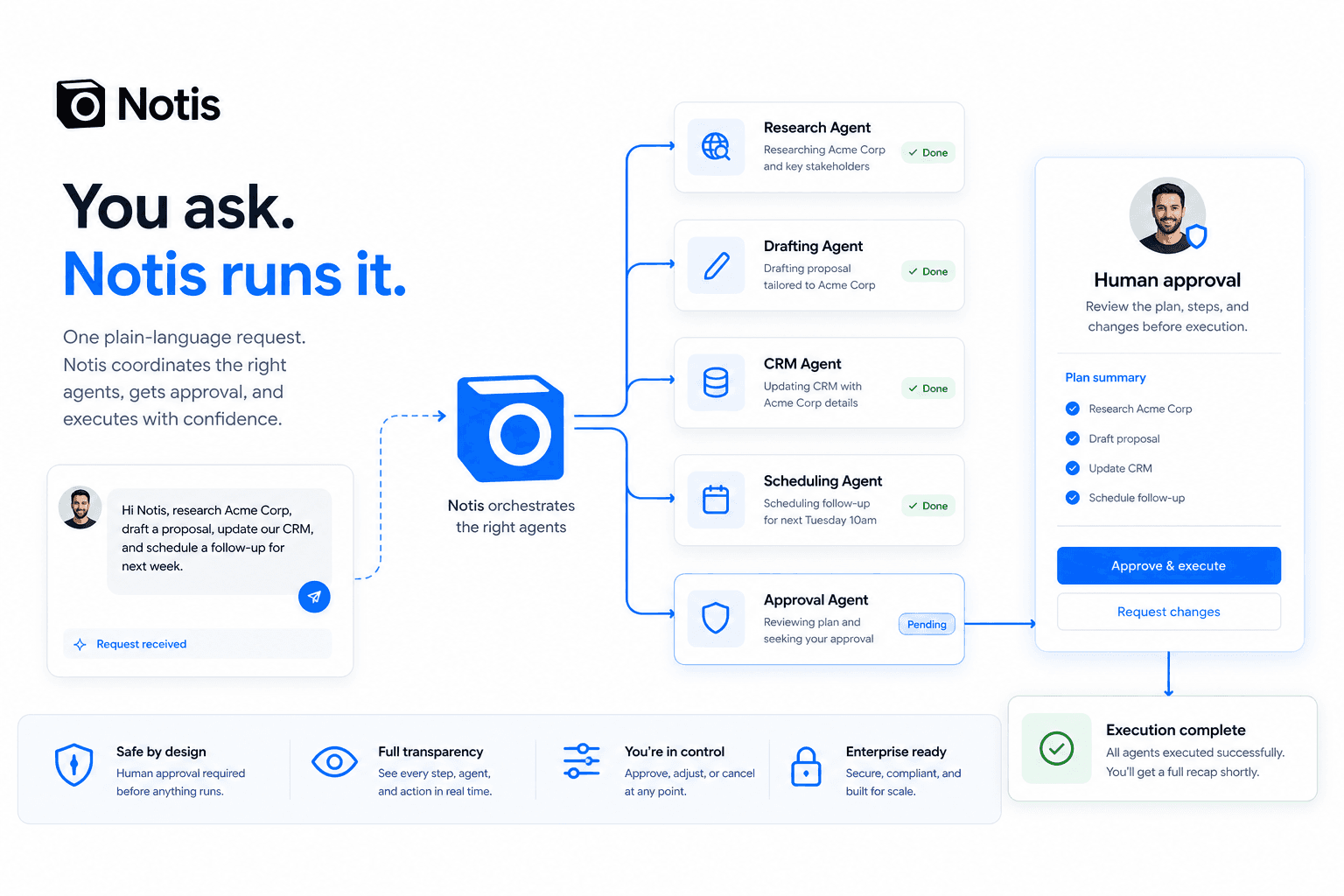
That is the lane Notis is trying to own: an agentic workspace for founders and operators who already live in messaging. You send the request where you are. Notis can remember context, use connected tools, run automations, search the web, update databases, manage notes, and route the result back to the channel you actually check. The product bet is simple: the best interface for many founder workflows is not a canvas. It is a conversation with tools attached and enough structure to make the work auditable.
So no, Notis is not trying to beat n8n at being n8n. It is not trying to beat LangGraph at being LangGraph. It is trying to replace the founder’s messy command center: the tabs, reminders, half-written notes, forgotten follow-ups, and “I’ll do it later” tasks that quietly tax your brain all day.
The honest recommendation
Use a builder when the workflow is stable, repeatable, and worth designing. Use n8n, Make, Zapier, Gumloop, or Relevance AI when you need a machine that does the same class of work over and over. Use developer frameworks when the agent is part of your product or infrastructure.
Use Notis when the problem is messier: work arrives from conversations, voice notes, meetings, emails, calendar events, documents, and random founder thoughts at inconvenient times. In that world, the winning agent is not the prettiest flowchart. It is the one that catches the work, understands the context, asks for approval when needed, and gets the thing done.
That is what I would optimize for in 2026: not more agents for the sake of agents, but fewer loose ends.

Flo is the founder of Mind the Flo, an Agentic Studio specialized into messaging and voice agents.
Related posts
The Best AI App Builders for Operators Who Want Output, Not More Tabs
A founder/operator guide to the AI app builders that actually help you ship business output: Lovable, Bolt, Replit, Base44, Bubble, Softr, Retool, Zapier, Make, and where Notis fits as the execution layer.
The Best Viktor Alternative for Founders Who Don't Live in Slack
A concise comparison of Viktor, the Slack‑only AI coworker for teams, versus Notis, a messaging‑native AI assistant built for solo founders who work across WhatsApp, iMessage, and other apps.
The Best AI Voice Agents for Operators in 2026
A founder-first comparison of the best AI voice agents in 2026, from Vapi and Retell to ElevenLabs, Bland, Synthflow, PolyAI, Cognigy, Sierra, Hume, OpenAI Realtime, and Notis. The real question: who turns voice into completed work?