

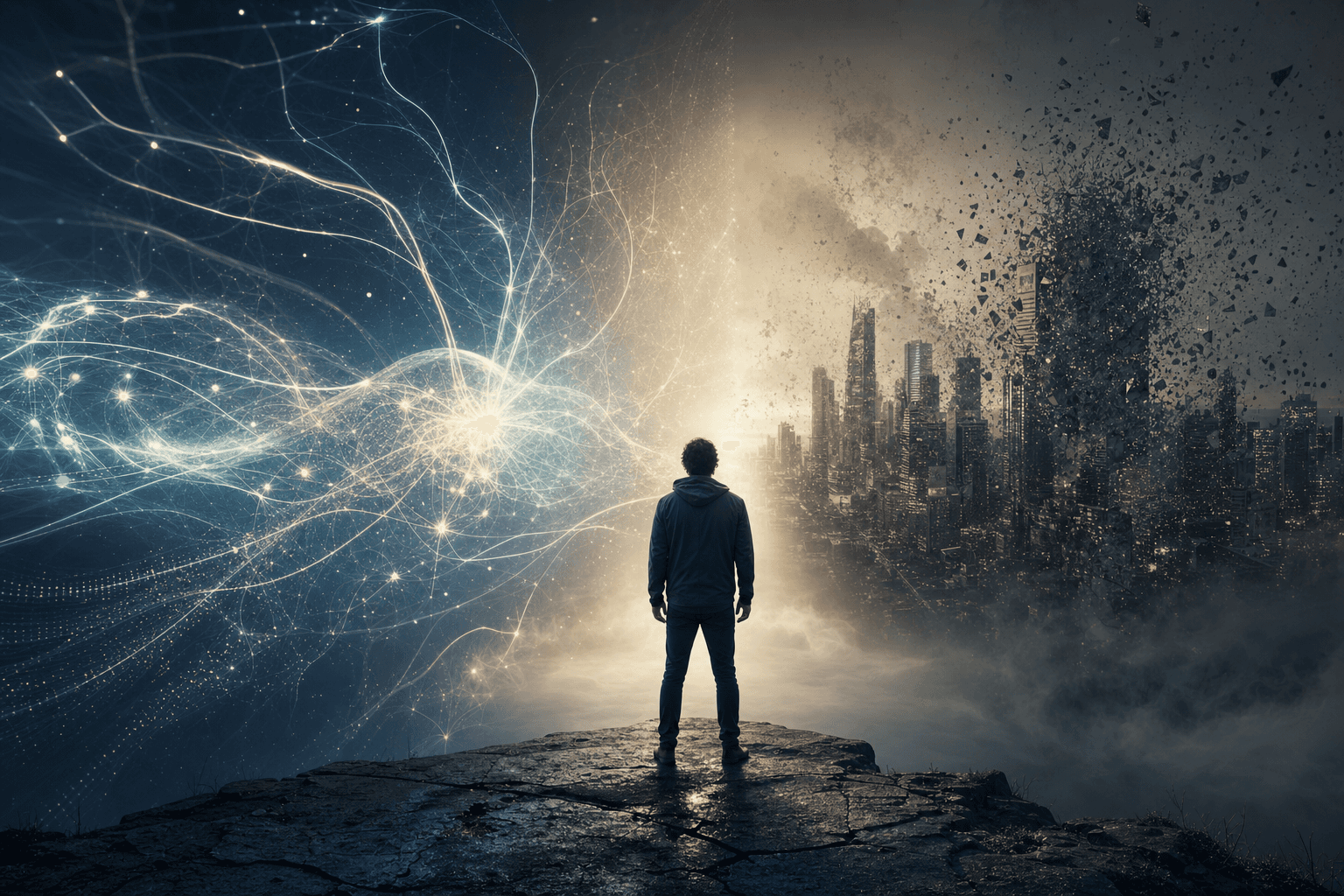
The AI Future No One Wants to Talk About
The scariest AI scenario might not be extinction. It might be a slower, more plausible collapse of the economic assumptions we still pretend are stable.
I think a lot of people in AI are still mentally modeling change as if it were linear. It is not. If intelligence is improving on an exponential curve, then the next decade is not going to feel like a more advanced version of today. It is going to feel like a category break.
That is why I take seriously a sentence that sounds absurd until you sit with it: there is a non-zero chance AI could end us, a higher chance it could break the economic system we currently call normal, and basically zero chance life looks remotely the same ten years from now. I am not saying this as clickbait. I am saying it because too many smart people are building on top of this curve while emotionally discounting what exponentials do.
The extinction take is the one everyone mocks, so let’s start there
I do not think human extinction in ten years is the base case. I do think pretending it belongs in the same bucket as science fiction is lazy. The people closest to frontier systems have spent the last few years issuing increasingly public warnings about misalignment, autonomous capability growth, biosecurity abuse, cyber offense, and the possibility that systems become strategically powerful before we learn how to robustly control them.
Even if you think the timelines are off, the structure of the argument is not crazy: if intelligence compounds faster than institutions adapt, we are entering a phase change with very little historical precedent. The honest position is not certainty. It is uncertainty plus asymmetry. If the downside is civilizational and the probability is non-zero, you do not get to shrug just because the claim sounds dramatic.
You also do not get to inflate it into prophecy. Serious people can disagree on whether frontier AI becomes existentially dangerous within a decade. What they cannot honestly say anymore is that the whole discussion is unserious. The right response is neither denial nor theatrical panic. It is sober respect for uncertainty.
The more likely shock is economic, not biological
If I had to bet on what breaks first, I would not bet on extinction. I would bet on the assumptions underneath modern capitalism. Not markets disappearing overnight. Not some Hollywood collapse. I mean the quieter foundations that make the system legible: wages linked to human labor, education roughly mapping to economic value, firms competing with human-scaled execution speed, and regulation moving fast enough to preserve trust.
That is where the next decade gets weird. AI does not need to become a god to wreck the pricing of knowledge work. It just needs to become cheap, reliable, fast, and good enough across a ridiculous number of tasks. When that happens, the value chain starts shifting under people’s feet. Entire layers of analysis, content, coordination, support, research, and software production get repriced.
A lot of jobs do not vanish in one dramatic announcement. They just stop justifying the same headcount, salary, or agency fees. That is why the economic collapse scenario feels more plausible than the extinction one in a ten-year window. We already know institutions move slowly. We already know technology tends to concentrate upside faster than it distributes it. Add systems that outperform humans in more cognitive tasks every year, and you get a world where trust and incentive structures start tearing.
The safest prediction is the deepest one: everything changes
Here is the only part I feel comfortable saying with confidence: there is no chance the next ten years leave everyday life untouched. That does not require AGI, superintelligence, or robot armies. It only requires continued progress at something close to the current pace. Work changes. Search changes. Education changes. Parenting changes. How companies are built changes. What counts as leverage changes. What counts as expertise changes.
Even the emotional texture of daily life changes once millions of people are interacting with systems that can think, speak, plan, remember, and execute with growing competence. That last part matters more than most founders admit. AI is not just automating tasks. It is changing the social expectation of what should be instant, personalized, and delegated. Once that expectation resets, products, jobs, and institutions built for slower human bottlenecks start looking broken.
This is why I keep saying the real product category is not chatbot. It is outsourced cognition. And once outsourced cognition works, a huge amount of the economy has to reorganize around it. That is not a niche software trend. That is a civilizational shift with product implications everywhere.
What founders should do with this instead of doomscrolling
The practical takeaway is not to become a bunker guy. It is to build and operate as if volatility is the default. Assume models will get dramatically better. Assume workflows built on scarcity of intelligence will be attacked from every angle. Assume customers will expect outcomes, not software. Assume trust, memory, and execution will matter more than raw model access because intelligence itself is becoming a commodity layer.
For operators, this means reducing dependency on roles and processes whose only moat is repetition. For founders, it means designing companies that can absorb capability jumps instead of being destroyed by them. For everyone, it means separating comforting stories from live reality. The future is not arriving in a neat product launch. It is arriving as a long, uneven rupture.
I build in AI, so I am not saying this from the outside. I am saying it from inside the machine. The most dangerous mistake right now is not overreacting. It is mistaking familiarity for safety. We have had enough demos, enough benchmarks, and enough real-world deployment to know we are not watching a normal software cycle. We are watching a new layer of civilization get poured in real time.
Maybe the extinction fears stay theoretical. I hope they do. Maybe capitalism mutates instead of collapses. That is possible too. But if you are still planning your company, career, or life as if the next decade is basically business as usual with better tools, you are not being optimistic. You are asleep.

Flo is the founder of Mind the Flo, an Agentic Studio specialized into messaging and voice agents.
Related posts
Why your AI Assistant Should Live in WhatsApp, Not Another App
The best assistant interface is the one that disappears into the chat thread you already use.
Why AI Productivity Tools Fail ADHD Founders (And What Actually Works)
AI productivity tools fail ADHD founders due to high activation costs; tools that live within existing messaging apps reduce friction and boost effectiveness.
The WhatsApp AI Assistant for Founders: Delegate, Execute, and Run Your Business From One Chat