

Stop Automating Repetitive Tasks. Delegate the Outcome.
A practical founder blueprint for turning repetitive work into messaging-native delegation, without building a fragile automation museum.
The trap with repetitive tasks is that founders try to automate the task they hate instead of delegating the outcome they actually need. So you wire up a rule. Then another rule. Then a weird exception. Three weeks later, you are not running a business. You are maintaining a tiny haunted factory of zaps, filters, templates, and calendar hacks.
The better question is not, “How do I automate this repetitive task?” It is, “What decision, message, update, or follow-up should exist when this work is finished?” That shift sounds small. It is not. It is the difference between duct-taping software together and giving an AI intern a job.
Repetitive work is usually a symptom, not the disease
Most repetitive founder work starts because the business is leaking context. A lead replies in email. A client asks something on WhatsApp. A meeting creates three follow-ups. A random idea appears while you are walking. None of those moments are hard in isolation, but each one asks you to stop, remember the larger situation, pick the next step, and move data into the right place.
That is why classic automation often disappoints solo founders. It is brilliant when the process is stable and dumb in a good way. Move a row. Rename a file. Send the same alert. But founder work is rarely that clean. It is messy, conversational, and full of tiny judgment calls.
McKinsey frames the opportunity around agentic AI as workflow-level work, not isolated prompts or one-off shortcuts. The value appears when AI can coordinate steps, use tools, and operate inside a real process with oversight. That is much closer to delegation than to the old “if this, then that” automation mindset.
Use rules for machines. Use an AI intern for messy admin.
Rules are still useful. Please do not ask an AI to rename every invoice PDF when a deterministic workflow can do it perfectly. The problem is that founders keep trying to force judgment-shaped work into rule-shaped systems.
A good rule says, “When a payment succeeds, add a row.” A good AI intern says, “This prospect replied positively, check our notes, draft a warm answer, suggest two meeting slots, and remind me tomorrow if I do not send it.” One is automation. The other is operational leverage.
This is where messaging-native matters. If you have to open a dashboard, design a workflow, configure nodes, and babysit logs, the task may be automated but your attention is not. For a solo founder, attention is the scarce resource. The interface should be the place where the work already interrupts you: WhatsApp, Telegram, Slack, email, or whatever channel you actually answer.
The founder test for what to delegate first
Start with the work that repeats often, has a clear “done” state, and benefits from context. Not the biggest process. Not the fanciest workflow. The annoying one you keep redoing because it is faster to do it manually than to build the perfect system.
Inbox triage is a good example. The output is not “read email.” The output is a clean decision: reply now, draft for later, archive, create a task, update a note, or chase someone. Meeting follow-ups are another. The output is not “summarize meeting.” It is “turn the conversation into the next three actions and make sure they do not die in my notes.”
The same pattern applies to customer requests, content ideas, research, invoices, scheduling, and investor updates. If the job begins with a message and ends with another message, reminder, note, or database update, it is probably a good candidate for an AI intern.
The Notis way: one message, many small executions
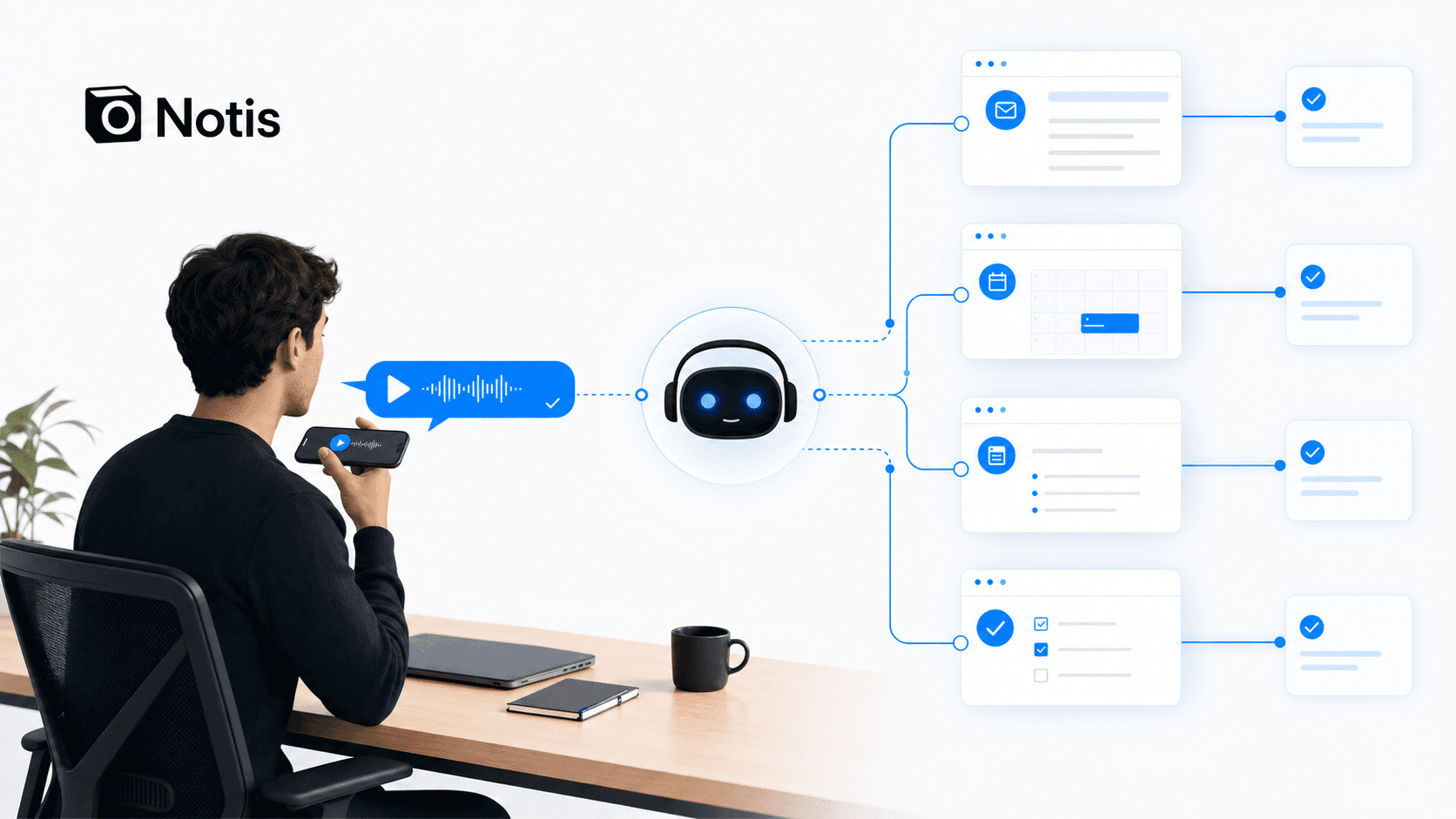
Notis is built around a simple bet: founders should be able to delegate from the channels they already use. Send a voice note. Forward an email. Drop a messy thought. Ask for the next step. Notis can use memory, skills, automations, and integrations to turn that input into useful work instead of another item in your capture graveyard.
That does not mean the AI should run your company unsupervised. I still like approval loops for external messages, sensitive updates, and anything involving money or reputation. But the approval should happen at the end of the work, not before you have spent thirty minutes setting up the workflow yourself.
Microsoft’s 2026 Work Trend Index talks about agents changing how knowledge work gets coordinated. The interesting part for founders is not the enterprise theater. It is the possibility of shrinking the gap between “I noticed this” and “the right thing happened.” That gap is where most solo operators lose hours.
What to automate this week
Pick one repetitive workflow and write the outcome in plain English. Not “automate email.” Try “when a serious lead replies, draft a response with context, propose times, and remind me if I have not answered by tomorrow.” Not “automate meeting notes.” Try “after every customer call, extract objections, update my CRM, and send me the follow-up draft.”
Then ask whether the work needs fixed rules, AI judgment, or both. Fixed rules handle the plumbing. The AI intern handles context, language, prioritization, and handoffs. You do not need to build a cathedral. You need one useful delegation loop that saves you from doing the same mental reset ten times a week.
If you want a place to start, use Notis.ai as the front door for the work you already send yourself. The goal is not to become an automation nerd. The goal is to stop carrying repetitive work in your head like it is a badge of honor.
Automate the boring mechanics. Delegate the messy outcome. Keep the final call. That is the founder version of leverage that does not require hiring someone, managing someone, or opening yet another app to check whether your automation remembered to work.
The market context behind this is not just vibes. McKinsey’s work on seizing the agentic AI advantage argues that the real shift is agents coordinating workflow steps, while Microsoft’s 2026 Work Trend Index frames agents as part of everyday knowledge-work coordination. That is the lens founders should use: not “which tiny task can I automate?” but “which recurring outcome can I safely delegate?”

Flo is the founder of Mind the Flo, an Agentic Studio specialized into messaging and voice agents.
Related posts
The Best AI Business Idea Is Boring: Become a One-Person Operator
The real AI business opportunity for solo founders is not another shiny idea list. It is using a messaging-native AI intern to operate faster with fewer moving parts.
The Right Way vs. the Wrong Way to Automate Your Business
Most businesses don’t fail at automation because the tools are bad. They fail because they automate the wrong things, in the wrong order, with nobody accountable for the result.
How I stay at Inbox Zero while scaling a company
Founder explains how removing repetitive email tasks and automating responses lets him keep inbox zero while scaling his company.