

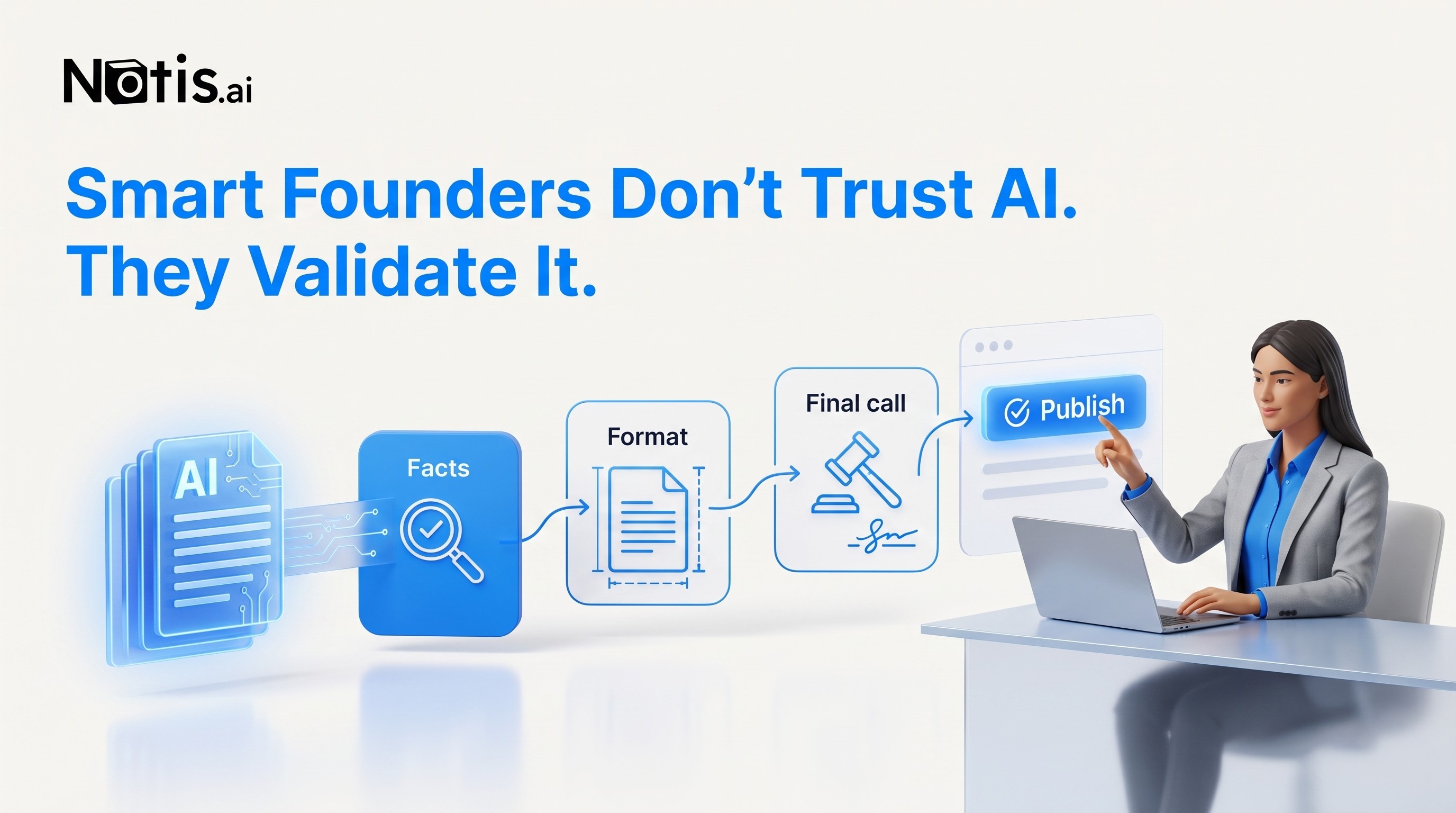
Smart Founders Don’t Trust AI. They Validate It.
AI delegation works when founders stop expecting perfection and build validation into the workflow. The win is not zero errors. It is getting five hours back while keeping the final call.
Sometimes AI feels annoyingly close to magic. Then, five minutes later, it formats every heading like it has never seen a blog post before. That does not make AI useless. It means the winning founder workflow is not blind trust. It is an AI validation workflow: delegate the heavy draft, research, sorting, and structuring work to AI, then keep the human final check where it actually matters.
The people who get disappointed with AI usually expected a perfect employee. The people who get leverage treat it like delegation. You would not let a freelancer publish under your name without review. You would not let an intern send investor updates without a quick read. AI is the same deal, except it can compress five hours of work into something you can review in ten minutes.
The goal is not perfect AI. The goal is controlled delegation.
Founders keep asking the wrong question: “Can I trust AI?” The useful question is: “Which parts of this task can AI do cheaply, quickly, and repeatedly, and which parts still need my judgment?” That shift sounds small, but it changes everything.
If you expect the machine to be right every time, every mistake feels like betrayal. If you expect variance, you design around it. A draft might need a source check. A summary might miss a nuance. A blog post might get the structure right but mangle the header formatting. Fine. The mistake is not proof that AI failed. The absence of a review step is the failure.
This is not only my opinion as someone building Notis. It is also where AI governance has been heading. The NIST AI Risk Management Framework talks about testing, evaluation, verification, validation, monitoring, and human oversight as lifecycle practices, not one-time vibes. In plain founder English: do not just put “human in the loop” on a slide. Decide what the human is checking and when they can stop the machine.
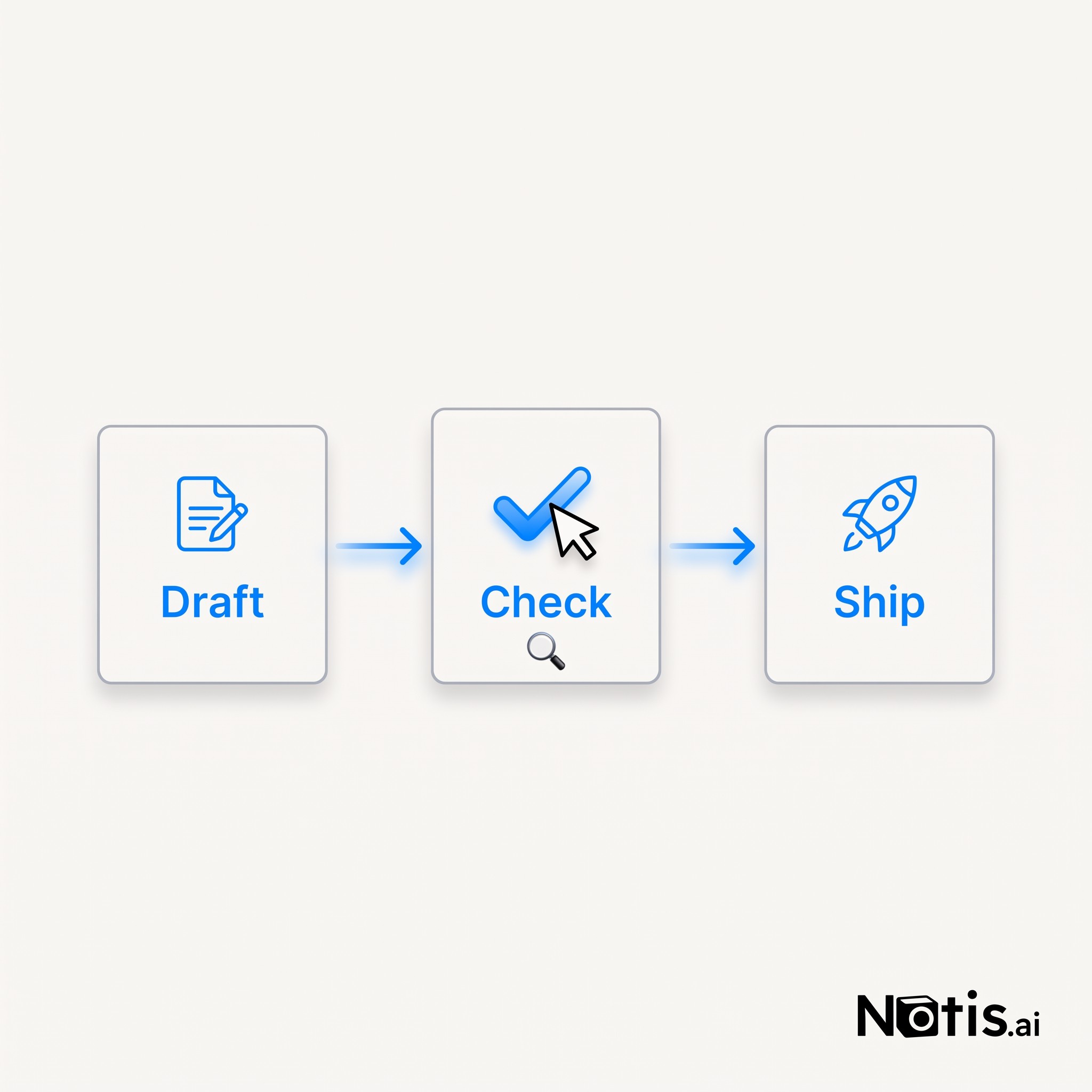
Why AI feels inconsistent even when it is useful
AI systems are probabilistic. They are not calculators wearing a nicer interface. They generate likely outputs from context, instructions, training patterns, retrieval, tool results, and whatever constraints you gave them. Change the context slightly and the output can shift. Give vague instructions and you get vague work. Ask for strategy and you may get brilliance on Monday and corporate soup on Tuesday.
That variability is frustrating because founders are tired. We want fewer things to manage, not another thing to babysit. But the practical question is not whether variance exists. It does. The question is whether the variance is smaller than the time saved. If AI saves you five hours and costs you ten minutes of review, that is not a broken system. That is leverage with quality control.
The trap is pretending review is embarrassing. It is not. Review is how all delegation works. Your name is on the output. Your judgment is the final product. The AI can draft the blog, summarize the meeting, create the comparison table, prepare the email, or clean the CRM. You still decide whether it is good enough to leave the building.
The founder version of human-in-the-loop is brutally simple
A lot of “human-in-the-loop” advice sounds like it was designed by a compliance committee that has never had to ship on a Tuesday afternoon. For a founder, the workflow needs to be lighter. The AI should do the maximum useful work before you arrive. Your review should be a fast, focused pass, not a second full production process.
IBM has a useful warning here: human involvement is not automatically governance if the human is only rubber-stamping outputs without context or authority. Their critique of “liability laundering” in human-in-the-loop systems is aimed at bigger organizations, but the founder lesson is the same: your review step needs teeth. If you cannot edit, reject, rerun, or escalate, you are not validating. You are just clicking a comforting button.
For most founder tasks, my review loop has five checks. First, context: did the AI understand what I actually wanted? Second, sources: are the factual claims grounded or at least phrased cautiously? Third, constraints: did it respect the format, channel, audience, and deadline? Fourth, voice: does it sound like me or like a LinkedIn ghostwriter trapped in a webinar? Fifth, final call: would I be comfortable with this going out under my name?
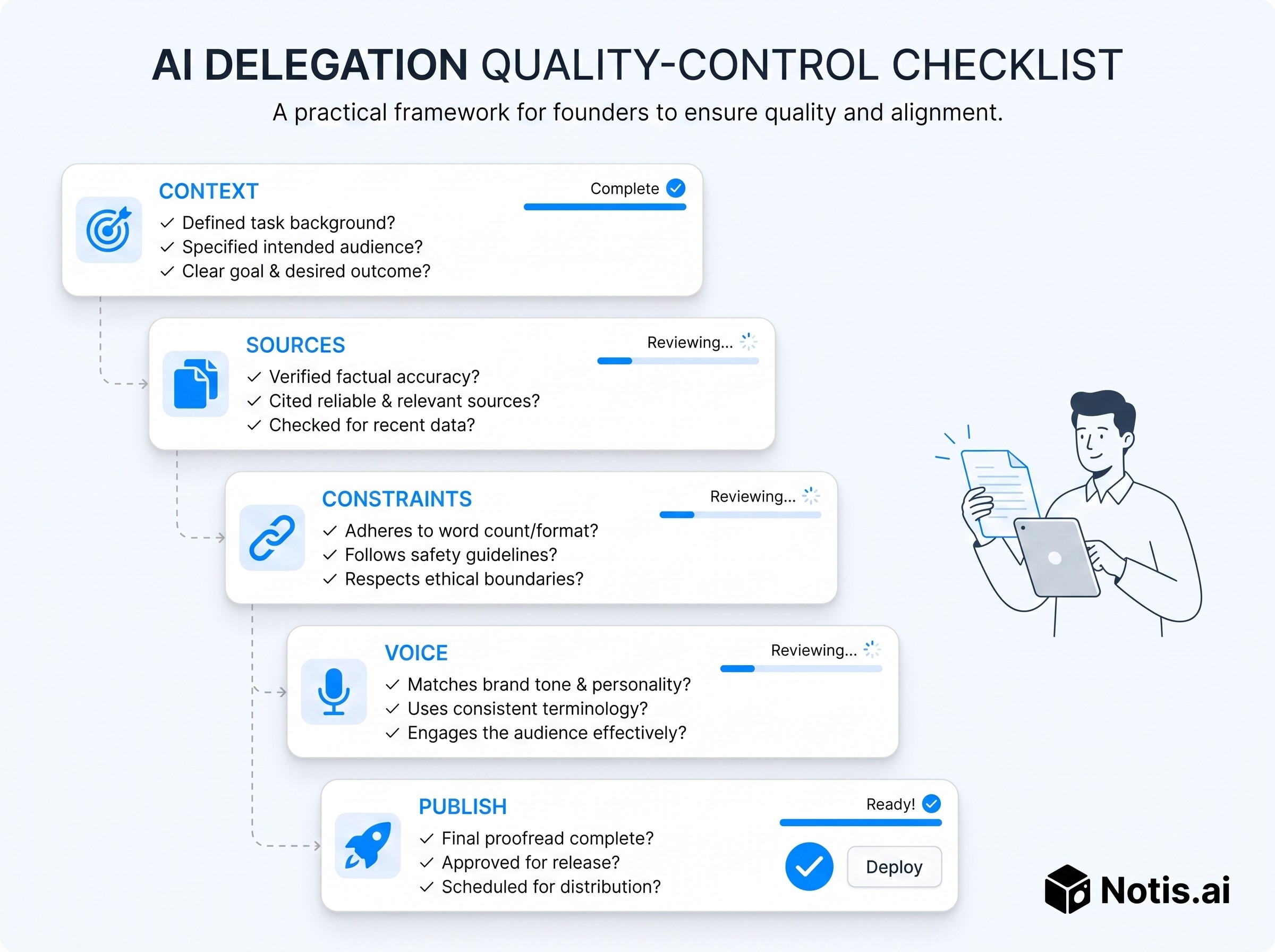
The validation workflow I use for Notis content
Notis has been helping write our blog posts, competitor comparisons, and content workflows for more than a year. It can take a source idea, research the angle, draft the structure, generate images, and save a draft. That is not theoretical productivity. That is the boring operational magic I care about.
But I am still the one hitting publish once a week. Sometimes the draft is strong. Sometimes a section is weird. Sometimes the headings are misformatted, or the conclusion has the emotional temperature of a microwave manual. When that happens, I ask Notis to redo the task or I edit the part myself. It is not dramatic. The machine saved me hours. Spending ten extra minutes to improve the final 10% is an excellent trade.
This is especially natural if you have ADHD or you already review everything because your brain does not trust any open loop. The validation step becomes part of the system instead of a shame spiral. The AI gives you a draft you can react to. Reacting is often easier than starting from nothing. For ADHD founders, that matters because the blank page is expensive and context switching is brutal.
This is also why I keep Notis messaging-native. If the idea starts as a voice note in WhatsApp, Telegram, Slack, iMessage, or email, the assistant can turn that messy thought into a draft, a task, a reminder, or a workflow without forcing you into yet another dashboard. The review can happen where the founder already is. That is the difference between an AI tool you admire and an AI intern you actually use. You can see that broader positioning on Notis.ai and in our post on the WhatsApp AI assistant built for founders who execute.
A good AI validation workflow reduces anxiety
The hidden benefit of validation is not just quality. It is nervous-system relief. When there is no process, every AI output creates a tiny existential question: should I trust this? Did it hallucinate? Am I about to look stupid? That uncertainty eats the time you were supposed to save.
A validation workflow turns the question into a routine. For factual work, check the source. For public writing, check the voice. For structured work, check the format. For sensitive work, slow down. For low-risk internal work, accept the 80% and move on. The point is not to inspect every comma. The point is to know which mistakes would matter.
Research on human evaluation of AI suggestions also keeps pointing toward the same messy truth: success depends on workflow design, reviewer context, and human judgment, not only model capability. The MIT Press journal Harvard Data Science Review has covered how evaluating AI assistance depends on the interaction between people, tasks, and systems, not just whether the model was impressive in isolation.
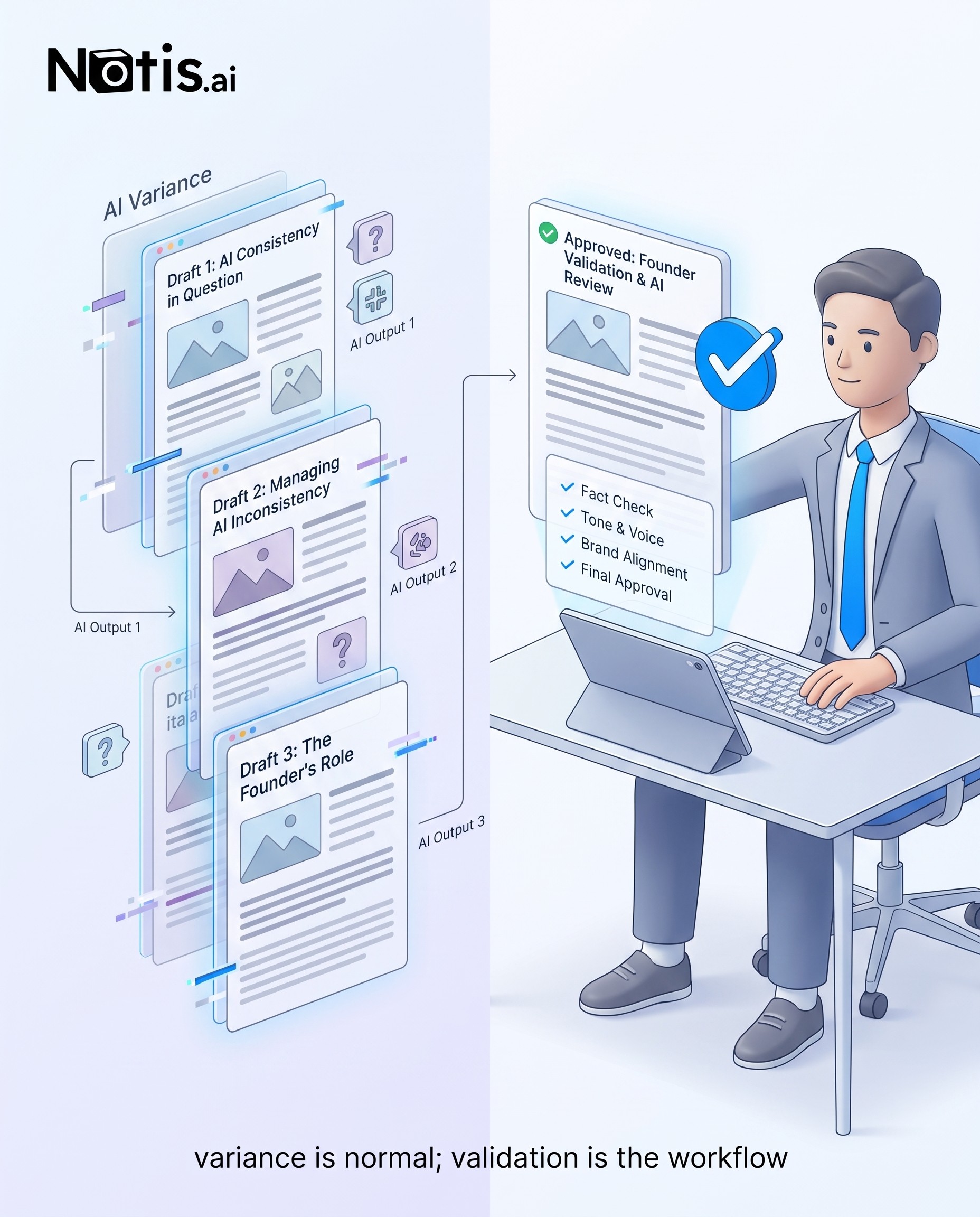
When to trust, when to check, when to redo
Not every task deserves the same level of scrutiny. A private brainstorming list can be messy. A customer email needs a tone check. A legal claim needs a real source. A blog post needs structure, originality, links, and voice. A database update needs the right fields. The review effort should match the blast radius.
My rule is simple: let AI move fast where the cost of being wrong is low, and slow it down where the output changes someone else’s understanding, money, time, or trust. That is not anti-AI. That is how you keep using AI after the novelty wears off.
The founders who win with AI will not be the ones who believe every output. They will be the ones who build boring, repeatable validation into the workflow. They will delegate aggressively, review intelligently, and stop asking the machine to remove their responsibility. That responsibility is the job. AI just makes the job smaller.
The real promise of AI delegation
The promise is not that you disappear. The promise is that you stop being the bottleneck for every first draft, every summary, every comparison, every follow-up, every tiny piece of operational sludge that currently lives in your head.
Let AI be inconsistent sometimes. Humans are inconsistent too, and we still manage to build companies together. The question is whether the workflow catches the important mistakes before they matter. If it does, you do not need perfect AI. You need an AI assistant that does the heavy lifting, shows its work where possible, and waits for your final call.
That is the boring, founder-friendly version of trust: not blind faith, not paranoia, just delegation with a checkmark before publish.

Flo is the founder of Mind the Flo, an Agentic Studio specialized into messaging and voice agents.
Related posts
The Best AI Assistant for ADHD Founders Is the One You Don’t Have to Open
For ADHD, AuDHD, autistic, and neurodivergent founders, the best AI assistant is not the one with the most impressive dashboard. It is the one that removes the smallest possible amount of friction between a thought and a finished action.
Your Life OS Should Start in Your Messages
Neurodivergent founders do not need another dashboard to maintain. They need an external operating layer that starts where their thoughts already appear: messages.
Your AI Intern Should Protect Your Social Battery
For neurodivergent founders, delegation is not just a productivity problem. It is an energy-management problem. Here is how an AI intern can absorb work without adding another human to manage.