

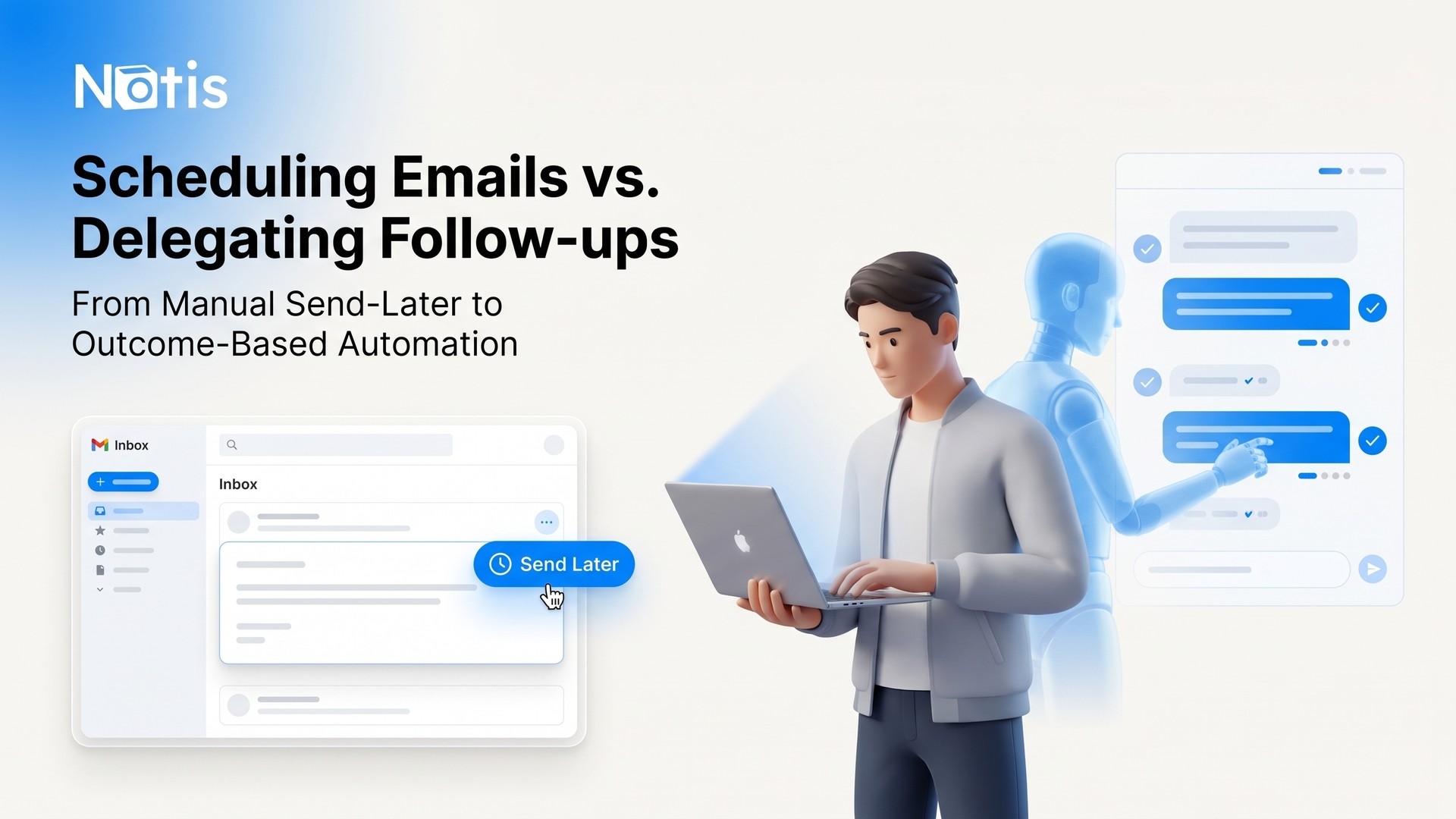
Scheduling Emails Is Fine. Delegating Follow-Ups Is Better.
Gmail’s Schedule Send is useful, but founders need more than delayed delivery. They need an AI intern that owns outcomes, follow-ups, and context.
Scheduling an email is one of those tiny productivity features that feels clever the first time you use it. You write at midnight, send at 9:00, and look like a functional adult. Wonderful. But for founders, “send this later” is usually not the real job.
The real job is: make sure the conversation moves. Get the reply. Keep the deal alive. Nudge without sounding needy. Follow up only if needed. Remember what happened last time. Book the meeting when the person says yes. That is not email scheduling. That is operational follow-through.
Gmail Schedule Send solves timing, not responsibility
Gmail’s built-in Schedule Send is genuinely useful. Google’s own help page says you can schedule up to 100 emails and cancel or edit scheduled messages before they go out (Google Help). Google introduced the feature as a way to write when convenient and send when it is better for the recipient (Google Workspace Updates).
That is a clean solution for a clean problem. You know the recipient. You know the message. You know the time. You just want Gmail to hold the email until later.
Founder work is rarely that clean. You do not always know whether you should follow up on Wednesday or only if there is no reply. You may want a different message depending on whether the prospect opened the door, ignored you, or asked a new question. You may need to check a calendar, attach a doc, mention a previous thread, or update your CRM. Schedule Send is a clock. It is not an intern.
Manual send-later creates a fake sense of control
The danger is subtle. You schedule the email, feel productive, and mentally close the loop. But the outcome is still unmanaged. If they reply, you need to notice. If they do not, you need another reminder. If they ask for a time, you need to coordinate. If the conversation changes, the scheduled email may become awkward.
This is how founders end up with a graveyard of half-managed loops: scheduled emails, snoozed emails, reminders, calendar notes, and a vague feeling that something important is hiding in the inbox. Google itself recommends batching email rather than constantly checking it, because reading, sorting, and replying are different activities (Google blog). Research on email batching has also linked fewer checking windows with lower distraction and stress. The point is obvious if you have ever tried to build while refreshing your inbox: email is a context-switch machine.
Delegate the outcome, not the timestamp
The Notis workflow is different. Instead of deciding every step yourself, you hand off the desired outcome in a message. “Follow up with Maya if she has not replied by Thursday, keep it short, and if she says yes, offer Tuesday or Wednesday afternoon.” That instruction contains timing, tone, condition, and next action in one natural sentence.
Even better, you can do it by voice. Forward the email to Notis. Send a WhatsApp voice note. Drop the messy instruction while walking between calls. The assistant can remember context, use integrations, and come back when approval is needed. You do not need to construct a perfect automation. You delegate like you would to a human intern, except the intern lives in your messages and does not require a weekly one-on-one to remember the basics.
When Schedule Send is still the right tool
There are cases where manual scheduling is perfectly fine. A newsletter. A simple thank-you note. A message you have already written and simply want delivered at a respectful time. Use the built-in tool. Do not over-engineer a sandwich.
But the moment the task has conditions, context, or follow-through, scheduling becomes too small. “Send this at 9” is not the same as “make sure this relationship progresses.” The second one is the kind of work an AI intern should own.
A simple founder workflow
Here is the better pattern. First, capture the loop immediately: forward the email or send a voice note to Notis. Second, define the outcome in human language: “get a meeting booked,” “make sure they receive the deck,” “nudge only if no reply,” or “draft a reply in my tone.” Third, let the assistant watch for the next state. Fourth, require approval before anything sensitive goes out.
This protects your focus because you are not returning to the inbox just to babysit your own reminder system. You are moving responsibility out of your head and into an assistant that can act across the tools where the work actually happens.
The upgrade is psychological as much as technical
Founders do not need more micro-controls. They need fewer open loops. Schedule Send is useful because it removes one tiny timing decision. Delegated follow-up is powerful because it removes the need to keep re-opening the same mental tab.
That is the promise of a messaging-native AI intern. You do not manage every timestamp. You describe the outcome, hand it off, and get back to the thing you were actually trying to build.

Flo is the founder of Mind the Flo, an Agentic Studio specialized into messaging and voice agents.
Related posts
The ADHD Founder Bug Capture Method: Notice It, Log It, Keep Coding
A practical workflow for ADHD founders and developers who spot bugs mid-flow: capture the issue, protect your attention, and batch fixes later.
ADHD Hyperfocus Meeting Prep: Show Up Ready Without Breaking Focus
A practical ADHD-founder workflow for staying in hyperfocus while Notis automatically prepares a concise meeting brief from calendar, email, and CRM context before every call.
The ADHD Founder Brain Dump Method: One Voice Note, Then Back to Work
A practical, founder-first method for using voice notes in WhatsApp, iMessage, or any daily messaging app as an external memory system before racing thoughts turn into operational debt.