

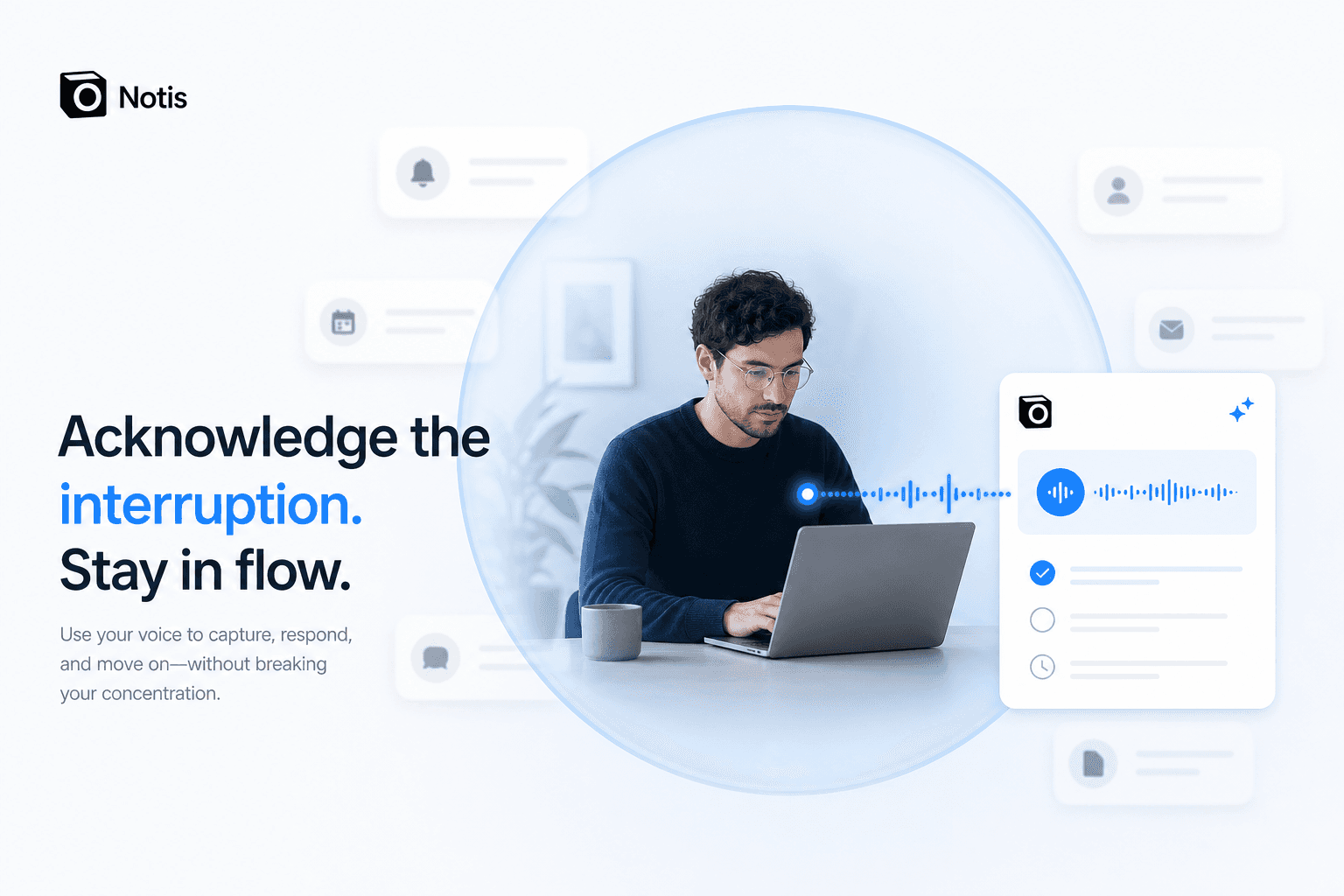
Protect Your Flow State: The 25-Minute Cost of One Notification
A practical ADHD-founder workflow for handling notifications without context switching: acknowledge the ping, voice-note the task to Notis, and stay in deep work.
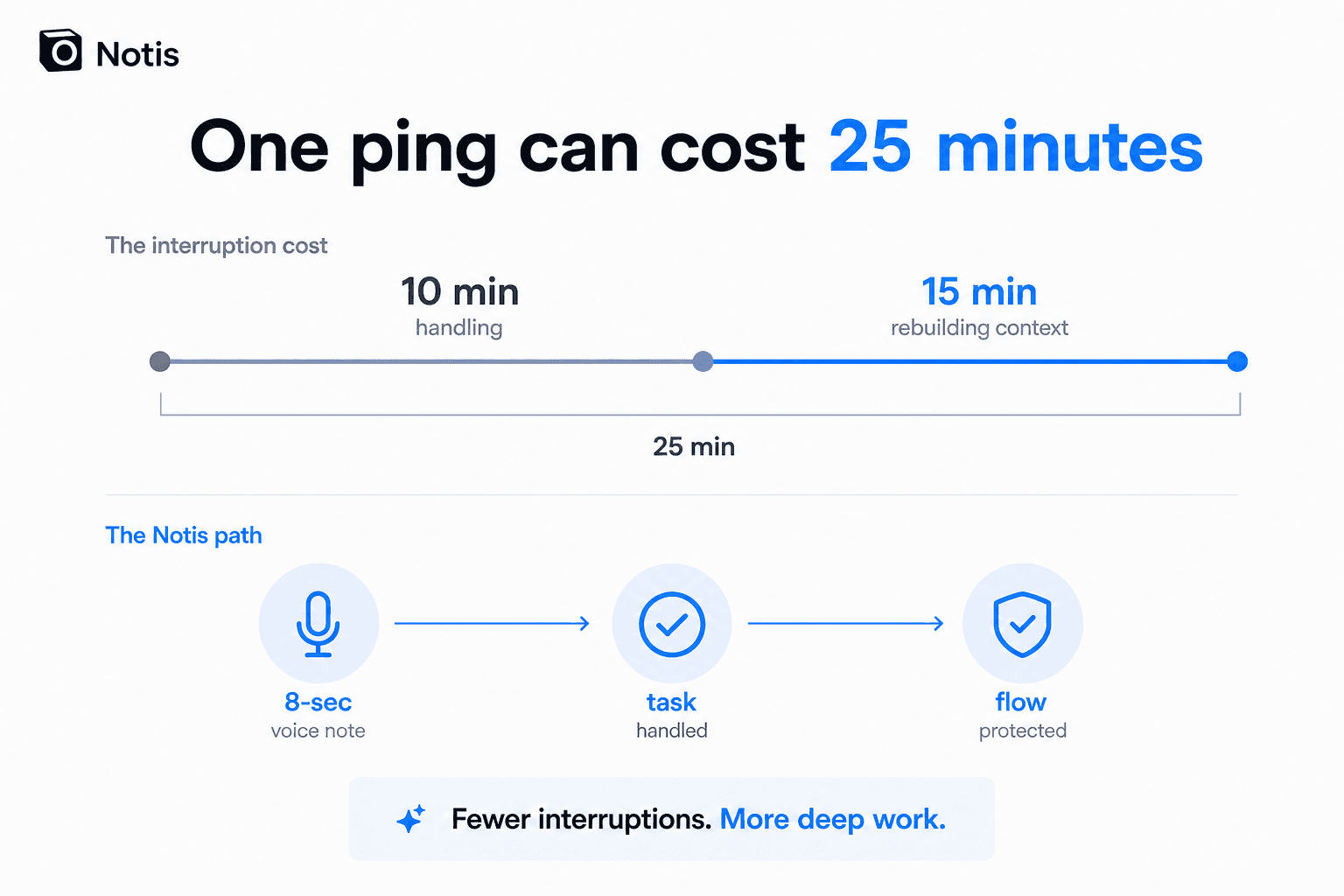
Every notification is a tiny hostile takeover of your brain. It looks harmless: a customer asking for a refund, a calendar ping, a Slack-ish blob of urgency, one email with a subject line that sounds more dramatic than it is. You tell yourself you will “just handle it quickly.” Then the real bill arrives. You spend ten minutes dealing with the thing, then another fifteen trying to remember what the hell you were building before the ping landed.
That is the founder version of context switching: not laziness, not lack of discipline, but a workflow that lets other people’s timing become your operating system. If you have ADHD, or even just a very interruptible builder brain, the cost is worse because getting into flow is already the rare expensive part. Once you are there, protecting it is not a productivity hack. It is survival.
The real problem is not the notification. It is the switch.
Research on interrupted work has been annoyingly consistent for years: interruptions do not just steal the minute they occupy. Gloria Mark and colleagues found in The Cost of Interrupted Work that interrupted work can come with higher stress, frustration, time pressure, and effort. UC Irvine’s later summary of Mark’s work puts the recovery problem in very human terms: it can take around 23 minutes to get back on track after an interruption.
There is also the sneaky residue problem. Sophie Leroy’s work on attention residue explains why a piece of your brain can stay stuck on the previous task after you switch. So when you interrupt a coding session to answer a refund email, you do not return as the same person. You return with a browser tab full of customer context, a half-finished sentence in your head, and the fragile architecture of your feature collapsed into fog.
Why ignoring notifications does not work for founders
The classic deep work advice is to turn everything off. Beautiful in theory. Slightly ridiculous when you are the founder, support team, product manager, marketer, and sometimes the person who remembers to pay the Stripe invoice. Ignoring notifications can create its own anxiety. You do not relax because the ping is gone. You wonder what is burning.
That is why the better move is not ignoring. It is acknowledging without engaging. The distinction matters. Ignoring says, “I refuse to know.” Engaging says, “I will abandon my current work and go through the portal.” Acknowledging says, “I saw it, I captured the next action, and I am not switching contexts right now.”
Even the notification itself can be enough to hurt performance. A study in the Journal of Experimental Psychology found that receiving cell phone notifications can create an attentional cost even when people do not fully interact with the phone. Your brain still checks the door. For ADHD founders, that door is basically made of magnets.
The Notis move: capture the interruption, delegate the next action, stay in flow
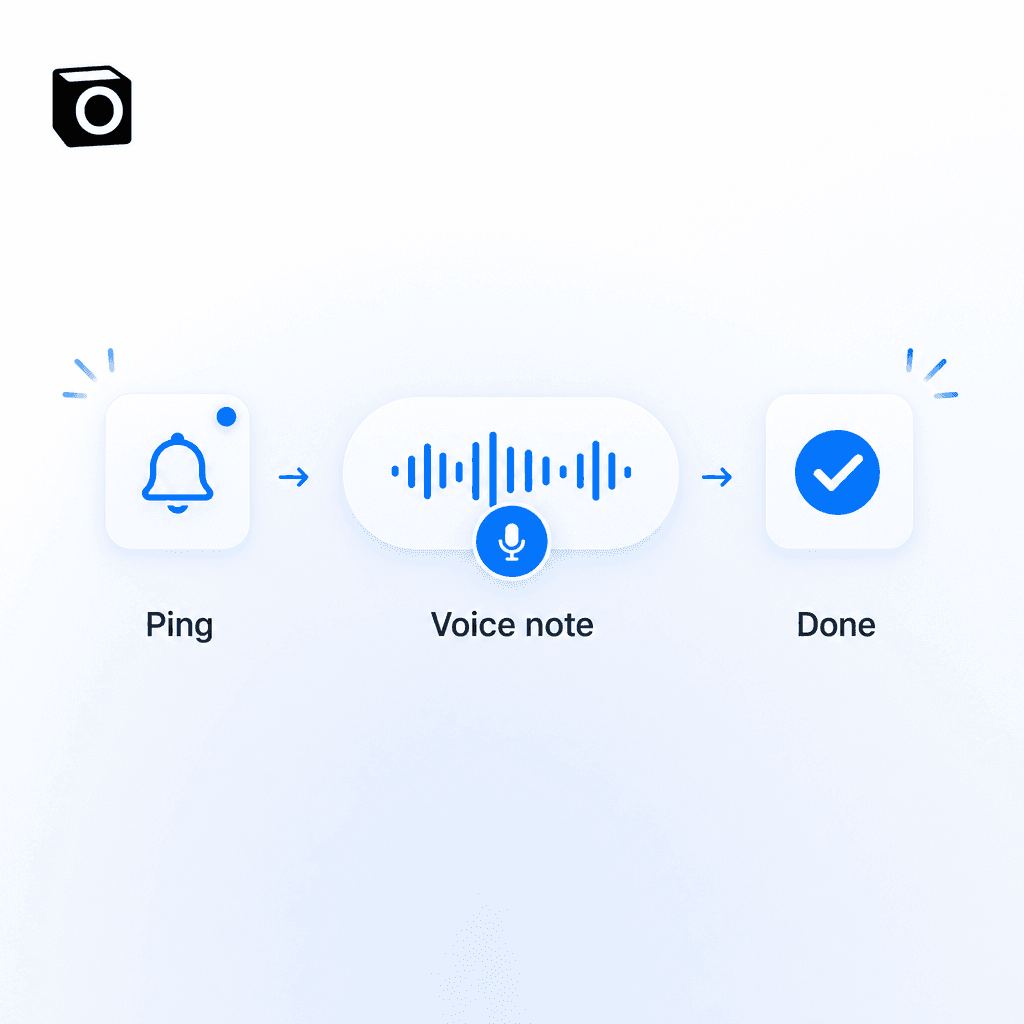
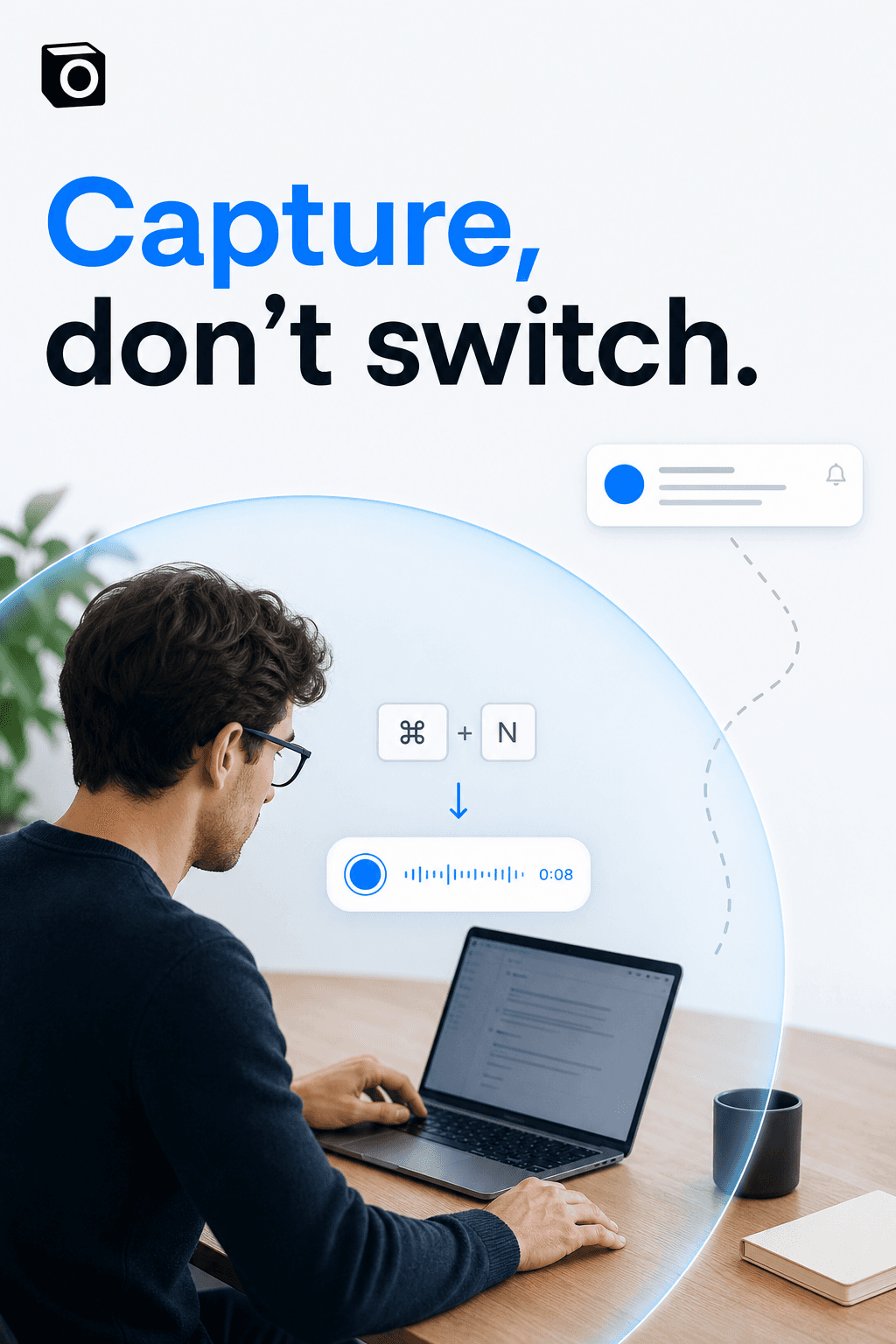
Here is the workflow I use when I am coding and a “quick” interruption appears. I do not open Gmail. I do not start typing the reply. I do not convince myself that customer support is only a two-minute detour. I hit the shortcut, record a voice note to Notis, and go back to the work that was already expensive to enter.
The voice note is not a diary entry. It is an instruction. “Hey Notis, check the last customer refund email, draft a direct reply, and only ask me if there is a policy decision I need to make.” Or: “Create a task to review this issue after the focus block and include the context from the last email.” Or: “Reply to the customer if this is clearly within refund policy.”
The point is not that voice notes are magical. The point is that speaking a task is low-friction enough to satisfy the anxious part of your brain without letting the interruption swallow the next 25 minutes. Notis is useful here because it lives where the interruption already lives: email, messaging, calendar, automations, tools. It can turn the spoken instruction into execution, not just a prettier note.
A simple rule for ADHD flow protection
When a notification arrives during deep work, ask one question: does this require my present attention, or only my future responsibility? Those are not the same thing. Most pings need ownership, not immediacy. A refund request needs a response. It does not necessarily need the best part of your coding brain right now.
If it requires present attention, handle it and accept the cost. Sometimes the building is actually on fire. But if it only requires future responsibility, voice-note it into Notis and keep going. This turns the interruption into a captured obligation instead of an open loop.
I like this better than pure notification blocking because it respects founder reality. You are not pretending the outside world does not exist. You are creating a membrane. Things can enter the system without entering your head.
Why this matters for voice notes to Notion and beyond
Search Console shows Notis already has meaningful visibility for intent like “notion ai voice notes” and “voice notes to notion,” especially around the existing guide on transcribing voice notes into Notion. That is still useful. But for founders, the next step is more important than transcription. The real question is not “how do I save this thought?” It is “how do I get this handled without breaking my flow?”
That is where the AI assistant category gets interesting. A notes app captures. An automation tool routes. A proper AI intern takes the messy spoken instruction, understands the context, uses the right tool, and comes back with progress. Sometimes that progress is a drafted email. Sometimes it is a task in the right database. Sometimes it is a summary for you to approve later.
Protecting flow is not selfish. It is how you ship.
Founders love to romanticize responsiveness because it feels responsible. But if every ping gets to decide your schedule, you are not responsive. You are rented. Your best work becomes whatever survived the notification weather.
So the next time a refund request, bug report, calendar ping, or random urgent-looking message appears while you are finally in flow, do not be a hero. Acknowledge it. Voice-note the next action to Notis. Let the system carry the obligation while you keep the expensive part of your brain pointed at the work only you can do.
The goal is not inbox zero. The goal is interruption zero-ish. Close enough that you can ship.

Flo is the founder of Mind the Flo, an Agentic Studio specialized into messaging and voice agents.
Related posts
Scheduling Emails Is Fine. Delegating Follow-Ups Is Better.
Gmail’s Schedule Send is useful, but founders need more than delayed delivery. They need an AI intern that owns outcomes, follow-ups, and context.
The ADHD Founder Bug Capture Method: Notice It, Log It, Keep Coding
A practical workflow for ADHD founders and developers who spot bugs mid-flow: capture the issue, protect your attention, and batch fixes later.
ADHD Hyperfocus Meeting Prep: Show Up Ready Without Breaking Focus
A practical ADHD-founder workflow for staying in hyperfocus while Notis automatically prepares a concise meeting brief from calendar, email, and CRM context before every call.