

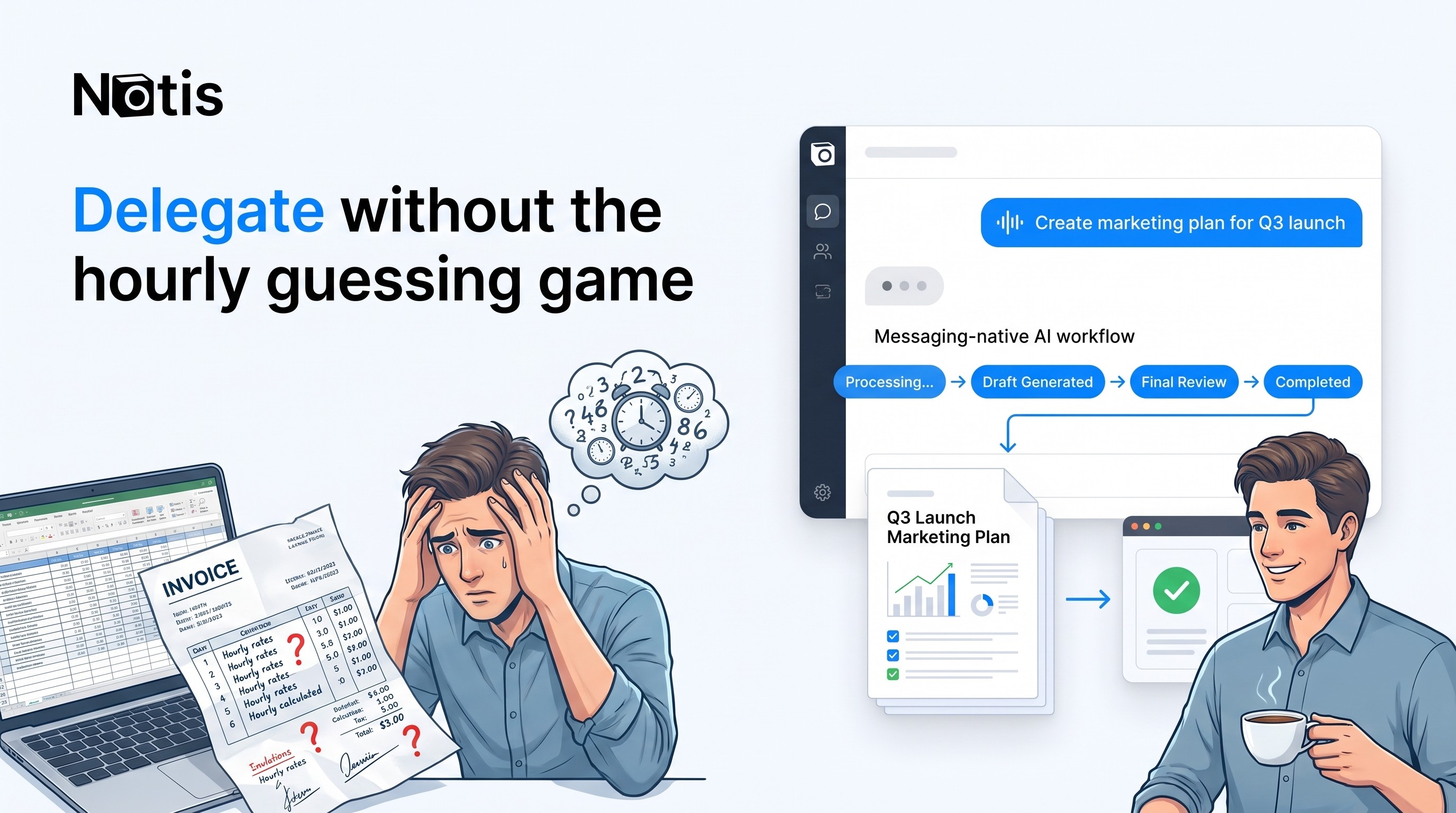
AI Assistant vs Freelancer: Delegate Without the Hourly Guessing Game
Freelancers sell time. AI assistants sell execution. Here’s how founders should decide what to delegate to humans, what to delegate to AI, and where approval still matters.
The most exhausting part of hiring freelancers is not the invoice. It is the guessing game. Did this take four hours or forty minutes? Are they solving the actual problem or protecting the next billable block? Are they under-communicating because they are busy, or because the work is not really moving? None of this makes freelancers bad. It just means the incentive model is weird when you are a founder trying to get leverage without adding another management job to your week.
That is why the question is no longer simply “should I hire a freelancer?” The better 2026 question is: when should a founder delegate to an AI assistant, when should they hire a human, and when should the task stay on their own desk? The answer is not “AI replaces everyone.” Boring. Also wrong. The answer is that AI changes the default unit of delegation from hours to outcomes.
This matters because the search behavior is already shifting. In Search Console, Notis is seeing relevant impressions for queries like “ai assistant for founders with no tech setup,” “voice ai assistant for founders,” “best ai virtual assistants 2026,” “ai intern,” and “ai intern meaning.” The intent is obvious: founders are not looking for another chatbot to admire. They are trying to understand what they can safely hand off.
The freelancer problem is incentive alignment
A freelancer is usually paid for time, scope, or deliverables. Time is simple to bill but terrible for trust. Scope is cleaner until the work changes, which it always does. Deliverables are best, but only if you can define quality before the work starts. That is the founder trap. You hire help because you are overloaded, then you need to become a project manager to make the help useful.
AI assistants are different because they do not care about protecting their afternoon. They do not get annoyed that the brief changed. They do not quietly optimize for the easiest interpretation of the task because the retainer is running out. The model still has limits, obviously. It can misunderstand you, hallucinate, or produce mediocre work if the context is thin. But the incentive problem is gone. The output is not pretending to be effort. It is just the best attempt the system can make with the context and tools you gave it.
That is the useful part of the “AI intern” metaphor. An intern is not a senior operator. You do not hand them your Stripe account and say “good luck.” But you can give them repeatable work, clear constraints, examples of good output, and an approval step. I wrote more about that framing in What Is an AI Intern? The Founder’s Answer in 2026, because it is still the cleanest mental model I know for founder delegation.
Delegation is not trust. It is controlled permission
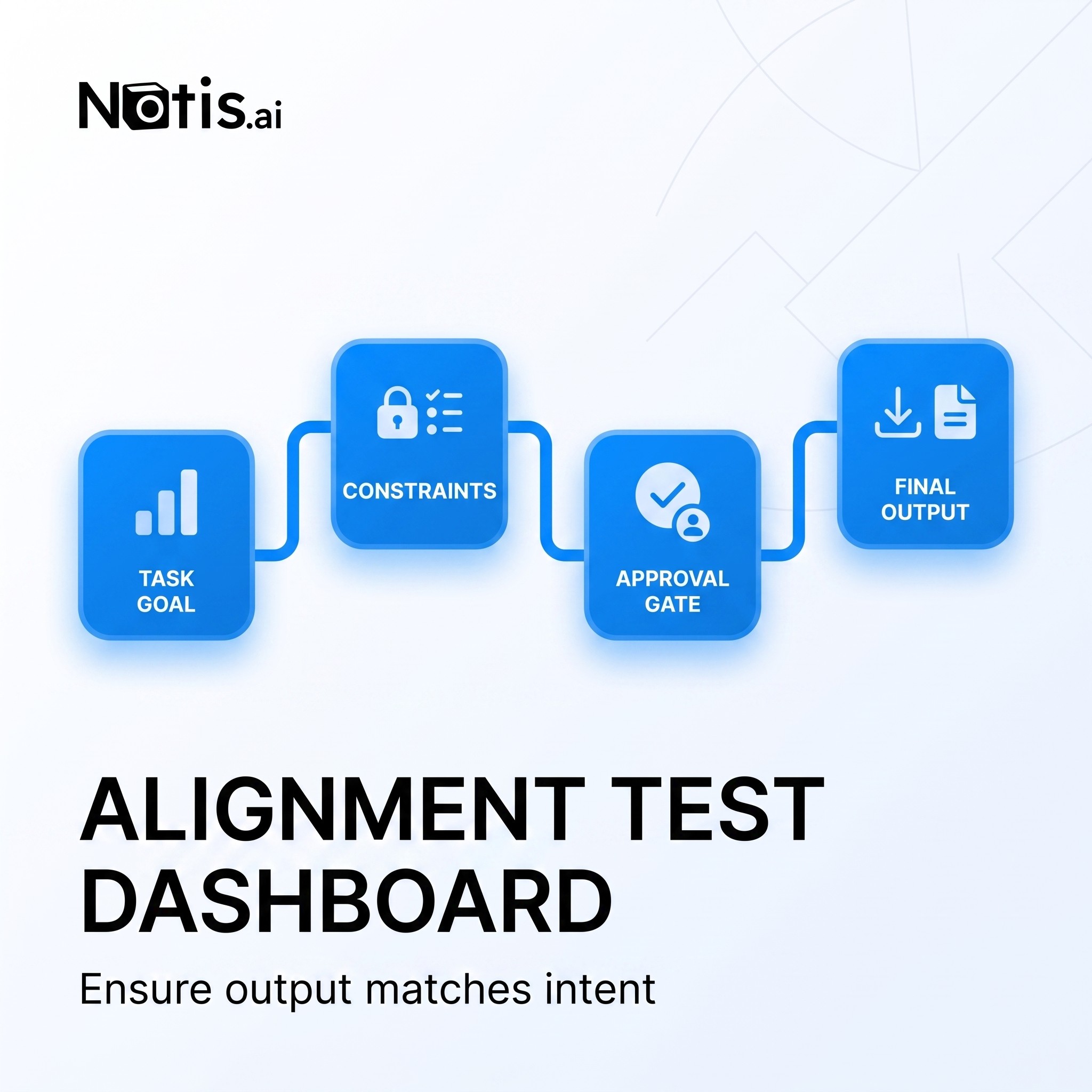
The Wharton Blueprint for AI Agent Adoption defines delegation as the user’s willingness to give an AI agent the autonomy and control needed to act on their behalf. That sentence is important because it separates “I trust the vibe” from “I have decided what this system is allowed to do.” Founders need the second one. Vibes do not scale. Permission does.
A good AI assistant setup has four parts. First, the goal: what should be true when the work is done? Second, the context: what does the assistant need to know about the company, customer, tone, constraints, and tools? Third, the boundary: what can it do without asking, and what must come back for approval? Fourth, the receipt: where does the finished work land so you do not have to hunt for it later?
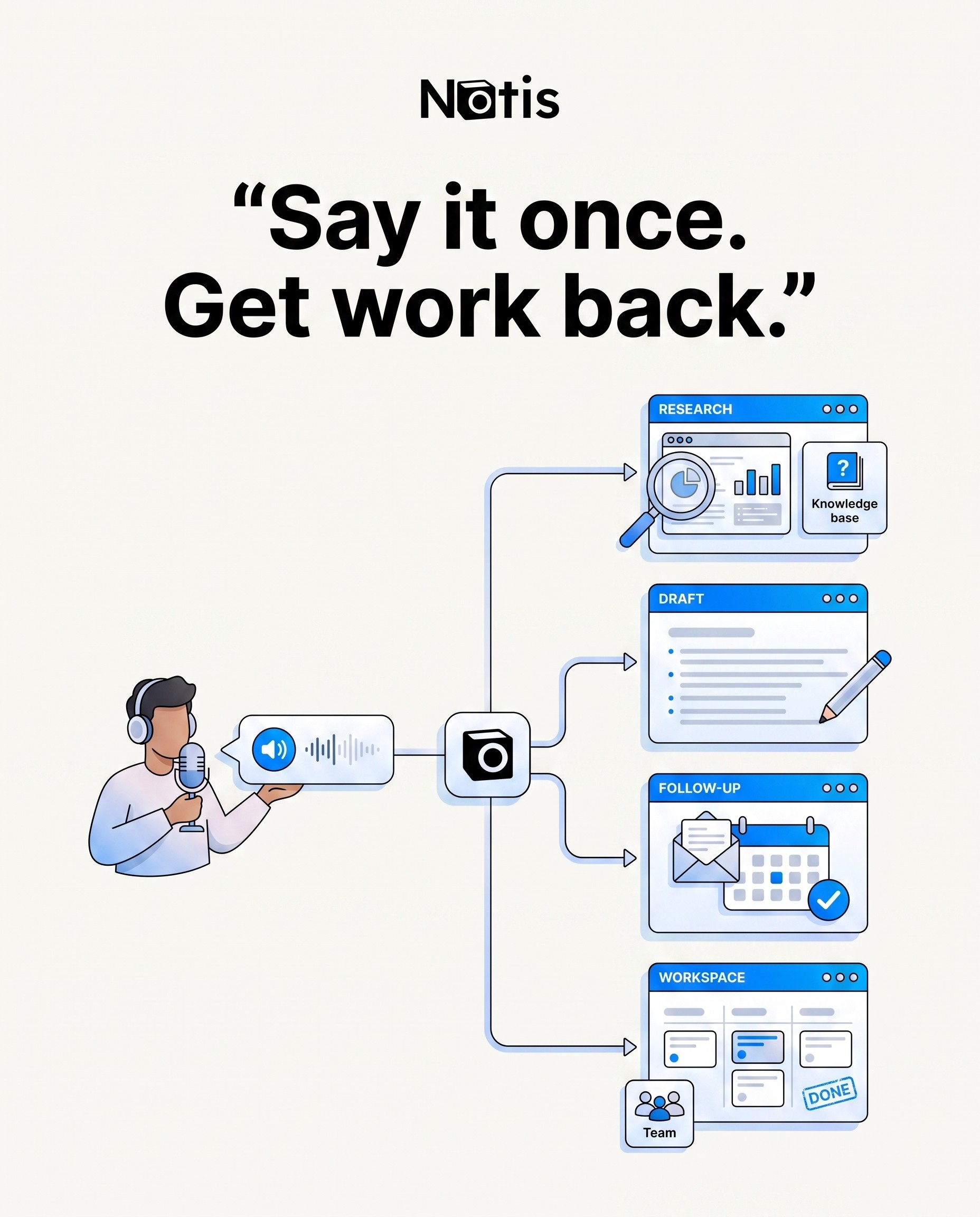
This is where messaging-native AI becomes more interesting than yet another dashboard. Founders do not need a new cockpit for every tiny act of delegation. They need to say the thing once, from the place where the thought appears, and get useful work back. That is why Notis lives in WhatsApp, Telegram, iMessage, Slack, email, and the desktop app. The capture surface is not the product. The product is the execution path after capture.
Use AI for repeatable ambiguity, not high-stakes judgment
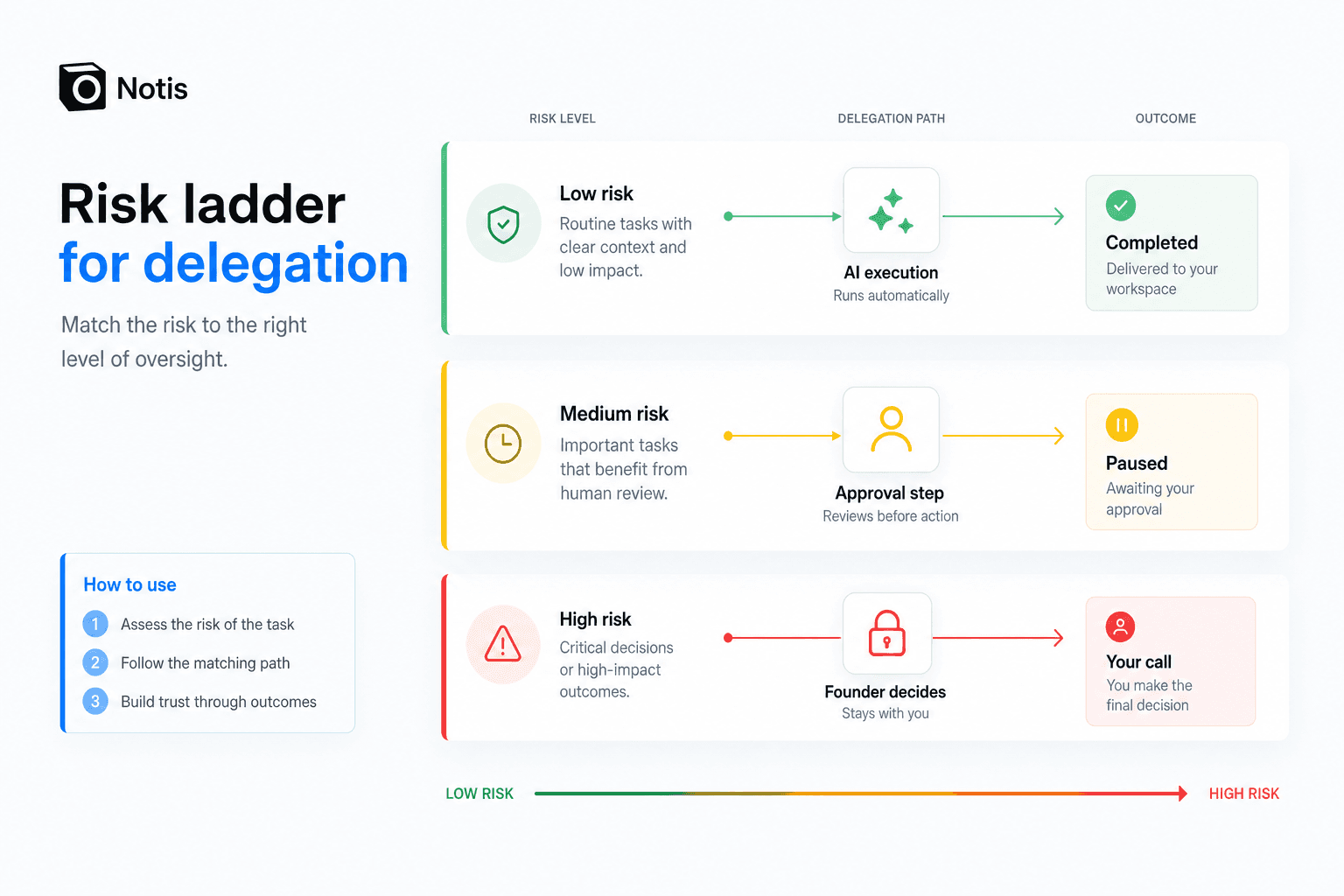
The best way to decide between an AI assistant and a freelancer is not by asking who is cheaper. Cheap help that creates review debt is expensive. Instead, classify the task by risk and repeatability.
Low-risk, repeatable tasks should default to AI. Meeting summaries, first-draft follow-ups, research briefs, content outlines, CRM notes, bug reports from voice notes, task extraction, formatting, and internal documentation are perfect examples. The cost of a slightly imperfect first version is low, and the speed advantage is absurd.
Medium-risk work should use AI with human approval. Customer emails, sales follow-ups, published content drafts, partnership outreach, product announcements, and anything that touches brand judgment should be drafted by AI and approved by you or someone you trust. You still get leverage, but you keep the part that actually matters.
High-risk decisions should stay with the founder, counsel, finance, or the relevant expert. Legal commitments, refunds with edge cases, hiring decisions, security changes, pricing strategy, and investor communication are not places to cosplay as autonomous because the demo looked cool. Use AI to prepare the brief, expose options, summarize tradeoffs, and draft the first version. Do not outsource accountability.
Where freelancers still win
There are still plenty of jobs where a human freelancer is the right answer. Taste-heavy design work, strategic repositioning, complex stakeholder interviews, high-empathy customer research, negotiation, and anything that requires lived judgment across messy human context can benefit from a real person. The mistake is using freelancers for work that was never really about human judgment in the first place.
If you are paying someone to turn your rambling voice memo into a structured task list, summarize a meeting, draft a standard email, clean up notes, create first-pass social posts, or move information from one tool to another, you are probably buying human hours for machine-shaped work. That does not mean the freelancer is bad. It means your workflow is outdated.
The founder workflow I would use
Start with an AI assistant as the default intake layer. Every loose thought, meeting note, customer issue, content idea, and admin request goes there first. The assistant turns it into a structured output: draft, task, note, reminder, database entry, brief, or follow-up. Then add approval gates for anything external or sensitive. Only bring in freelancers when the work requires taste, relationships, judgment, or sustained ownership beyond what an assistant should handle.
This is also how we built Notis. You can send a messy voice note like “turn this call into action items and draft the follow-up email,” and Notis can use your context, skills, automations, and integrations to push the work where it belongs. It is not a magical employee. It is closer to a messaging-native AI intern that already sits in the channels where founders actually think.
The real comparison is not AI vs people
The real comparison is unmanaged delegation vs designed delegation. A freelancer without clear acceptance criteria becomes another inbox. An AI assistant without boundaries becomes a toy that occasionally does useful work. But when you define the goal, context, approval rules, and output destination, both humans and AI become much easier to use.
My bias is simple: delegate to AI first when the task is repeatable, text-heavy, context-driven, and reversible. Delegate to humans when the task needs taste, trust, negotiation, or accountability. Keep the highest-risk judgment with yourself. The founder win is not replacing people. It is removing the hourly guessing game from work that should never have been billed by the hour in the first place.

Flo is the founder of Mind the Flo, an Agentic Studio specialized into messaging and voice agents.
Related posts
AI Note-Taking Apps Are Solving the Wrong Problem
Most AI note-taking apps help you capture more. Founders need the next step: turning messy voice notes into finished work without opening another app.
From Voice Note to Finished Work: The AI Shift ADHD Founders Need
Organized notes are not the win anymore. For ADHD founders, the real shift is from capturing thoughts to having AI agents turn a voice note into finished work ready to review.
Why AI Email Assistants Fail Founders Who Need Execution
If your inbox tool can only draft replies, it has not solved the work.